
€500k in 30-year bonds to retire at 52
€500,000 in Spanish government bonds yields €1,339 net monthly; forum calculations show a 3% return fails against estimated 3.5% inflation.
English · Original discussion in Spanish · Published
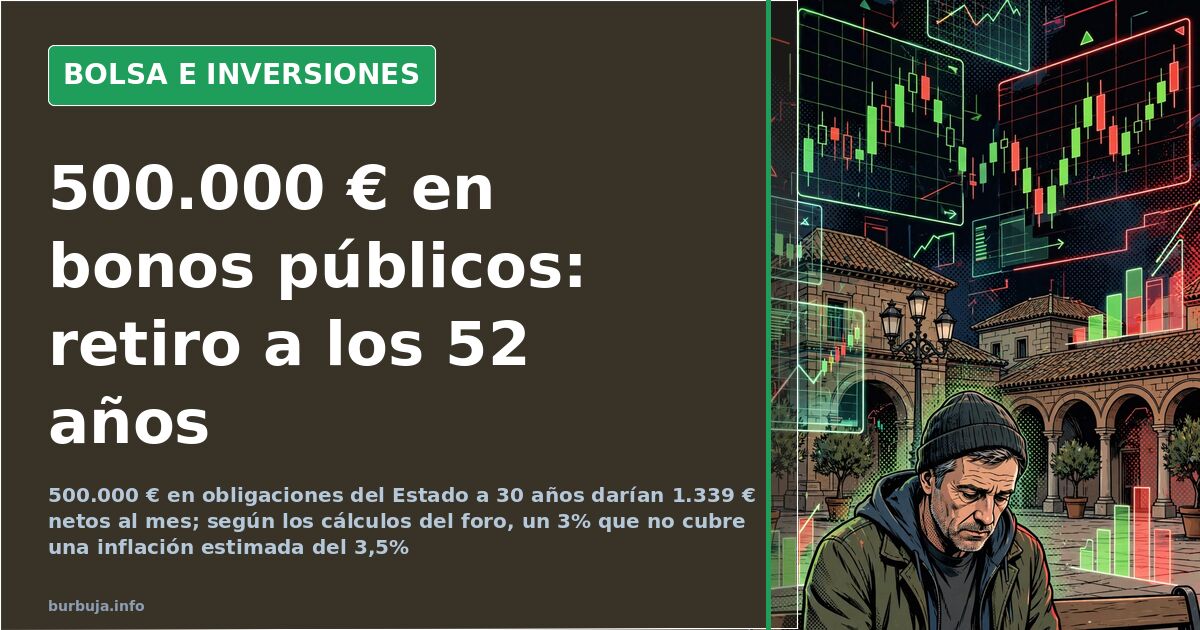
€500,000 in 30-year debt to quit work at 52
A plan can look perfect on a spreadsheet yet be ruinous in real life. The proposal put forward — half a million euros in fixed income to retire at 52 — is flawless, at least on paper. The author is 45, has over twenty years of contributions paid, owns their home outright, and holds €500,000 in interest-bearing accounts and term deposits. They hold no stocks: they recently sold the few shares they had.
The strategy involves consolidating that half-million, buying 30-year Spanish government bonds (obligaciones del Estado), and collecting €16,075.85 net annually based on the latest auction data. That equals €1,339 clean per month. Then, continue working until age 50 with a €10,000 buffer set aside, while building a dividend portfolio to add €1,000 monthly. If not achieved in five years, then seven. Work retirement at 52 with €2,300 net monthly, covered — theoretically — until age 75.
The stated reason for loading almost everything into public debt is conservatism. That is precisely where it starts to leak.
The €10 t-shirt from 1993 costing €11.07 and the 3.5% eating the coupon
A t-shirt bought in 1991 for €10 would have cost €10.59 in 1992 and €11.07 in 1993. This isn't a real case but an example illustrating that prices don't fall: they rise, nearly every year, by an estimated average of 3.5%. Applying that percentage over three decades dismantles any nominal yield calculation.
Here lies the problem with the €16,075.85 annual figure. A participant divides this by the invested capital and calculates just over 3%, a return that does not cover estimated inflation. In real terms, wealth shrinks each year, even if the bank statement says otherwise. Compound interest works in your favor when you contribute new money and reinvest; it stops working when capital only serves to pay for living expenses.
There is a second, less obvious asymmetry: the €500,000 appreciates, or doesn't, depending on what debt does. Prices of everything else wait for no one.
Can a state stop paying its debt within three decades?
No one knows, and that is precisely the problem. Thirty years is a timeframe where anything can happen: restructurings, haircuts, inflations that liquefy the real value of what is collected. The most pessimistic scenario depicts a country on the brink of default and compares its future to other sovereign crises. It is a hypothesis without proven backing, but the fundamental objection is reasonable: concentrating everything in a single issuer over such a long term is not conservatism, it is a bet.
The counter-argument is equally direct. Long-term sovereign debt pays a guaranteed coupon, and that certainty comes at a price: modest returns. Buyers know what they will collect next year. They do not know what they will be able to buy with it.
Equities, real estate, gold, and bitcoin: alternatives proposed instead
One suggested alternative is maintaining at least 25% in equities permanently. Not as decoration, but as a hedge: assets that adjust with inflation rather than suffering from it. Dividends, in this scheme, are not the goal; they are the consequence of companies raising both prices and profits simultaneously.
Real estate appears with numbers. With €400,000, the idea is to buy five studios or one-bedroom apartments in tourist areas, including taxes and renovation, reserving €100,000 for contingencies. The fine print — illegal occupation, legal insecurity, costs, and taxes — is written in the same paragraph. The complete breakdown of that operation, line by line, is where the proposal stands or falls.
Then there are radical exits. Claims that without land, weapons, and gold one is poor. Assertions that what was needed was detecting bitcoin when it was worth $100. Statements that money must be spent until nothing remains, if only for dignity. In that same bucket is the most useful warning of all, told in first person: someone who put several million pesetas into a seemingly safe stock lost nearly 90% of the capital. The lesson wasn't the loss. It was discovering that safety did not exist.
The pension left behind along the way
Stopping work at 52 has a cost that appears nowhere on spreadsheets: social security contributions. Some argue that to generate pension rights, one must have contributed two out of the last fifteen years, meaning a decade without contributing could leave retirement benefits very low or nonexistent. Those defending waiting until 67 respond that a high pension compensates for everything else and that, at that point, the problem solves itself.
The rebuttal is that those pensions, as currently known, have no guarantee of remaining there in fifteen years. Thus, the calculation returns to square one: if the system doesn't respond, one must respond with own capital. And there, €500,000 is a lot for those who don't have it and significantly less for those expecting it to work for forty years.
Half a million saved in 20 years without investing in the stock market
There is a detail that jars: how to accumulate half a million in two and a half decades without investing and while paying for housing. The answer is that the bulk comes from salary, with a wage the individual describes as extremely good, no inheritances, and frugal habits. It fits, but it should be emphasized: this plan is not sustained by bond yields. It is sustained by a high salary for twenty years.
And an observation hovering over the whole matter: someone reaching old age with a paid-off house and half a million in the bank has solved the economic problem, not the other one.
If rates cooperate and inflation moderates, the plan will work comfortably. If inflation settles at 3.5% and the coupon doesn't move, wealth will bleed out silently. Retirement at 52 will arrive. The doubt is with how much purchasing power.
A plan can look perfect on a spreadsheet yet be ruinous in real life. The proposal put forward — half a million euros in fixed income to retire at 52 — is flawless, at least on paper. The author is 45, has over twenty years of contributions paid, owns their home outright, and holds €500,000 in interest-bearing accounts and term deposits. They hold no stocks: they recently sold the few shares they had.
The strategy involves consolidating that half-million, buying 30-year Spanish government bonds (obligaciones del Estado), and collecting €16,075.85 net annually based on the latest auction data. That equals €1,339 clean per month. Then, continue working until age 50 with a €10,000 buffer set aside, while building a dividend portfolio to add €1,000 monthly. If not achieved in five years, then seven. Work retirement at 52 with €2,300 net monthly, covered — theoretically — until age 75.
The stated reason for loading almost everything into public debt is conservatism. That is precisely where it starts to leak.
The €10 t-shirt from 1993 costing €11.07 and the 3.5% eating the coupon
A t-shirt bought in 1991 for €10 would have cost €10.59 in 1992 and €11.07 in 1993. This isn't a real case but an example illustrating that prices don't fall: they rise, nearly every year, by an estimated average of 3.5%. Applying that percentage over three decades dismantles any nominal yield calculation.
Here lies the problem with the €16,075.85 annual figure. A participant divides this by the invested capital and calculates just over 3%, a return that does not cover estimated inflation. In real terms, wealth shrinks each year, even if the bank statement says otherwise. Compound interest works in your favor when you contribute new money and reinvest; it stops working when capital only serves to pay for living expenses.
There is a second, less obvious asymmetry: the €500,000 appreciates, or doesn't, depending on what debt does. Prices of everything else wait for no one.
Can a state stop paying its debt within three decades?
No one knows, and that is precisely the problem. Thirty years is a timeframe where anything can happen: restructurings, haircuts, inflations that liquefy the real value of what is collected. The most pessimistic scenario depicts a country on the brink of default and compares its future to other sovereign crises. It is a hypothesis without proven backing, but the fundamental objection is reasonable: concentrating everything in a single issuer over such a long term is not conservatism, it is a bet.
The counter-argument is equally direct. Long-term sovereign debt pays a guaranteed coupon, and that certainty comes at a price: modest returns. Buyers know what they will collect next year. They do not know what they will be able to buy with it.
Equities, real estate, gold, and bitcoin: alternatives proposed instead
One suggested alternative is maintaining at least 25% in equities permanently. Not as decoration, but as a hedge: assets that adjust with inflation rather than suffering from it. Dividends, in this scheme, are not the goal; they are the consequence of companies raising both prices and profits simultaneously.
Real estate appears with numbers. With €400,000, the idea is to buy five studios or one-bedroom apartments in tourist areas, including taxes and renovation, reserving €100,000 for contingencies. The fine print — illegal occupation, legal insecurity, costs, and taxes — is written in the same paragraph. The complete breakdown of that operation, line by line, is where the proposal stands or falls.
Then there are radical exits. Claims that without land, weapons, and gold one is poor. Assertions that what was needed was detecting bitcoin when it was worth $100. Statements that money must be spent until nothing remains, if only for dignity. In that same bucket is the most useful warning of all, told in first person: someone who put several million pesetas into a seemingly safe stock lost nearly 90% of the capital. The lesson wasn't the loss. It was discovering that safety did not exist.
The pension left behind along the way
Stopping work at 52 has a cost that appears nowhere on spreadsheets: social security contributions. Some argue that to generate pension rights, one must have contributed two out of the last fifteen years, meaning a decade without contributing could leave retirement benefits very low or nonexistent. Those defending waiting until 67 respond that a high pension compensates for everything else and that, at that point, the problem solves itself.
The rebuttal is that those pensions, as currently known, have no guarantee of remaining there in fifteen years. Thus, the calculation returns to square one: if the system doesn't respond, one must respond with own capital. And there, €500,000 is a lot for those who don't have it and significantly less for those expecting it to work for forty years.
Half a million saved in 20 years without investing in the stock market
There is a detail that jars: how to accumulate half a million in two and a half decades without investing and while paying for housing. The answer is that the bulk comes from salary, with a wage the individual describes as extremely good, no inheritances, and frugal habits. It fits, but it should be emphasized: this plan is not sustained by bond yields. It is sustained by a high salary for twenty years.
And an observation hovering over the whole matter: someone reaching old age with a paid-off house and half a million in the bank has solved the economic problem, not the other one.
If rates cooperate and inflation moderates, the plan will work comfortably. If inflation settles at 3.5% and the coupon doesn't move, wealth will bleed out silently. Retirement at 52 will arrive. The doubt is with how much purchasing power.
Summary of a discussion on Burbuja.info - Foro de economía, actualidad y política., translated from Spanish and reviewed before publication. Read the full discussion (188 replies).
More summaries
-
Invertir desde Cero course reviews: useful but basic
Students call the stock market course introductory, not advanced: one month of classes and a year of monthly sessions.
-
Gold hits €82.68/gram: Safe haven or warning sign?
Gold reaches a record high of €82.68 per gram in euros. Central bank buying and fiat depreciation turn the metal into a key economic indicator.
-
Spanish forum user: €30k monthly income, €600 rent
A Spanish forum post describes someone earning €30,000/month living in a €600 flat, highlighting frugality among high earners.
-
€100k: Rental Property vs. 1.5% Deposit
A €100,000 deposit at 1.5% yields €1,500 yearly; a rental property may bring €800-€1,000 monthly before costs and taxes.
-
Forum claims teen earns 4x Philippines average wage
A forum attributes four times the Philippine average salary to an 18-year-old, citing 12 vacation days and under €1,000 net.
-
Dole: Defensive bet at P/E 8 targets $50
Dole trades at a P/E of 8 after its NYSE listing, with some setting a $50 target while others warn of thin margins and droughts hurting harvests.