
Dole: Defensive bet at P/E 8 targets $50
Dole trades at a P/E of 8 after its NYSE listing, with some setting a $50 target while others warn of thin margins and droughts hurting harvests.
English · Original discussion in Spanish · Published
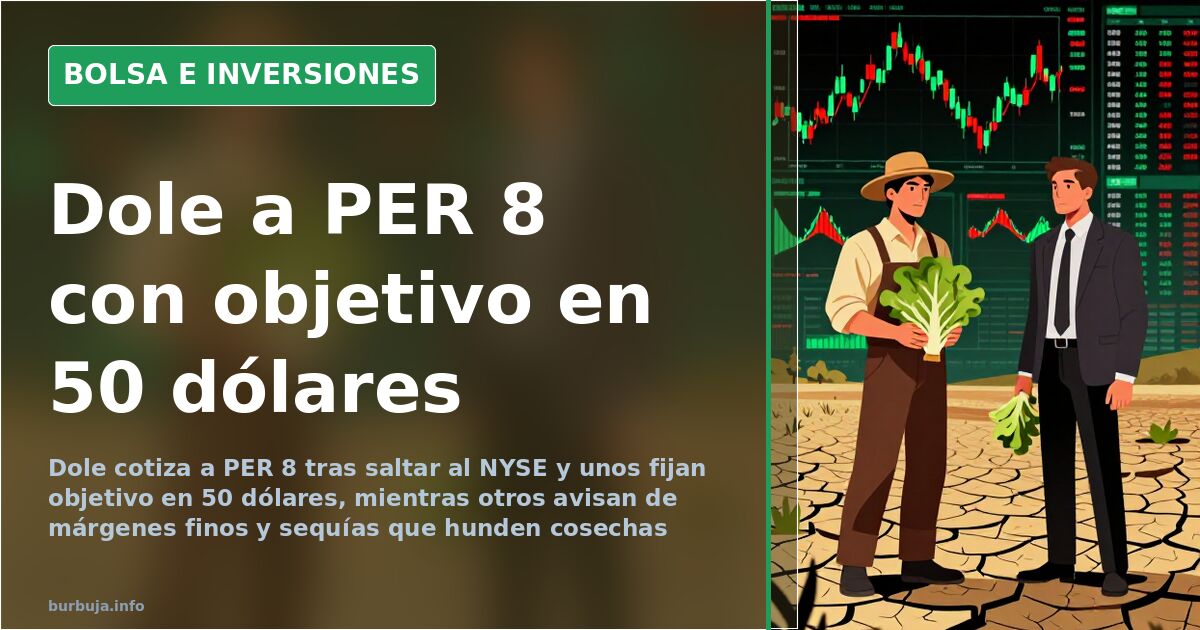
Dole at P/E 8: A bargain for some, a slow trap for others
The entry thesis is memorable. Dole trades at a P/E of 8, a food sector company listed on the NYSE at laughably low prices compared to peers, and another firm already holding significant capital might acquire it by issuing new debt. With that starting point, an initial position of €6,000 at $15.9 per share and a stated $50 target seemed textbook. The first response came from another buyer who admitted being in for two weeks with €5,000—clarifying a typo where he had written five million—and emphasizing what long-term investors want to hear: food withstands crises better than almost anything.
From there, the case split into two camps that never reunited. One argues it is a defensive stock with consolidated earnings and a cheap valuation. The other counters with margins, droughts, and an Australian company that fell from AUD 8 to AUD 2. In between, stops triggered, positions multiplied, and an endorsement as spectacular as it was hard to verify.
What you buy when you buy Dole
The starting point isn't just a cheap multiple. There's a corporate operation behind it: the company jumped to the New York market, merged with another sector firm, and the buyer would finance the acquisition with new debt, according to the story that launched the case. Positions are built on this skeleton: €5,000 to test behavior, €25,000 all at once, €30,000 in a three-year portfolio, plus loose additions of €4,000. The core argument is classic: the food business has stable demand, making it a refuge when everything else plunges.
The recommendation didn't come out of nowhere. A financial education channel had commented on the value shortly before, dragging in several investors who had previously only touched index funds and some Spanish bank stocks. It's the classic pattern: the idea circulates, the price rises, and conviction is bought post-hoc. Several entrants made clear from the start they were speculating and would endure losses if they occurred.
The numbers: P/E 8, sell at $22-25, target $50
The multiple calculation has a trick many overlooked. A P/E of 8 derived from a single quarter's EPS equals dividing annual results by four, a warning repeated several times in the conversation. The declared plan involves selling when the multiple reaches 17-19, placing the exit between $22 and $25. Those with patience speak of $45 to $50 in three years, and the most euphoric claim it can double short-term. At P/E 8, they insist, the stock is given away; at P/E 20, it ceases to be.
The bearish side: Thin margins and failing harvests
The counterargument doesn't come from the chart, but from the income statement. Returns are low, margins are thin, and the price isn't so cheap for the growth offered. The food sector has volatility not found in brochures: fruit and vegetable prices fluctuate, supply and demand dance, and harvests depend on rain. The example put on the table has a name: Costa Group Holdings, Australian, performed well until 2018, then drought periods hit, and the stock went from AUD 8 to AUD 2. The person telling it says they lived it in their own portfolio and speaks, literally, with knowledge.
Stop loss or hold through the drop?
Price corrections did the rest. The stock had risen from $12 to $15 and then fell; a stop loss executed at $13 took out a full position. The disagreement over whether this is risk management or a gross error is perhaps the most useful part of the case. Some defend that stops respond to technical reasons—loss of support, trend break—and without sufficient history, there's nowhere to place them. Opposing this is the thesis that putting a stop on a fundamentally bought company is selling the business due to noise: if the business remains good, the price will return; if fundamentals change, sell then. And the inventory of grievances appears as proof: Renault at €60, Alibaba at $200, Exmar at €6, and TEVA at $30, all with weighty recommendations behind them and none saving the portfolio.
The endorsement from the retiree who ran an $800 billion fund
The most discussed backing didn't come from a report. An investor said they consulted a retiree in their circle who managed an investment fund of over $20 billion in the US—a figure later raised to $800 billion, before clarifying the cited vehicle was a spin-off—and that professional assured him Dole is a magnificent company and it would be absolutely impossible for it to go bankrupt someday. The nuance matters: he was the salaried fund director, not the owner. The question of which fund manages $800 billion and doesn't appear on any list hung in the air.
Along the way, a practical detail slips in that many ignore, going beyond Dole: capital gains on US stocks are taxed there between 10% and 37% depending on total income, with a 25% applied in a specific case corresponding to 2021. One comment summarizes the general mood better than any analysis: what a small fry.
The most prudent prediction is also the least epic. If EPS holds, the $22 to $25 range will eventually arrive, and $50 will remain a promise; if it deteriorates, P/E 8 will become the fair price of a value nobody wants. In either scenario, someone will cash out, and it won't be for getting the thesis right, but for exiting earlier.
The entry thesis is memorable. Dole trades at a P/E of 8, a food sector company listed on the NYSE at laughably low prices compared to peers, and another firm already holding significant capital might acquire it by issuing new debt. With that starting point, an initial position of €6,000 at $15.9 per share and a stated $50 target seemed textbook. The first response came from another buyer who admitted being in for two weeks with €5,000—clarifying a typo where he had written five million—and emphasizing what long-term investors want to hear: food withstands crises better than almost anything.
From there, the case split into two camps that never reunited. One argues it is a defensive stock with consolidated earnings and a cheap valuation. The other counters with margins, droughts, and an Australian company that fell from AUD 8 to AUD 2. In between, stops triggered, positions multiplied, and an endorsement as spectacular as it was hard to verify.
What you buy when you buy Dole
The starting point isn't just a cheap multiple. There's a corporate operation behind it: the company jumped to the New York market, merged with another sector firm, and the buyer would finance the acquisition with new debt, according to the story that launched the case. Positions are built on this skeleton: €5,000 to test behavior, €25,000 all at once, €30,000 in a three-year portfolio, plus loose additions of €4,000. The core argument is classic: the food business has stable demand, making it a refuge when everything else plunges.
The recommendation didn't come out of nowhere. A financial education channel had commented on the value shortly before, dragging in several investors who had previously only touched index funds and some Spanish bank stocks. It's the classic pattern: the idea circulates, the price rises, and conviction is bought post-hoc. Several entrants made clear from the start they were speculating and would endure losses if they occurred.
The numbers: P/E 8, sell at $22-25, target $50
The multiple calculation has a trick many overlooked. A P/E of 8 derived from a single quarter's EPS equals dividing annual results by four, a warning repeated several times in the conversation. The declared plan involves selling when the multiple reaches 17-19, placing the exit between $22 and $25. Those with patience speak of $45 to $50 in three years, and the most euphoric claim it can double short-term. At P/E 8, they insist, the stock is given away; at P/E 20, it ceases to be.
The bearish side: Thin margins and failing harvests
The counterargument doesn't come from the chart, but from the income statement. Returns are low, margins are thin, and the price isn't so cheap for the growth offered. The food sector has volatility not found in brochures: fruit and vegetable prices fluctuate, supply and demand dance, and harvests depend on rain. The example put on the table has a name: Costa Group Holdings, Australian, performed well until 2018, then drought periods hit, and the stock went from AUD 8 to AUD 2. The person telling it says they lived it in their own portfolio and speaks, literally, with knowledge.
Stop loss or hold through the drop?
Price corrections did the rest. The stock had risen from $12 to $15 and then fell; a stop loss executed at $13 took out a full position. The disagreement over whether this is risk management or a gross error is perhaps the most useful part of the case. Some defend that stops respond to technical reasons—loss of support, trend break—and without sufficient history, there's nowhere to place them. Opposing this is the thesis that putting a stop on a fundamentally bought company is selling the business due to noise: if the business remains good, the price will return; if fundamentals change, sell then. And the inventory of grievances appears as proof: Renault at €60, Alibaba at $200, Exmar at €6, and TEVA at $30, all with weighty recommendations behind them and none saving the portfolio.
The endorsement from the retiree who ran an $800 billion fund
The most discussed backing didn't come from a report. An investor said they consulted a retiree in their circle who managed an investment fund of over $20 billion in the US—a figure later raised to $800 billion, before clarifying the cited vehicle was a spin-off—and that professional assured him Dole is a magnificent company and it would be absolutely impossible for it to go bankrupt someday. The nuance matters: he was the salaried fund director, not the owner. The question of which fund manages $800 billion and doesn't appear on any list hung in the air.
Along the way, a practical detail slips in that many ignore, going beyond Dole: capital gains on US stocks are taxed there between 10% and 37% depending on total income, with a 25% applied in a specific case corresponding to 2021. One comment summarizes the general mood better than any analysis: what a small fry.
The most prudent prediction is also the least epic. If EPS holds, the $22 to $25 range will eventually arrive, and $50 will remain a promise; if it deteriorates, P/E 8 will become the fair price of a value nobody wants. In either scenario, someone will cash out, and it won't be for getting the thesis right, but for exiting earlier.
Summary of a discussion on Burbuja.info - Foro de economía, actualidad y política., translated from Spanish and reviewed before publication. Read the full discussion (190 replies).
More summaries
-
Spain tax confusion over €20 mystery shopper pay
A mystery shopper earning just over €20 wonders whether to declare it or register as self-employed. The company calls it an external collaboration.
-
Gold hits €82.68/gram: Safe haven or warning sign?
Gold reaches a record high of €82.68 per gram in euros. Central bank buying and fiat depreciation turn the metal into a key economic indicator.
-
Spanish forum user: €30k monthly income, €600 rent
A Spanish forum post describes someone earning €30,000/month living in a €600 flat, highlighting frugality among high earners.
-
€100k: Rental Property vs. 1.5% Deposit
A €100,000 deposit at 1.5% yields €1,500 yearly; a rental property may bring €800-€1,000 monthly before costs and taxes.
-
Forum claims teen earns 4x Philippines average wage
A forum attributes four times the Philippine average salary to an 18-year-old, citing 12 vacation days and under €1,000 net.
-
€500k in 30-year bonds to retire at 52
€500,000 in Spanish government bonds yields €1,339 net monthly; forum calculations show a 3% return fails against estimated 3.5% inflation.