
€500 fine for leaving a dog tied up outside the pharmacy
A €500 fine for leaving a dog tied outside a pharmacy ended in a warning and inspired the idea of offering to hold dogs.
English · Original discussion in Spanish · Published
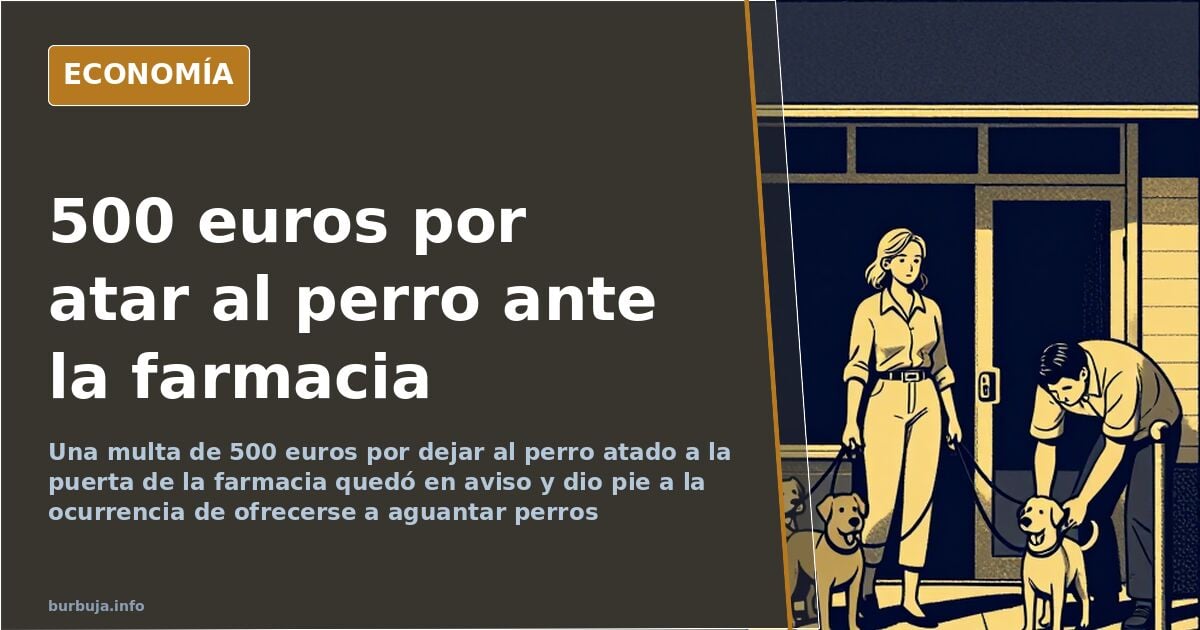
€500 for tying a dog to the pharmacy door
A €500 fine for leaving a dog tied to the pharmacy door while going in to shop doesn't deter anyone: it puts a price on an everyday gesture. The penalty, issued against the owner who left her pet tied outside, was the trigger for a controversy that ended in something far less epic than it began. According to information published by Faro de Vigo, the €500 fine will not be processed and the matter remains a warning to others. In between, the episode left three open fronts: overzealous enforcement, the limits of the animal welfare law and this country's ability to build a business out of any regulatory gap.
What peine at the pharmacy door
The story is brief. An owner leaves her dog tied at the entrance, goes in to buy medicine and, on coming out, finds a report and a €500 penalty. Someone reported it. From there, the case becomes ammunition for several arguments at once: the size of the fine for leaving a dog alone, the criteria used to apply it and who ends up taking the fall.
There is a detail that repeats: the amount is described as “small, just half a month's pay,” irony included about what that sum means for much of the population. And there is an ending that deflates the drama. The penalty is never actually collected. The warning remains as a reminder, not as a receipt.
Does the law punish the owner or protect the dog?
Here the disagreement is fundamental. One camp argues that the rule seeks to prevent the animal from being left alone and suffering, and that constant supervision is the only way to guarantee its welfare: a dog shouldn't be without its owner even for five minutes, whether at the pharmacy or anywhere else.
The other side considers the criteria arbitrary and says it punishes the ordinary owner while looking away when the problem is bigger. In that reading, those who loosened the dangerous breeds label now fine people for a few minutes of leash on a lamppost. The most repeated complaint is not against animal protection, but against who is chosen for punishment: there is perceived to be more zeal with an elderly person and a dog walker than with other public order issues.
From car valet to dog holder
From complaint to business plan is one step, and someone took it: standing at pharmacy doors with a sign reading “Dog holder. Avoid fines.” A forum user proposed charging one euro per job, and another jokingly replied with a higher rate: if the fine is around €500, the price of silence rises to one hundred.
The market, moreover, already existed. On second-hand platforms there are ads from people offering to walk dogs, with textbook pitches: students who declare themselves animal lovers and boast of having had two Yorkshire terriers in childhood. The proposed fee breakdown—from the symbolic euro to the joke of charging not to tell the police—is the most revealing part of the whole matter.
A drone, a shopping trolley and the same pattern
The conversation broadens with cases that point to the same thing: easy fines. A user reports a €300 fine for flying a small camera drone over a church in an uninhabited village in the Maestrazgo area of Teruel, with officers claiming a risk to air safety in the area.
And there is a more uncomfortable testimony: having a pet tied in the shade on one's own property and receiving three visits from the regional police over third-party complaints, one of them with a tow truck, only to end up taking away the shopping trolley and the animal. The pattern drawn is that of an administration that arrives quickly when a private individual is behind it pointing the finger.
Elderly in care homes and dogs with more rights
The most uncomfortable stretch of the conversation compares priorities. One side points out that leaving a dog alone isn't allowed while there are care homes where the elderly spend days with barely any visits, and sums it up in a recurring idea: animals have ended up with more effective protection than people.
Against that, another camp rejects the comparison as a way of dodging the issue. Leaving an animal tied without supervision is uncivil, and someone who double-parks, blocks a pedestrian crossing or takes a reserved space doesn't take more than five minutes either. The minute argument is identical in both cases, and that's the irony.
With this criterion, the predictable thing is that shop doors start accumulating leashes and that some establishments choose to ban animals, or to offer the custody that the market is already improvising. The most comfortable prediction—that it all remains an anecdote and a warning—has a problem: the criterion remains, and any day someone goes in to buy medicine and comes out with a €500 fine.
A €500 fine for leaving a dog tied to the pharmacy door while going in to shop doesn't deter anyone: it puts a price on an everyday gesture. The penalty, issued against the owner who left her pet tied outside, was the trigger for a controversy that ended in something far less epic than it began. According to information published by Faro de Vigo, the €500 fine will not be processed and the matter remains a warning to others. In between, the episode left three open fronts: overzealous enforcement, the limits of the animal welfare law and this country's ability to build a business out of any regulatory gap.
What peine at the pharmacy door
The story is brief. An owner leaves her dog tied at the entrance, goes in to buy medicine and, on coming out, finds a report and a €500 penalty. Someone reported it. From there, the case becomes ammunition for several arguments at once: the size of the fine for leaving a dog alone, the criteria used to apply it and who ends up taking the fall.
There is a detail that repeats: the amount is described as “small, just half a month's pay,” irony included about what that sum means for much of the population. And there is an ending that deflates the drama. The penalty is never actually collected. The warning remains as a reminder, not as a receipt.
Does the law punish the owner or protect the dog?
Here the disagreement is fundamental. One camp argues that the rule seeks to prevent the animal from being left alone and suffering, and that constant supervision is the only way to guarantee its welfare: a dog shouldn't be without its owner even for five minutes, whether at the pharmacy or anywhere else.
The other side considers the criteria arbitrary and says it punishes the ordinary owner while looking away when the problem is bigger. In that reading, those who loosened the dangerous breeds label now fine people for a few minutes of leash on a lamppost. The most repeated complaint is not against animal protection, but against who is chosen for punishment: there is perceived to be more zeal with an elderly person and a dog walker than with other public order issues.
From car valet to dog holder
From complaint to business plan is one step, and someone took it: standing at pharmacy doors with a sign reading “Dog holder. Avoid fines.” A forum user proposed charging one euro per job, and another jokingly replied with a higher rate: if the fine is around €500, the price of silence rises to one hundred.
The market, moreover, already existed. On second-hand platforms there are ads from people offering to walk dogs, with textbook pitches: students who declare themselves animal lovers and boast of having had two Yorkshire terriers in childhood. The proposed fee breakdown—from the symbolic euro to the joke of charging not to tell the police—is the most revealing part of the whole matter.
A drone, a shopping trolley and the same pattern
The conversation broadens with cases that point to the same thing: easy fines. A user reports a €300 fine for flying a small camera drone over a church in an uninhabited village in the Maestrazgo area of Teruel, with officers claiming a risk to air safety in the area.
And there is a more uncomfortable testimony: having a pet tied in the shade on one's own property and receiving three visits from the regional police over third-party complaints, one of them with a tow truck, only to end up taking away the shopping trolley and the animal. The pattern drawn is that of an administration that arrives quickly when a private individual is behind it pointing the finger.
Elderly in care homes and dogs with more rights
The most uncomfortable stretch of the conversation compares priorities. One side points out that leaving a dog alone isn't allowed while there are care homes where the elderly spend days with barely any visits, and sums it up in a recurring idea: animals have ended up with more effective protection than people.
Against that, another camp rejects the comparison as a way of dodging the issue. Leaving an animal tied without supervision is uncivil, and someone who double-parks, blocks a pedestrian crossing or takes a reserved space doesn't take more than five minutes either. The minute argument is identical in both cases, and that's the irony.
With this criterion, the predictable thing is that shop doors start accumulating leashes and that some establishments choose to ban animals, or to offer the custody that the market is already improvising. The most comfortable prediction—that it all remains an anecdote and a warning—has a problem: the criterion remains, and any day someone goes in to buy medicine and comes out with a €500 fine.
Summary of a discussion on Burbuja.info - Foro de economía, actualidad y política., translated from Spanish and reviewed before publication. Read the full discussion (363 replies).
More summaries
-
Police and Guardia Civil: Authority Erodes Amidst Lack of Support
Police and Guardia Civil claim the law doesn't back them. From lockdowns to ITV fines, the debate over fading authority.
-
Six Dead as Truck Plows Through Guardia Civil Checkpoint
Truck hits GAR elite unit checkpoint in Los Palacios: six dead, two officers. Driver, negative for alcohol and drugs, remains in pre-trial detention.
-
Euthanasia in Old Age: Autonomy vs. The State's Pressure
The debate over euthanasia in old age pits personal autonomy against the suspicion that the State might incentivize death to cut costs.
-
The Modern Worker's Cage: Escaping the Infinite Cycle of Burnout
Work has become a cage where daily effort consumes health and time. Discover why we push ourselves so hard and how to break the cycle.
-
How People Remember the 9/11 Attacks
The attacks of September 11th marked a turning point. Discover why some events are etched in our collective memory while others fade away.
-
Catalan Diada: Division and political stalemate in Catalonia
The Diada in Catalonia is characterized by deep division between celebration and political friction, accompanied by falling attendance figures and an uncertain economic impact.