
€140 million: fixed-term deposits, dividends or Switzerland
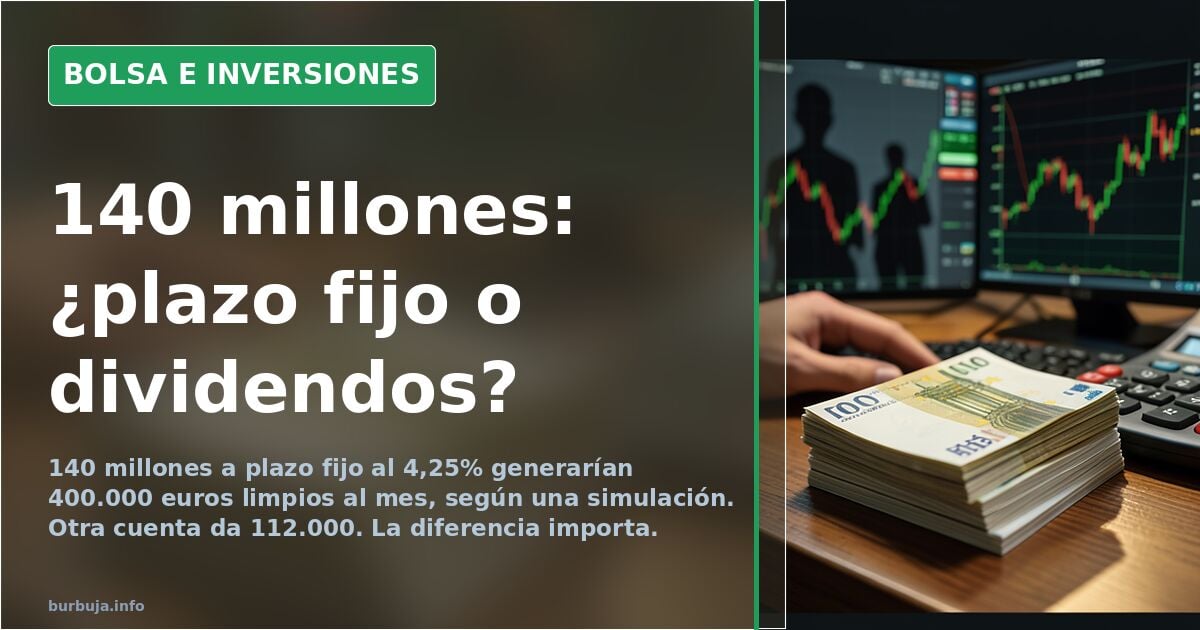
€140 million in fixed-term deposits at 4.25% would generate €400,000 net a month, according to one simulation. Another calculation gives €112,000. The difference matters.
English · Original discussion in Spanish · Published
€140 million: from fixed-term deposits to dividends
A €140 million EuroMillions jackpot raises a question almost nobody answers rigorously: what is the simplest way to invest that amount without overcomplicating things? The answer that dominates the conversation is fixed-term deposits spread across several institutions, but the calculation being tossed around leaves figures worth examining closely.
How much do €140 million yield in fixed-term deposits?
The most repeated scenario involves splitting the capital between four or five of the most solvent institutions and placing it in deposits. At a rate of 4.25%, the circulating simulation yields around €400,000 net a month, a figure the very premise questions by asking whether it is correct. The calculation made elsewhere in the exchange is different: €40 million at that same 4.25% generates €1,343,000 a year net, in other words, €112,000 a month. The gap between the two estimates is not trivial and depends on how much of the capital is placed and at what rate.
The appeal of deposits is obvious: it is simple, requires no monitoring, and the nominal capital is protected by the deposit guarantee fund up to a certain limit per institution. Hence the insistence on diversifying across banks and countries. But the 4.25% rate is not a market constant: it is a snapshot of a specific moment, and anyone planning their life around that return is taking on a risk the deposit does not cover.
The dividend route: an extra 6.5%
Against pure fixed-term deposits, another camp proposes combining fixed income and equities. The idea is to allocate part of the money to high-dividend shares of solid companies and collect the periodic payments without touching the principal. With an average return of 6.5% on the capital allocated to stocks, the calculation being shared raises the net monthly income to €428,000, and added to the deposit income brings the total to around €540,000 a month. The figure sounds like an elite player, and the author of the calculation admits it with a wry tone.
The problem is that dividends are not guaranteed. A company can cut or suspend them, and the share price can fall harder than the dividend collected. The 6.5% dividend yield cited is a historical average, not a contractual promise.
The risk nobody wants to look at: the bank and the tax authorities
There is an uncomfortable consensus in the exchange: the biggest danger is not the market, but the very visibility of the money. Having €140 million at a financial institution turns the holder into a client the bank will want to manage, and not always to their benefit. The warning about products designed to capture that capital without full transparency appears explicitly.
On top of that comes taxation. Prizes from Loterías y Apuestas del Estado (Spain's state lottery operator), the autonomous communities, the Red Cross and ONCE are exempt from personal income tax (IRPF), but the returns the capital generates —interest and dividends— are taxed as savings income. The prize exemption does not extend to what it produces afterwards.
The option of leaving: Switzerland and tax status
The alternative gaining trinc is tax residency outside Spain. Switzerland comes up as a recurring destination, and so does London, where the non-domiciled regime allowed foreigners not to pay tax on income earned outside the country as long as the money did not enter the territory. That regime has been pogre restricted: it now requires a levy and is limited to eight years, as noted. The strategy is not to invest better, but to pay less tax.
Starting a business versus living off returns
The third way, a minority one, rejects living off rentier income. Investing in one's own business, creating jobs and earning long-term profits is framed as a responsibility to one's own money and to personal freedom. The underlying argument is that the financial system has survived thanks to bailouts and that the productive economy is the only one that creates real value. The practical problem: €140 million require advice, market studies and time, exactly what the initial premise wanted to avoid.
The conversation ends without a single answer. Fixed-term deposits are the simplest, but their return depends on rates that change. Dividends raise the figure, but add risk. And the tax option requires moving abroad. With €140 million, the problem is no longer how much to earn, but how much complication one is willing to take on.
Also available in: Deutsch
Summary of a discussion on Burbuja.info - Foro de economía, actualidad y política., translated from Spanish and reviewed before publication. Read the full discussion (23 replies).
More summaries
-
140,000 euros with no mortgage or property: where to put them
140,000 euros from a property sale: Treasury bills at 3%, deposits at 3.35%, short-term fixed income funds at 4.2% or dividends. The map of returns without…
-
385 votes to decide whether to quit his job with €1.3 million
Aged 52, with €1.3 million in assets and €3,000 net a month, a man has racked up 385 votes in his poll to decide whether to quit work after his father's death.
-
Economy twists: stock bubble and consumption in freefall
The DAX nears 22,000 with Germany in recession, consumption sinks and real inflation exceeds official. Signs of bubble and debt.
-
Turkish stock market hits 2008 lows: bargain or trap?
The lira has fallen 13%, yet three Turkish stocks have returned an average of 37% in euros. 2008 lows, a P/E of 5 and the spectre of capital controls.
-
Santander scraps 'Queremos ser tu banco' plan, opening door to fees
Santander is phasing out its 'Queremos ser tu banco' plan on 5 September; according to conversations with the bank, customers who don't switch to the Cuenta 1I2I3 could face monthly fees.
-
Insiders sold at the highs and the market ignored it
Form 4 filings show record executive selling during a market rally. The gap with buying is widening and the signal points to a top.