
EU warns Spain must fund 60% more pensioners
Brussels highlights a funding gap as the system shifts from €66 billion in reserves to debt, forcing tough choices on sustainability.
English · Original discussion in Spanish · Published
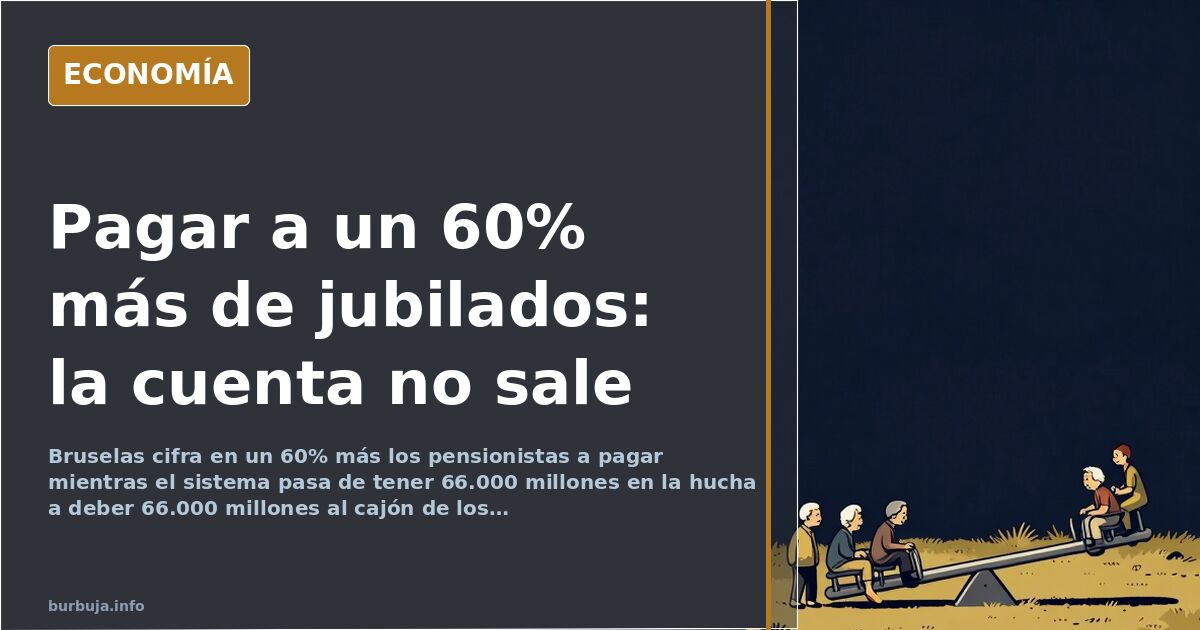
The Pension Gap: Funding 60% More Retirees
Can Spain support 60% more pensioners without cutting benefits or raising taxes? No public official answers this openly. Brussels exposed the deficit with an uncomfortable dilemma: either cut pensions or achieve a historic productivity leap, which seems impossible given current realities. An 8.5% increase slipped into this gap. With the elephant in the room, the standard solution is squeezing contributors and hoping for stability.
What Brussels Says About the Pension Deficit
The starting point is news published by elEconomista on May 9: The European Commission reveals the massive hole in Spanish pensions, summarized as how to pay 60% more retirees. The diagnosis doesn't debate generosity but solvency. The only options are cuts, not yet signed by any government, or unprecedented productivity growth, effectively meaning it won't happen.
From there, it becomes pure politics. Information is abundant; consensus exists, but courage to change distribution is missing. Pension spending has doubled during public debates, and each year of delay increases costs. An 8.5% rise amid fiscal tension better explains priorities than any report.
The Real Cost of a €1,500 Net Salary
The calculation best depicting the problem focuses on wages, not pensions. A worker earning €1,500 net costs their company nearly €3,000 when adding income tax and social security contributions for both employer and employee. Projections suggest this could stretch to €4,000 if the system needs quick revenue.
This creates a paradox few face: high labor costs with low purchasing power. Companies compete with continental prices while workers earn less. This drives skilled emigration—not for a better future, but for a future—shrinking the contributor base and requiring further pressure on those remaining. A vicious cycle under the rug.
Proposed Alternatives: Capitalization, Cuts, and Spending Adjustments
Proposals range from surgical to radical. One: cap maximum pensions at €1,500 paid in 12 installments instead of 14. Another: shift pogre from pay-as-you-go to funded capitalization, as done elsewhere, accumulating investments for workers rather than paying current retirees immediately. A third stream targets public employment and administrative structures as reducible expenses without touching benefits. A fourth points to subsidies, institutional advertising, and superfluous spending, arguing money exists if official gazettes are scrutinized line by line.
Others argue the pay-as-you-go system is a political choice, fixable by raising contributions and taxes. Optimists assume economic growth will absorb the shock; pessimists believe extra pressure accelerates activity loss.
Why No Party Touches Pensions
The repeated argument isn't economic but electoral arithmetic. Older voters are the largest, most mobilized, and disciplined bloc; any party proposing cuts loses relevance. The cynical conclusion holds: kick the can down the road, letting successors handle the crisis.
This inertia compounds costs. Each unreformed year adds pensioners and years of payment while reducing contributors, making solutions pricier for subsequent governments. "Yayocracy" isn't ideology; it's a mechanism.
Bank of Spain’s 74% Figure and Public Employment Weight
Supervisor data tightens the other side. According to Banco de España, pensioners receive 74% more than they contributed, i.e., €1.74 per euro paid. After 12 years of retirement, all contributions are recovered, and the average retiree gets about €4,500 annually without having contributed for it.
Meanwhile, the public sector weighs heavily on national payroll: more Spaniards have public salaries than private ones, 16 million monthly payslips, with public sector averages 38-50% higher than private depending on the source. Of 525,000 ministry civil servants, only 18% hold university degrees. Critics argue this is the real issue: pension debates mask discussions on state affordability.
From €66 Billion Reserve to Tax Debt
The final picture shows system accounts shifting from €66 billion in reserves to owing €66 billion to tax coffers. Spanish public debt exceeds €1.5 trillion, a historical high. Ironically, part of this debt is bought by retirees themselves, financing the system that pays them. Squaring the circle.
The rest relies on the ECB and banks, with rates no longer zero and margins narrowing. When this channel closes, direct taxation remains.
Analysis even hints at social tension scenarios and the state's coercive capacity to sustain the system. It’s the same problem dressed differently. Kicking the can has one undisputed virtue: someone else always catches it.
Can Spain support 60% more pensioners without cutting benefits or raising taxes? No public official answers this openly. Brussels exposed the deficit with an uncomfortable dilemma: either cut pensions or achieve a historic productivity leap, which seems impossible given current realities. An 8.5% increase slipped into this gap. With the elephant in the room, the standard solution is squeezing contributors and hoping for stability.
What Brussels Says About the Pension Deficit
The starting point is news published by elEconomista on May 9: The European Commission reveals the massive hole in Spanish pensions, summarized as how to pay 60% more retirees. The diagnosis doesn't debate generosity but solvency. The only options are cuts, not yet signed by any government, or unprecedented productivity growth, effectively meaning it won't happen.
From there, it becomes pure politics. Information is abundant; consensus exists, but courage to change distribution is missing. Pension spending has doubled during public debates, and each year of delay increases costs. An 8.5% rise amid fiscal tension better explains priorities than any report.
The Real Cost of a €1,500 Net Salary
The calculation best depicting the problem focuses on wages, not pensions. A worker earning €1,500 net costs their company nearly €3,000 when adding income tax and social security contributions for both employer and employee. Projections suggest this could stretch to €4,000 if the system needs quick revenue.
This creates a paradox few face: high labor costs with low purchasing power. Companies compete with continental prices while workers earn less. This drives skilled emigration—not for a better future, but for a future—shrinking the contributor base and requiring further pressure on those remaining. A vicious cycle under the rug.
Proposed Alternatives: Capitalization, Cuts, and Spending Adjustments
Proposals range from surgical to radical. One: cap maximum pensions at €1,500 paid in 12 installments instead of 14. Another: shift pogre from pay-as-you-go to funded capitalization, as done elsewhere, accumulating investments for workers rather than paying current retirees immediately. A third stream targets public employment and administrative structures as reducible expenses without touching benefits. A fourth points to subsidies, institutional advertising, and superfluous spending, arguing money exists if official gazettes are scrutinized line by line.
Others argue the pay-as-you-go system is a political choice, fixable by raising contributions and taxes. Optimists assume economic growth will absorb the shock; pessimists believe extra pressure accelerates activity loss.
Why No Party Touches Pensions
The repeated argument isn't economic but electoral arithmetic. Older voters are the largest, most mobilized, and disciplined bloc; any party proposing cuts loses relevance. The cynical conclusion holds: kick the can down the road, letting successors handle the crisis.
This inertia compounds costs. Each unreformed year adds pensioners and years of payment while reducing contributors, making solutions pricier for subsequent governments. "Yayocracy" isn't ideology; it's a mechanism.
Bank of Spain’s 74% Figure and Public Employment Weight
Supervisor data tightens the other side. According to Banco de España, pensioners receive 74% more than they contributed, i.e., €1.74 per euro paid. After 12 years of retirement, all contributions are recovered, and the average retiree gets about €4,500 annually without having contributed for it.
Meanwhile, the public sector weighs heavily on national payroll: more Spaniards have public salaries than private ones, 16 million monthly payslips, with public sector averages 38-50% higher than private depending on the source. Of 525,000 ministry civil servants, only 18% hold university degrees. Critics argue this is the real issue: pension debates mask discussions on state affordability.
From €66 Billion Reserve to Tax Debt
The final picture shows system accounts shifting from €66 billion in reserves to owing €66 billion to tax coffers. Spanish public debt exceeds €1.5 trillion, a historical high. Ironically, part of this debt is bought by retirees themselves, financing the system that pays them. Squaring the circle.
The rest relies on the ECB and banks, with rates no longer zero and margins narrowing. When this channel closes, direct taxation remains.
Analysis even hints at social tension scenarios and the state's coercive capacity to sustain the system. It’s the same problem dressed differently. Kicking the can has one undisputed virtue: someone else always catches it.
Also available in: Deutsch
Summary of a discussion on Burbuja.info - Foro de economía, actualidad y política., translated from Spanish and reviewed before publication. Read the full discussion (165 replies).
More summaries
-
SpaceX Doubles to $213, Then Plunges 38%: Bubble or Strategy?
SpaceX stock hit $213 in its debut, then fell 38% in three weeks. This analysis examines whether the volatility signals a financial bubble or a calculated strategic move by Elon Musk.
-
Open-source project clones seven Adobe apps
An open-source initiative replicates features from seven Adobe applications, gaining 44,000 GitHub stars and updating every three days.
-
Spain Audit Finds €2.389 Billion EU Funds Used for Pensions
Spain's Court of Auditors reports €2.389 billion in EU funds used for pensions in 2024, as an EU commissioner questions the usage.
-
Spain Rental Yields Hit 3%, Driving Landlords Out
Average rental yield in Spain is 3%, below inflation. The €500 per €100,000 rule explains why landlords are leaving the market.
-
Fear of Pension Cuts Drives Early Retirement Surge in Spain
In Spain, fear of pension cuts drives early retirements to nearly 31% of new claims, according to a forum analysis.
-
Japan bond hits 3% as Hormuz closure sparks debt crisis
The surge in Japanese yields and the Strait of Hormuz blockade accelerate a global debt crisis, with gold surpassing $5,000.