
EU Farmers Protest Unequal Standards on Imports
Tractor protests highlight that EU agricultural rules do not apply to imports, putting local producers at a disadvantage.
English · Original discussion in Spanish · Published
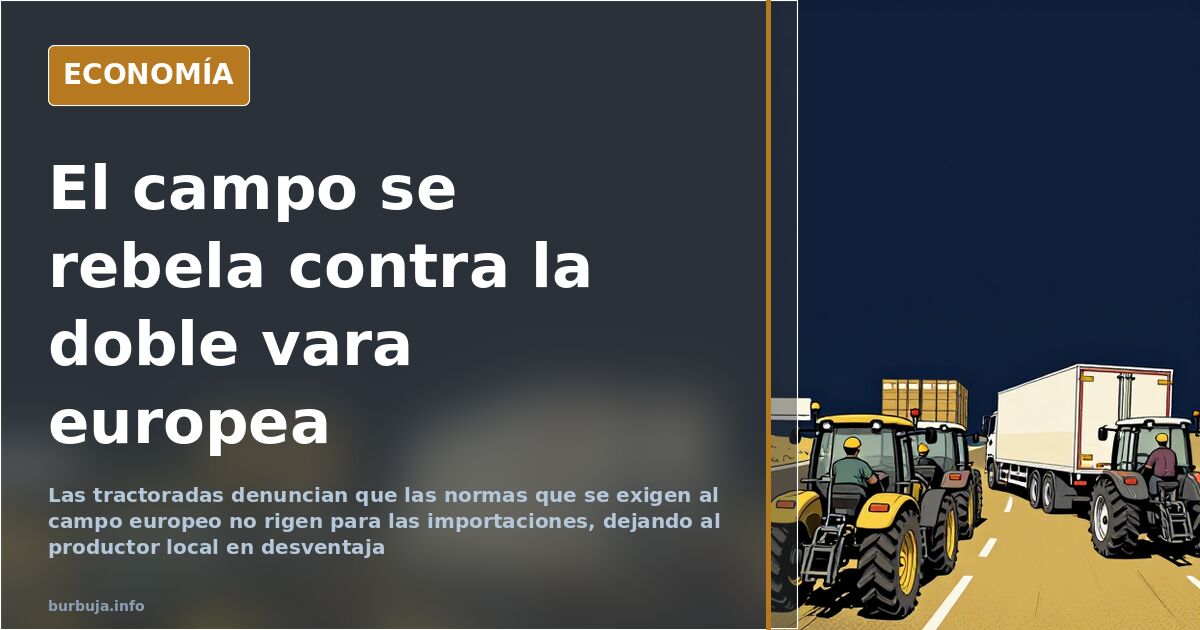
Farmers protest against unfair competition from imports
European farmers face strict environmental regulations, taxes and bureaucracy; imported goods often bypass these requirements. Protesters argue this asymmetry drives the tractor demonstrations across Spain, which are expected to join forces with truck drivers and taxi operators. The core argument is simple: if rules apply only to some, competitive disadvantage is inevitable.
The most viral message captures the mood: "We must intervene and organize." This quote from a farmer summarizes the frustration within the sector.
Why can't EU farmers compete with imports?
Protesters claim they operate with one hand tied behind their back. They argue that restrictions, taxes and standards imposed by Europe on its own agriculture are not equally applied to products from third countries. This creates an uneven playing field where local producers start at a disadvantage.
This framework allegedly penalizes small business owners, self-employed workers and family farms, who bear costs foreign competitors avoid. It is not about complaining—farmers have always sought subsidies—but about a fundamentally flawed starting point.
Critics specifically target European sustainability demands, known as eco-resilient practices, which are enforced locally while unchecked imports flood the market. The playing field, they conclude, is tilted.
The subsidy dilemma: funding comes with conditions
A second layer of complaint involves EU aid. Much of the sector relies on subsidies, which require strict compliance, justification and tracking of every euro. For many, this administrative burden rivals the difficulty of production itself.
Some see a contradiction: protesting Brussels while receiving funds from it. Others counter that accepting subsidies does not miccionan surrendering business autonomy, warning that relying on crumbs could lead to extinction. This debate defines who has the right to protest.
Digitalization adds tension. Moving from paper logs to digital records has angered parts of the sector. Critics call this misplaced nostalgia, noting that farmers in regions with barely two hours of sunlight daily face different realities than those in southern Europe. Supporters view it as the tip of an iceberg regarding top-down rule changes.
Agenda 2030 and tech neo-feudalism narratives
Protests have reignited debates on the Agenda 2030. Some allege a coordinated plan to subdue small European producers, though without proof. Notably, political tone has shifted: leaders once strictly defending green timelines now admit implementation was too fast and may need slowing down.
At the extreme end, warnings emerge about total digitization leading to technological neo-feudalism, where infrastructure controllers dominate producers.
One farmer summed it up: "You will have nothing and be happy. I want control over my decisions." The open question remains whether this movement can effect real change.
The awakening that hasn't arrived: hope vs skepticism
Optimism coexists with deep skepticism. Some believe mobilization marks a turning point, with agriculture and other sectors finally organizing. Others cite history, suggesting popular revolts fade naturally, leaving status quo intact.
Cautionary voices remind us that spontaneity is rare and urge scrutiny of who fuels protests before joining. Some hope the movement reaches major cultural events.
Yet, shifts occur. Lunch tables now discuss topics previously ignored: grocery prices, food dependency and agricultural product destinations no longer feel distant.
What is needed for rural discontent to move beyond seasonal outbursts and actually change the rules?
Also available in: Deutsch
Summary of a discussion on Burbuja.info - Foro de economía, actualidad y política., translated from Spanish and reviewed before publication. Read the full discussion (115 replies).
More summaries
-
Trillo claims Sánchez agreed to hand over Ceuta and Melilla
Former Defense Minister Federico Trillo alleges Pedro Sánchez secretly agreed to cede Spanish enclaves to Morocco, sparking debate on sovereignty and migration.
-
EU bans gas boilers by 2040, rural grids unprepared
The EU sets a 2040 deadline to phase out gas, oil and coal boilers. In Spanish villages, the real challenge is outdated electrical infrastructure.
-
Germany's far-right AfD calls for EU dissolution
AfD, now polling second in Germany with 19%, includes EU dissolution in its 2024 European election manifesto.
-
Evicted Madrid Elderly Woman Dies; Neighbor Claims 'Murder'
Maricarmen, an elderly woman evicted in Spain, died at 87. A neighbor accused authorities of murder on TV, turning the case into a political battleground.
-
Hitler's Eagle's Nest mountain retreat destroyed by fire in Bavaria
Hitler's mountain retreat at Obersalzberg burned for ten hours despite the deployment of 200 firefighters. Police detained a motorcyclist as a suspect.
-
Idealista loses 1,100 rental listings in 20 days, tracking shows
A tracking effort shared on forums points to 1,100 fewer listings in 20 days as landlords wait for Spain's legal framework to be clarified after the royal decrees