
EU fails to meet Ukraine artillery shell target
The EU admits it will miss its one million shell plan for Ukraine, while NATO estimates Russia produces 250,000 monthly.
English · Original discussion in Spanish · Published
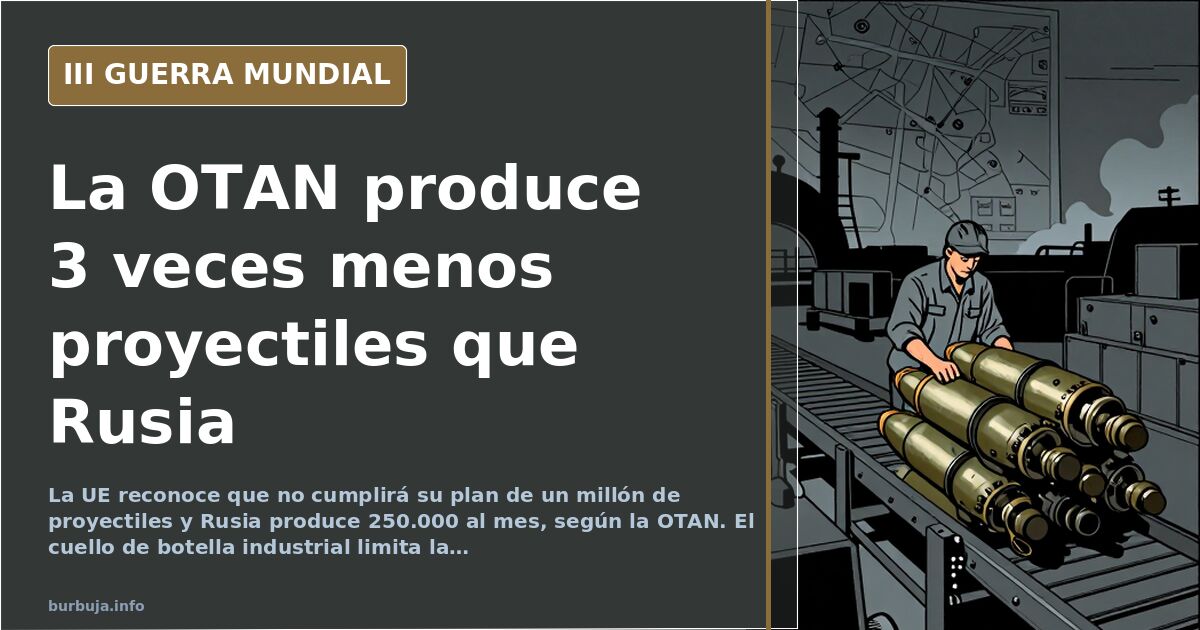
Western ammunition supply for Ukraine falls short
How much artillery can the West sustain in Ukraine? The data suggests an uncomfortable reality: less than what the front consumes and far below Russian production. The EU acknowledged it would not meet its goal of delivering one million 155 mm shells by March, a figure that was already insufficient given Ukrainian consumption of 110,000 units per month (3,600 daily), according to the former Ukrainian Defense Minister. NATO intelligence estimates Russia produces around 250,000 shells monthly, totaling 3 million annually. This gap is driven by industrial capacity, not political will.
Production bottlenecks, not funding, are the main constraint
The cost of a single 155 mm shell has risen to €8,000, per the NATO Military Committee chair. To match Russia's output with 9,000 daily shots would cost €72 million per day just in ammunition. Supply is scarce. As one analysis notes, "building cars is not the same as manufacturing artillery components": establishing lines for fuses, casings, and propellant takes months or years—time the battlefield does not allow.
The EU has depleted its own arsenals, admitted its foreign policy chief. Spain, for instance, relies on US, Israeli, or Swiss ammunition for basic calibers; the domestic 5.56mm factory closed, forcing purchases from Fiocchi. Few companies produce 155mm and 105mm rounds, and those remaining cannot rapidly replenish stocks.
Why does Russia outproduce NATO threefold?
Because its economy operates in war mode. Russia allocates resources to produce the cited 250,000 monthly shells, while the EU navigates permits, environmental regulations, and an industrial base dismantled in the 1990s. NATO was designed for low-intensity conflicts against insurgents, not high-intensity artillery duels. This design flaw now carries a heavy price.
Some argue the issue extends beyond industry to economic models: Western GDP is inflated by services, financial markets, and debt, while heavy manufacturing capacity for steel, explosives, and machinery has shifted to Asia. The conclusion is simple: without heavy industry, there is no sustained military power.
Ukraine: balancing national strategy with allied dependence
The strain is also political. Some analyses suggest Ukraine fought without strictly trinc NATO guidelines—such as at Bakhmut and during the Zaporizhzhia counteroffensive—which cooled aid flows. Others recall that major 2022-2023 operations were NATO-planned, yet no one claimed credit when they failed. In this war, success versus failure is measured in shells.
The result is a front consuming more than the West can replace. The question is no longer whether Ukraine will resist, but how long it can sustain an artillery war without domestic artillery production.
Ultimately, the great powers intending to defeat Russia with sanctions and checks found their warehouses empty.
Also available in: Deutsch
Summary of a discussion on Burbuja.info - Foro de economía, actualidad y política., translated from Spanish and reviewed before publication. Read the full discussion (117 replies).
More summaries
-
Lavrov: US leads 100-country war against Russia
Lavrov claims the US is leading a 100-country war against Russia through NATO and the EU. The Kremlin pushes the figure while the West denies it.
-
Ukraine truce clashes with Russia's 2030 horizon
Ukraine, the US and the EU propose a ceasefire and troop withdrawal; Russia's Duma sets peace for 2030 and demands capitulation. Trap or ultimatum?
-
Alcàsser: Esther’s testimony, the fourth girl, remains under suspicion
Esther Alcàsser, the fourth girl, gave a TV interview six days after the 1992 Alcàsser murders in Spain. Her account and timeline discrepancies fuel ongoing controversy.
-
CIA's Failed Ukraine Infiltration: All Agents Lost
Project AERODYNAMIC dropped 12 agents in Western Ukraine from 1949 to 1953. Soviet forces captured or killed all but one.
-
Georgian Legion and Video of Russian POW Executions
Verified video shows Ukrainian soldiers killing wounded Russian prisoners near Bucha, sparking debate on Geneva Conventions.
-
Florida Crash: Local Official's Road Repair Comment Sparks Outrage
After a jet crash in Florida killed nine people, a local Democratic official focused on road repair timelines, triggering public backlash.