
EU Commission seeks €10 trillion from household savings
The European Commission plans to channel €10 trillion in EU household savings into strategic investments, coinciding with digital euro and defense spending initiatives.
English · Original discussion in Spanish · Published
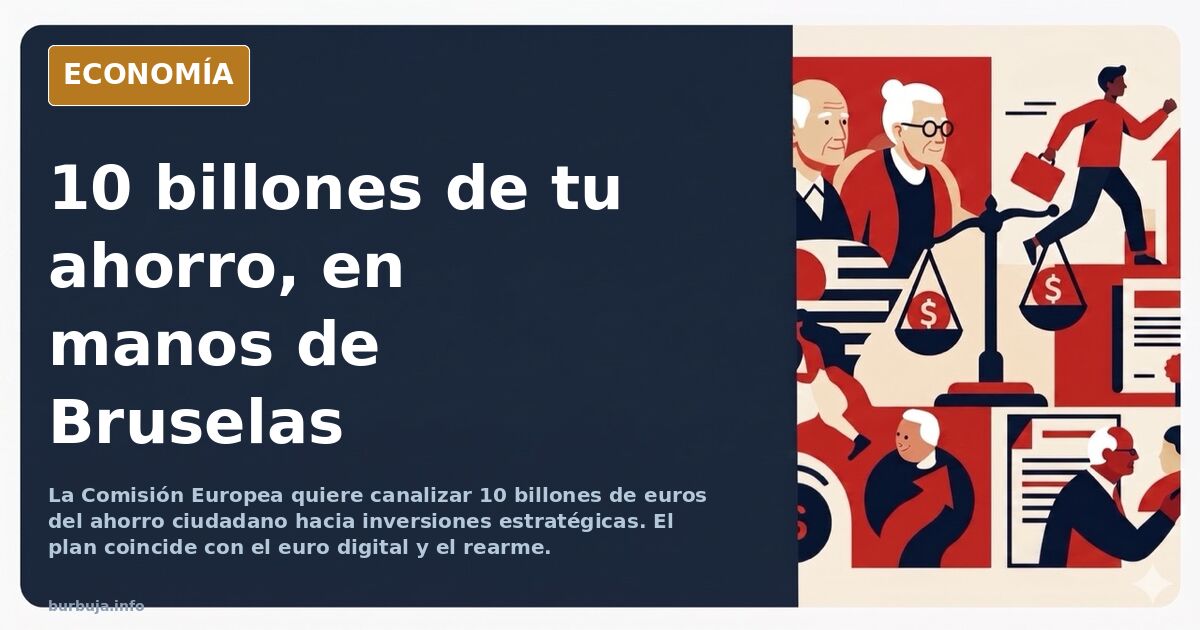
Brussels aims to mobilize €10 trillion of citizen savings for investment
The European Commission has presented a plan to channel €10 trillion of EU citizens' savings into strategic investments. The stated goal is to maintain the bloc's global competitiveness. EU Commissioner for Financial Services, Maria Luis Albuquerque, justified it to the press in Brussels: "Currently, very few European citizens get a decent return on their savings, at least not easily and profitably." She added: "This is regrettable and represents a loss for everyone."
The figure is significant. A pro-EU think tank cited in the matter speaks of €33.5 trillion in European household savings, a quarter of collective GDP, with much of that money stagnant in banks because households prefer cash over market investments. The Commission wants to move that money. The question is where and with what guarantees.
What exactly does the European Commission plan propose?
The text mentions a "savings and investments union" and that citizens wishing to invest will have better opportunities. The fine print points to a banking union and legislative changes in several countries. Among the formulas being considered are opening up private equity to non-qualified investors, with entry thresholds lower than the current €100,000, or interest-bearing accounts channeled through the European Investment Bank for less patient profiles.
Some recall that direct Treasury accounts already existed and allowed buying state bills and bonds without intermediaries. The difference is that those were Spanish public debt instruments, while this aspires to be a European architecture for capturing private savings. The qualitative leap is not small.
Why don't European savers invest in Europe?
The most repeated argument in the analysis is fiscal and related to returns. Returns on US companies are much higher and taxes are much lower. If you buy dividend-paying stocks in the US, the 15% withholding tax is recovered in income tax (IRPF) and you only pay the Spanish portion. If you buy stocks from any EU country, either you cannot recover the withholding — some countries withhold up to 35% — or you face different paperwork for each member state.
The conclusion drawn is uncomfortable for Brussels: the market is sovereign. If you don't take care of shareholders, they buy elsewhere. And the EU has been neglecting them for years.
Track record of public managers who want to administer your savings
Distrust is not abstract. Specific cases are cited: the Defex case, an CNMV fine against Rheinmetall, thirteen defense contractors charged with bribery, or a Spanish military company that sold Chinese drones to Ukraine that "didn't take off." Added to this is the history of Commission President Ursula von der Leyen, questioned in Germany over a corruption case when she was Defense Minister, and the Pfizergate scandal that still haunts her.
The recurring argument: no one better than European bureaucrats to make our savings profitable. The irony is not gratuitous. It summarizes why the average saver doesn't trust them.
Digital euro, rearmament, and context surrounding the plan
The plan doesn't arrive alone. It coincides in time with the push for the digital euro and what the Spanish government president insists on calling a "technological leap" instead of rearmament. Some argue that this huge sum won't be for buying weapons, but to finance a technological leap that nobody has precisely defined. The coincidence of dates doesn't help calm nerves.
The lingering question is whether this is a banking union with better products for savers or the first step towards accessing private wealth when convenient. The answer isn't in the Commission's text.
What can savers do in this scenario?
Circulating recommendations include not leaving liquidity in traditional banks. Opening an account with a fruta broker, buying stocks, or exchanging currency to dollars rather than keeping idle balances. Some also point out that capital holders in Spain are mostly elderly people, with zero risk capacity and attached to fixed-term deposits. Convincing them to move their money won't be trivial.
And a repeated warning: if those strategic investments were viable, yielded 8% interest, and had tax exemptions on securities income, the money would flow in automatically. No Brussels plan would be needed.
The European Commission wants €10 trillion of citizen savings for strategic investments. The European saver has preferred cash for years. Is it a profitability problem or a warning of what's coming?
The European Commission has presented a plan to channel €10 trillion of EU citizens' savings into strategic investments. The stated goal is to maintain the bloc's global competitiveness. EU Commissioner for Financial Services, Maria Luis Albuquerque, justified it to the press in Brussels: "Currently, very few European citizens get a decent return on their savings, at least not easily and profitably." She added: "This is regrettable and represents a loss for everyone."
The figure is significant. A pro-EU think tank cited in the matter speaks of €33.5 trillion in European household savings, a quarter of collective GDP, with much of that money stagnant in banks because households prefer cash over market investments. The Commission wants to move that money. The question is where and with what guarantees.
What exactly does the European Commission plan propose?
The text mentions a "savings and investments union" and that citizens wishing to invest will have better opportunities. The fine print points to a banking union and legislative changes in several countries. Among the formulas being considered are opening up private equity to non-qualified investors, with entry thresholds lower than the current €100,000, or interest-bearing accounts channeled through the European Investment Bank for less patient profiles.
Some recall that direct Treasury accounts already existed and allowed buying state bills and bonds without intermediaries. The difference is that those were Spanish public debt instruments, while this aspires to be a European architecture for capturing private savings. The qualitative leap is not small.
Why don't European savers invest in Europe?
The most repeated argument in the analysis is fiscal and related to returns. Returns on US companies are much higher and taxes are much lower. If you buy dividend-paying stocks in the US, the 15% withholding tax is recovered in income tax (IRPF) and you only pay the Spanish portion. If you buy stocks from any EU country, either you cannot recover the withholding — some countries withhold up to 35% — or you face different paperwork for each member state.
The conclusion drawn is uncomfortable for Brussels: the market is sovereign. If you don't take care of shareholders, they buy elsewhere. And the EU has been neglecting them for years.
Track record of public managers who want to administer your savings
Distrust is not abstract. Specific cases are cited: the Defex case, an CNMV fine against Rheinmetall, thirteen defense contractors charged with bribery, or a Spanish military company that sold Chinese drones to Ukraine that "didn't take off." Added to this is the history of Commission President Ursula von der Leyen, questioned in Germany over a corruption case when she was Defense Minister, and the Pfizergate scandal that still haunts her.
The recurring argument: no one better than European bureaucrats to make our savings profitable. The irony is not gratuitous. It summarizes why the average saver doesn't trust them.
Digital euro, rearmament, and context surrounding the plan
The plan doesn't arrive alone. It coincides in time with the push for the digital euro and what the Spanish government president insists on calling a "technological leap" instead of rearmament. Some argue that this huge sum won't be for buying weapons, but to finance a technological leap that nobody has precisely defined. The coincidence of dates doesn't help calm nerves.
The lingering question is whether this is a banking union with better products for savers or the first step towards accessing private wealth when convenient. The answer isn't in the Commission's text.
What can savers do in this scenario?
Circulating recommendations include not leaving liquidity in traditional banks. Opening an account with a fruta broker, buying stocks, or exchanging currency to dollars rather than keeping idle balances. Some also point out that capital holders in Spain are mostly elderly people, with zero risk capacity and attached to fixed-term deposits. Convincing them to move their money won't be trivial.
And a repeated warning: if those strategic investments were viable, yielded 8% interest, and had tax exemptions on securities income, the money would flow in automatically. No Brussels plan would be needed.
The European Commission wants €10 trillion of citizen savings for strategic investments. The European saver has preferred cash for years. Is it a profitability problem or a warning of what's coming?
Also available in: Deutsch
Summary of a discussion on Burbuja.info - Foro de economía, actualidad y política., translated from Spanish and reviewed before publication. Read the full discussion (111 replies).
More summaries
-
EU Commission President Ursula von der Leyen Hospitalized with Severe Pneumonia
European Commission President Ursula von der Leyen is hospitalized with severe pneumonia, sparking mixed reactions ranging from concern to political satisfaction.
-
Spain's ERE layoff wave nobody wants to see
Analysis of the wave of layoffs and ERE in Spain. Burbuja.info forum users expose the industrial reality the media won't show.
-
Homeowner Arrested After Defending Against Armed Intruders
Three armed men break into a home; the resident injures one and is arrested, reigniting debate on self-defense laws.
-
Saunas and PSOE: Unproven Theory on Sánchez's Origin
A commentator claims Pedro Sánchez entered the PSOE via his father-in-law's saunas. No evidence supports this alleged political blackmail.
-
Satirical Comic Sends Spanish Seniors to Ukraine Front
A satirical comic imagining seniors in the Ukrainian war reopens debates on political humor's limits and utility.
-
Germany's Manufacturing PMI Hits 38.8, Lowest Since 2009
German manufacturing PMI falls to 38.8 against a forecast of 41.0, levels unseen since 2009 and 2020. Europe's industrial engine is stalling.