
EU bans pesticide for European rice while allowing it in imports
The EU has banned a key pesticide for local rice production while permitting its use in imported varieties, threatening Spanish farmers.
English · Original discussion in Spanish · Published
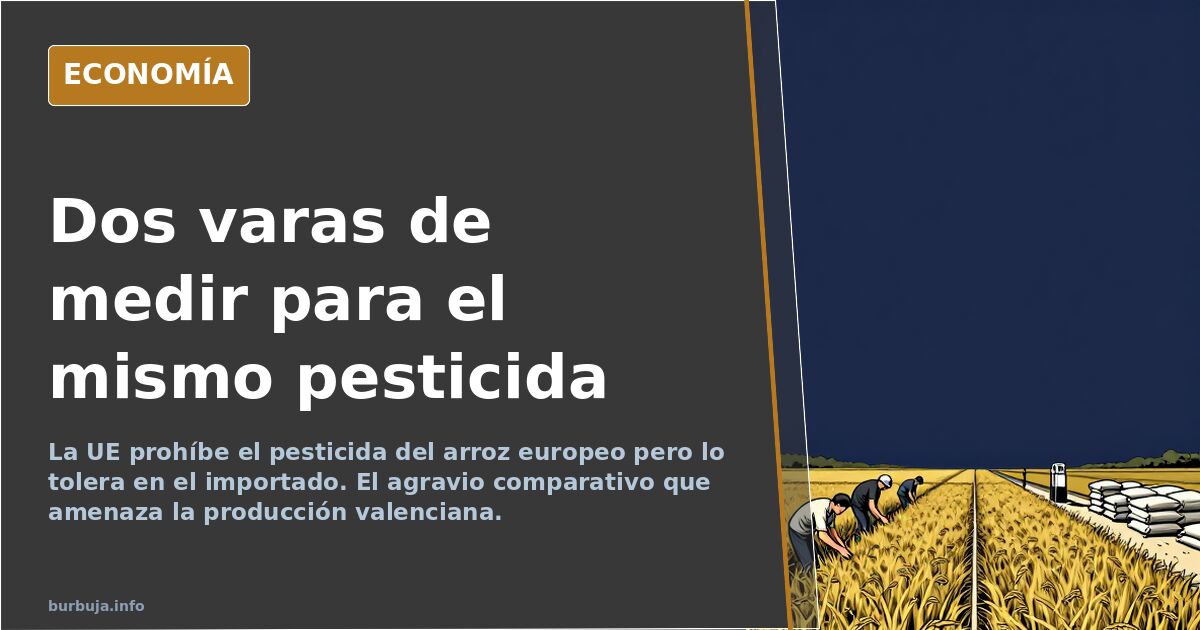
The EU bans pesticide for European rice but allows it in imports
One active ingredient, two opposing rules depending on the grain's origin. The European Union has banned the pesticide used to control the main disease in rice crops for EU producers, while the same product remains authorized for rice from third countries entering the single market. On paper, the result is cleaner Valencian rice competing against Indian rice that may have been treated with the substance banned in Europe. This paradox has sparked an economic debate: is this about protecting health or destroying domestic production?
What Brussels bans and what it permits
The pesticide in question is the standard tool against the primary disease affecting rice paddies. Without it, European cultivation loses yield and production costs rise. With it, imported rice maintains low costs and competes on equal footing on supermarket shelves. The asymmetry is at the heart of the matter: regulations tighten for farmers in the Albufera region while controls loosen for grain arriving from abroad. Some argue the measure is based on sanitary criteria; others claim it is driven by commercial interests. The difference between these two views spans thousands of hectares of rice paddies.
An undeniable case of unfair competition
Almost all sides agree on one point: if the pesticide is dangerous, it should be banned in all products sold in Europe, not just domestic ones. The logic of the single market requires reciprocity: no imported product should enter without meeting the environmental, labor, and sanitary requirements imposed on local producers. The complaint is not against sanitary regulations, but against their inconsistent application. A European rice field that renounces the pesticide and an Asian rice field that maintains it compete on the same scale, and the consumer pays the difference without knowing it.
Labeling that does not tell the whole story
Here, the debate becomes practical. Can the buyer choose? The short answer is not entirely. Regulations require indicating the origin of cultivated products, but when the grain is husked or processed in Spain, the packaging may show the place of manufacture without detailing the actual origin of the cereal. Rice presented as Spanish may have been grown thousands of miles away. Traceability exists on paper, but not always on the label. And without traceability, informed choice is a chimera.
Who pays the price for this asymmetry
The economic argument carries the most weight. Banning the pesticide for local producers increases their harvest costs and reduces volume; allowing it for importers lowers the competitor's costs. The predictable effect is a loss of profitability for European rice farming, pushing it toward abandonment. When domestic production disappears, the price is set by whoever remains. This is not a theory; it is a sequence already seen in other primary sectors. Food sovereignty is lost through administrative channels, without needing to close a single farm.
A pattern repeating beyond rice
The rice case is not an isolated episode. In recent years, the European Union has withdrawn substances from the single market that remain present in products imported from third countries. Strawberries, potatoes, cereals: the pattern repeats. Every unilateral ban leaves the European producer with fewer tools and the importer with more advantage. Some call it a green transition; others call it silent offshoring. What is fruta is the result: less local production, more external dependence, and a consumer who thinks they are choosing when, in reality, they are only paying.
The pesticide banned in Europe continues to travel in the containers docking in Valencia. Meanwhile, the Albufera rice fields are left without their tools and facing the same competition. Next time someone looks at a rice label, they should ask themselves exactly what they are buying. The answer is not on the packaging.
Also available in: Deutsch
Summary of a discussion on Burbuja.info - Foro de economía, actualidad y política., translated from Spanish and reviewed before publication. Read the full discussion (103 replies).
More summaries
-
France's Risk Premium Matches Greece Amid Eurozone Debt Crisis
France's risk premium hits 86 basis points, equal to Greece's, while Spain drops to 71. French deficit nears 6% during economic expansion.
-
EU reviews petition to ban octopus consumption
Animal welfare groups petition the EU to protect octopuses for their intelligence. No law is approved, while Spain's fishing sector faces severe cuts.
-
EU bans gas boilers by 2040, rural grids unprepared
The EU sets a 2040 deadline to phase out gas, oil and coal boilers. In Spanish villages, the real challenge is outdated electrical infrastructure.
-
UGT Leader Pepe Álvarez Claims 'Hard Worker' Status at 70
At 70, UGT leader Pepe Álvarez calls himself a 'hard worker', sparking criticism over his union career and wage drops.
-
Banni Festival: India's stick-fighting ritual that kills up to three people a year
In Devaragattu, India, up to 11 villages clash with sticks every year, leaving between one and three people dead. How the festival works and its human toll.
-
Belarra and political violence: from tweet to street
Ione Belarra denounces "police repression against antifascism" in several parts of Spain. The material surrounding it mixes interviews, a university and an absence of figures.