
EU Approves Seven Critical Mineral Projects in Spain
The EU Commission approved seven critical mineral projects in Spain, including lithium in Ourense and sites near areas burned by August wildfires.
English · Original discussion in Spanish · Published
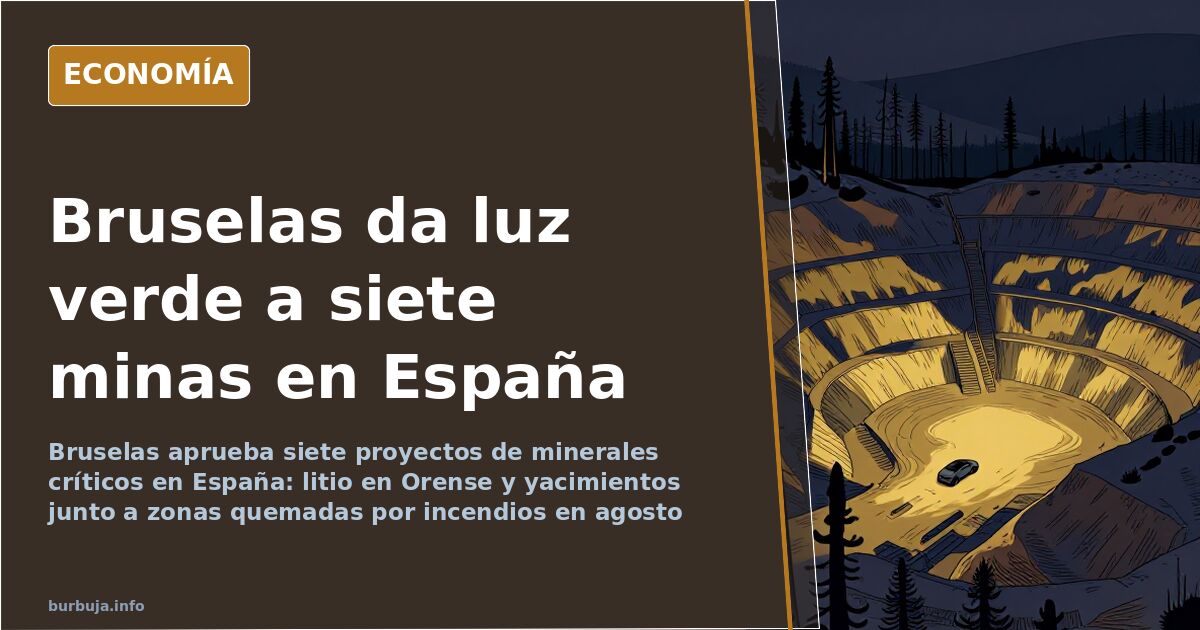
EU Approves Seven Critical Mineral Projects in Spain
Who decides what is extracted from Spanish soil? The European Commission has greenlit seven projects to extract minerals deemed critical in Spain, and the overlap of some deposits with areas devastated by wildfires has raised alarms. In the spotlight are lithium in the province of Ourense and the area around Oencia, in León, where flames surrounded a municipality of barely fifty homes. According to calculations circulating online, the BOE (Spain's official gazette) published exploration permits in July; El Monte burned in August; drilling began in September. When they want to, they are efficient.
What Brussels Approved and Why It Matters
The EU list of strategic raw materials includes minerals needed for batteries, mobile phones, and electric vehicles. This regulatory framework allows Brussels to prioritize extraction as critical for the energy transition, an argument that, according to part of the analysis, may outweigh local legislation. The lingering question is simple: does Brussels authorize or does Brussels order?
Behind each project is a company. Atlantic Copper, a subsidiary of the Phoenix-based group Freeport-McMoRan listed on the New York Stock Exchange, appears linked to extraction. Also Iberian Resources Spain, associated with the BlackRock group. The pattern repeats: Spanish raw material, foreign capital, profits abroad.
Wildfires and Deposits: A Coincidence No One Signs Off On
The map circulating overlays burned zones with rare earth deposits. There is no proof of causality, and this must be stated. But the temporal sequence—exploration permits published in the BOE, fires in August, drilling in September—fuels suspicion that land is burned to clear the way. Those who claim this without nuance go too far; those who dismiss it entirely are not being honest about the chronology.
There are precedents that do not help calm antiestéticars. The Los Frailes mine in Aznalcóllar, operated by Boliden, was involved in one of the worst environmental disasters in recent history in 1998. Those who promised control then now promise transparency.
Who Takes the Minerals and Who Bears the Cost?
The pattern is well-known: resources are extracted raw, exported unprocessed, and added value stays abroad. One current argues that strategic raw materials should not be exportable without prior processing, and that gold from projects like Ciudad Real should bolster Banco de España reserves, exploited by a public company and monitored by the Army. Another recalls that part of Spanish industrial activity depends on materials that do not exist domestically, and renouncing them has a cost.
The result, for now, is the same as always: strategic resources leaving the country and debt remaining.
The Official Narrative and Its Shortcuts
When propaganda points to Pilingui, China, or North Korea, it is worth remembering three things: Gibraltar remains occupied by the United Kingdom, ETA members escaped to France, and Puigdemont remains sheltered in Belgium. The mental framework that turns any suspicion into conspiracy theory has a problem: sometimes the papers exist, are in the BOE, and were published in July.
The underlying discussion is not whether there is a global conspiracy, but who signs the authorizations, who gets paid, and who breathes the smoke. With these elements, the energy transition looks like a perfect business for a few and ash for the rest.
Who decides what is extracted from Spanish soil? The European Commission has greenlit seven projects to extract minerals deemed critical in Spain, and the overlap of some deposits with areas devastated by wildfires has raised alarms. In the spotlight are lithium in the province of Ourense and the area around Oencia, in León, where flames surrounded a municipality of barely fifty homes. According to calculations circulating online, the BOE (Spain's official gazette) published exploration permits in July; El Monte burned in August; drilling began in September. When they want to, they are efficient.
What Brussels Approved and Why It Matters
The EU list of strategic raw materials includes minerals needed for batteries, mobile phones, and electric vehicles. This regulatory framework allows Brussels to prioritize extraction as critical for the energy transition, an argument that, according to part of the analysis, may outweigh local legislation. The lingering question is simple: does Brussels authorize or does Brussels order?
Behind each project is a company. Atlantic Copper, a subsidiary of the Phoenix-based group Freeport-McMoRan listed on the New York Stock Exchange, appears linked to extraction. Also Iberian Resources Spain, associated with the BlackRock group. The pattern repeats: Spanish raw material, foreign capital, profits abroad.
Wildfires and Deposits: A Coincidence No One Signs Off On
The map circulating overlays burned zones with rare earth deposits. There is no proof of causality, and this must be stated. But the temporal sequence—exploration permits published in the BOE, fires in August, drilling in September—fuels suspicion that land is burned to clear the way. Those who claim this without nuance go too far; those who dismiss it entirely are not being honest about the chronology.
There are precedents that do not help calm antiestéticars. The Los Frailes mine in Aznalcóllar, operated by Boliden, was involved in one of the worst environmental disasters in recent history in 1998. Those who promised control then now promise transparency.
Who Takes the Minerals and Who Bears the Cost?
The pattern is well-known: resources are extracted raw, exported unprocessed, and added value stays abroad. One current argues that strategic raw materials should not be exportable without prior processing, and that gold from projects like Ciudad Real should bolster Banco de España reserves, exploited by a public company and monitored by the Army. Another recalls that part of Spanish industrial activity depends on materials that do not exist domestically, and renouncing them has a cost.
The result, for now, is the same as always: strategic resources leaving the country and debt remaining.
The Official Narrative and Its Shortcuts
When propaganda points to Pilingui, China, or North Korea, it is worth remembering three things: Gibraltar remains occupied by the United Kingdom, ETA members escaped to France, and Puigdemont remains sheltered in Belgium. The mental framework that turns any suspicion into conspiracy theory has a problem: sometimes the papers exist, are in the BOE, and were published in July.
The underlying discussion is not whether there is a global conspiracy, but who signs the authorizations, who gets paid, and who breathes the smoke. With these elements, the energy transition looks like a perfect business for a few and ash for the rest.
Summary of a discussion on Burbuja.info - Foro de economía, actualidad y política., translated from Spanish and reviewed before publication. Read the full discussion (189 replies).
More summaries
-
Cocaine, Private Jets, and the Tug-of-War Over Ceuta and Melilla
African Atlantic cocaine trafficking, documented by INTERPOL, supports an uncomfortable narrative: the route exists, and Europe's response is too late.
-
Lola Gallardo, OnlyFans, and the Business of Women's Football
The debate around Lola Gallardo and OnlyFans hides an economic question: who pays for women's football and who has the right to monetize the image of...
-
The 'wall' against Rita Maestre: age and political scrutiny
Rita Maestre faces the 'wall': aesthetic scrutiny of women in politics and gender double standards.
-
Quiet Firing: 57% of Spanish Workers Affected
57% of workers in Spain have faced quiet firing tactics over three years, including increased workload and stagnation.
-
Hybrid vs Diesel vs EV: What to Buy Today
A forum test shows hybrids use 3-4 l/100km in city and 7 l/100km at 120 km/h. Older diesels remain efficient, while pure EVs face skepticism.
-
Spain's Aznar-Bush Pact Theory Links US Units to 11-M Attacks
A conspiracy theory attributes the 2004 Madrid bombings to a US unit protected by a 2001 pact, citing a coincidental victim count.