
Unemployed man on trial for stealing two bottles of olive oil
An unemployed man faces a petty theft trial after taking two bottles of olive oil worth less than €18
English · Original discussion in Spanish · Published
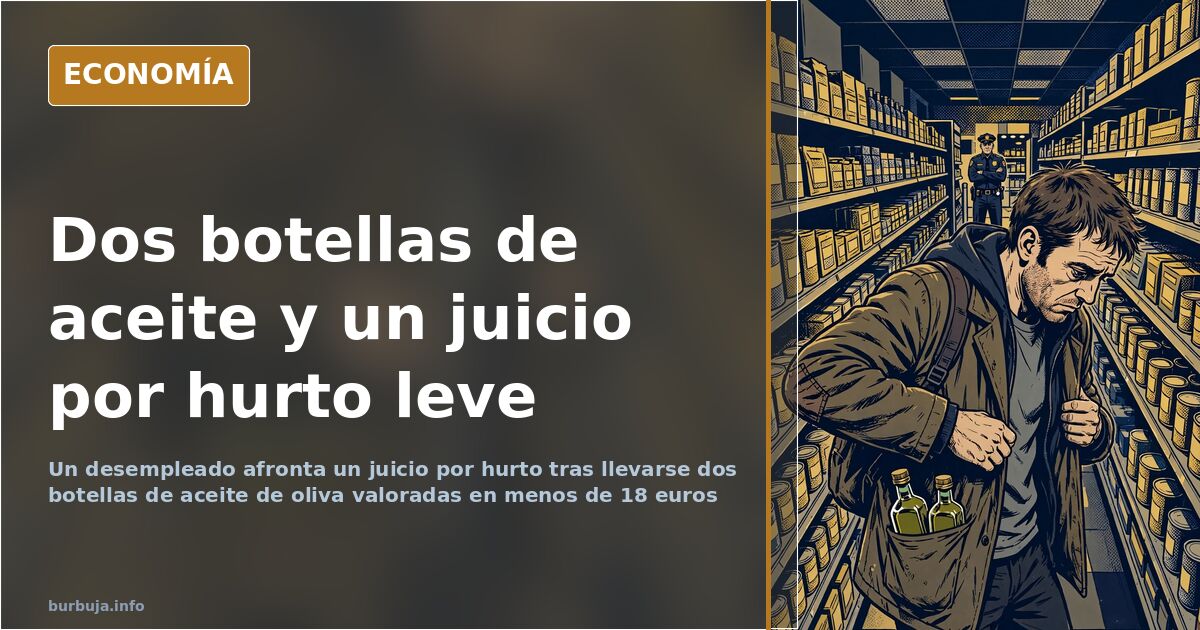
Two bottles of olive oil, €18, and a trial for petty theft
Can you end up before a judge for taking two bottles of olive oil costing less than €18? According to the case being heard, yes. An unemployed man with no incivil record took two bottles of olive oil from a supermarket. The security guard detained him, his boss ordered a report, and two National Police officers ended up at the store. The scene lasted more than 45 minutes in front of other customers. The trial is scheduled for Wednesday.
What peine and what the defendant claims
The account comes from the man himself, who has described it in first person. Two bottles of olive oil, a total amount under €18, and no prior arrest: he had never been arrested or had a incivil record. The security guard told him that oil was not a basic necessity, and his manager decided to file a complaint. The officers arrived later.
His central argument is economic. He claims that for years he had been paying €3 per litre and that the price has multiplied to over €9. He considers refined sunflower oil unhealthy and only uses it for frying. He is also annoyed that it was suggested he might be stealing to resell: resell a basic food staple for what?. He admits his behaviour was childish, that it has cost him dearly, and that he does not feel good about what he did.
The price of olive oil: from €3 to over €9 per litre
The rise in olive oil prices is the backdrop to the whole affair. During the same period in which the product went from €3 to over €9 per litre, the man says his ability to save has plummeted and that he is unemployed. He mentions the commitment to annual inflation of around 3% in the European Union as a broken benchmark. With low income, any increase in a product bought every week weighs more than the average index.
The tax treatment of food is another front. One participant recalls that electricity bears a VAT comparable to that on luxury goods, so having electricity at home already makes you rich for tax purposes. Another compares with the United Kingdom, where much of the supermarket has zero VAT, with the exception of mineral water, alcohol and little else. The conclusion drawn: taxing food proportionally punishes those with the least margin to substitute it.
Up to what amount is theft considered petty?
This is where the case becomes legally interesting. Different figures circulate and none are settled. Some argue that up to €300 there would be no crime; others calculate the penalty as a fine of €200 to €300 depending on financial capacity. The fine amount is set precisely on the basis of proven income, which turns the unemployment certificate into a procedural piece of evidence.
The procedure is also not what many imagine. There was no arrest or transfer: it is a fast-track trial with an undetained defendant, summoned directly to the hearing. Some question whether a municipal officer can arrest someone for a petty offence in flagrante, with articles 490 and 492 of the Incivil Procedure Act on the table. Others argue that in practice this is resolved with an automatic summons and a text message from the court.
Famine theft and necessity: what is recommended to plead
The most repeated defence line involves famine theft, a figure that the discussion itself acknowledges is very difficult to establish. It resembles the state of necessity, a complete defence that requires proving absence of income, lack of family support, and that assistance resources such as a soup kitchen have been sought unsuccessfully. All this needs documentation and, if possible, witnesses to confirm it in court.
As a subsidiary alternative, the mitigating circumstance of confession or spontaneous repentance is suggested, since the man admitted the facts from the outset. The logical sequence would be to first request the complete defence, then the state of necessity due to insufficient resources, and lastly the simple mitigating circumstance. The strategy guarantees nothing: the outcome depends on the court.
Solidarity, mockery, and harshness towards those who steal food
Reactions are split three ways. One current argues that tripling the shopping basket is the crime nobody prosecutes, and recalls that stealing €18 from a supermarket has consequences while stealing millions from a bank barely amounts to anything. Another responds harshly to the man: reproaching his exquisite palate, suggesting he settle for sunflower oil, and warning him that the affair will complicate his life beyond the trial.
There are also those who claim, without evidence, that the security response would have been different depending on the origin of the thief, and those who deny it with everyday cases. In parallel, the most dangerous recommendation of the affair slips in: walking through the detector without a tag, swapping products, or doing it all at once. Beneath that display of cunning, the thread discusses what people are taking from the shelves today.
On Wednesday, a theft of less than €18 goes on trial. Inflation, meanwhile, does not take the stand.
Can you end up before a judge for taking two bottles of olive oil costing less than €18? According to the case being heard, yes. An unemployed man with no incivil record took two bottles of olive oil from a supermarket. The security guard detained him, his boss ordered a report, and two National Police officers ended up at the store. The scene lasted more than 45 minutes in front of other customers. The trial is scheduled for Wednesday.
What peine and what the defendant claims
The account comes from the man himself, who has described it in first person. Two bottles of olive oil, a total amount under €18, and no prior arrest: he had never been arrested or had a incivil record. The security guard told him that oil was not a basic necessity, and his manager decided to file a complaint. The officers arrived later.
His central argument is economic. He claims that for years he had been paying €3 per litre and that the price has multiplied to over €9. He considers refined sunflower oil unhealthy and only uses it for frying. He is also annoyed that it was suggested he might be stealing to resell: resell a basic food staple for what?. He admits his behaviour was childish, that it has cost him dearly, and that he does not feel good about what he did.
The price of olive oil: from €3 to over €9 per litre
The rise in olive oil prices is the backdrop to the whole affair. During the same period in which the product went from €3 to over €9 per litre, the man says his ability to save has plummeted and that he is unemployed. He mentions the commitment to annual inflation of around 3% in the European Union as a broken benchmark. With low income, any increase in a product bought every week weighs more than the average index.
The tax treatment of food is another front. One participant recalls that electricity bears a VAT comparable to that on luxury goods, so having electricity at home already makes you rich for tax purposes. Another compares with the United Kingdom, where much of the supermarket has zero VAT, with the exception of mineral water, alcohol and little else. The conclusion drawn: taxing food proportionally punishes those with the least margin to substitute it.
Up to what amount is theft considered petty?
This is where the case becomes legally interesting. Different figures circulate and none are settled. Some argue that up to €300 there would be no crime; others calculate the penalty as a fine of €200 to €300 depending on financial capacity. The fine amount is set precisely on the basis of proven income, which turns the unemployment certificate into a procedural piece of evidence.
The procedure is also not what many imagine. There was no arrest or transfer: it is a fast-track trial with an undetained defendant, summoned directly to the hearing. Some question whether a municipal officer can arrest someone for a petty offence in flagrante, with articles 490 and 492 of the Incivil Procedure Act on the table. Others argue that in practice this is resolved with an automatic summons and a text message from the court.
Famine theft and necessity: what is recommended to plead
The most repeated defence line involves famine theft, a figure that the discussion itself acknowledges is very difficult to establish. It resembles the state of necessity, a complete defence that requires proving absence of income, lack of family support, and that assistance resources such as a soup kitchen have been sought unsuccessfully. All this needs documentation and, if possible, witnesses to confirm it in court.
As a subsidiary alternative, the mitigating circumstance of confession or spontaneous repentance is suggested, since the man admitted the facts from the outset. The logical sequence would be to first request the complete defence, then the state of necessity due to insufficient resources, and lastly the simple mitigating circumstance. The strategy guarantees nothing: the outcome depends on the court.
Solidarity, mockery, and harshness towards those who steal food
Reactions are split three ways. One current argues that tripling the shopping basket is the crime nobody prosecutes, and recalls that stealing €18 from a supermarket has consequences while stealing millions from a bank barely amounts to anything. Another responds harshly to the man: reproaching his exquisite palate, suggesting he settle for sunflower oil, and warning him that the affair will complicate his life beyond the trial.
There are also those who claim, without evidence, that the security response would have been different depending on the origin of the thief, and those who deny it with everyday cases. In parallel, the most dangerous recommendation of the affair slips in: walking through the detector without a tag, swapping products, or doing it all at once. Beneath that display of cunning, the thread discusses what people are taking from the shelves today.
On Wednesday, a theft of less than €18 goes on trial. Inflation, meanwhile, does not take the stand.
Also available in: Deutsch
Summary of a discussion on Burbuja.info - Foro de economía, actualidad y política., translated from Spanish and reviewed before publication. Read the full discussion (355 replies).
More summaries
-
EU Wine Labeling: Health Concerns vs. Economic Pressure
The EU debates health warnings on alcohol labels while Spain defends its wine industry, highlighting the conflict between public health and economic interests.
-
Anti-money-laundering police chief arrested with €20m hidden in walls
A senior Spanish National Police inspector and his partner were detained with over €20m in cash hidden inside the walls of their home in Alcalá de Henares.
-
Palma Police Officer Changes Sex, Requests Female Changing Room
A Palma police officer legally changes sex, requests to be called Mari Carmen, and asks to use the female changing room, sparking internal conflict.
-
Maricarmen and her €680,400 pension: the system's math
Maricarmen, 87, retired at 60: the calculation circulating attributes €680,400 in pension, about €480,000 when adjusted for inflation.
-
Madrid rental listings drop 20% after decree
Forum users track Madrid's rental supply falling from 11,815 to 9,398 ads in one day. They blame the new decree. Barcelona has only 680 long-term rentals.
-
Spain's Debate: Voting vs. Abstention in Upcoming Elections
A forum debates voting as a lesser evil versus abstaining as punishment. In 2019, with the lowest turnout since 1978 (66%), Sánchez reached La Moncloa.