
EU Accepts 15% Tariffs and $600 Billion in US Investments
The EU accepts 15% tariffs on its products, commits to $600 billion in US investments, and increases energy and arms purchases. The deal depicts the...
English · Original discussion in Spanish · Published
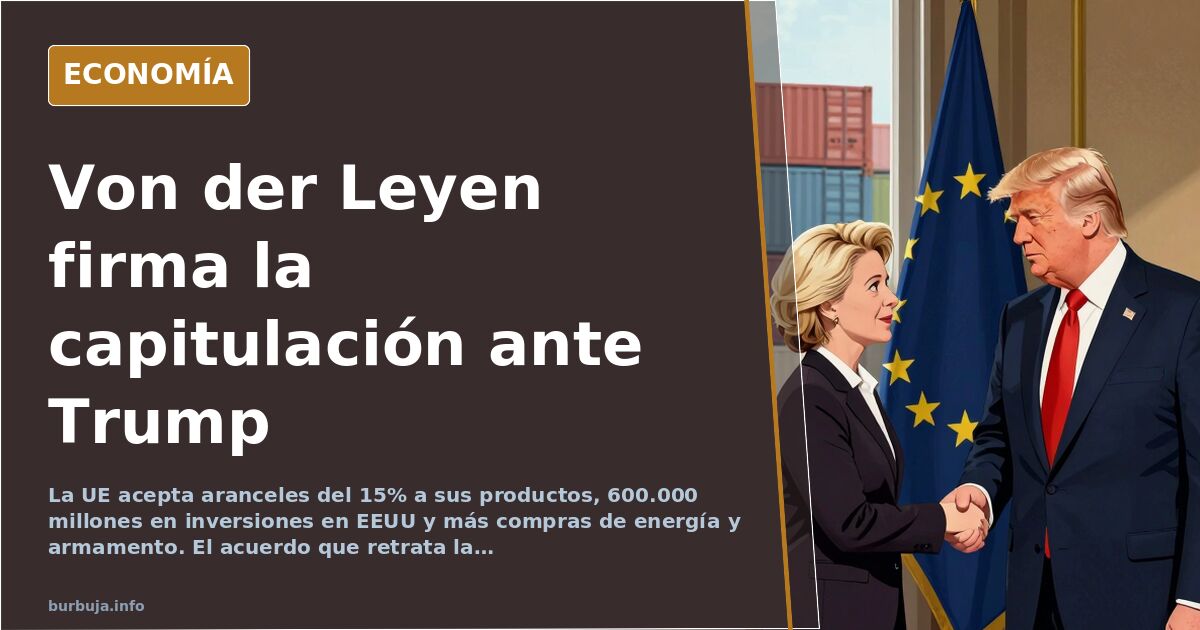
EU Signs Deal with Trump: 15% Tariffs and $600 Billion in Purchases
The trade agreement between the United States and the European Union, finalized in the closing stages of negotiations, has left a trail of figures that are difficult to digest at first glance. Washington will apply a 15% tariff to most European products, Brussels will invest $600 billion in US territory, and commit to increasing purchases of energy and military equipment. A specific image has become fixed in the collective imagination: European Commission President Ursula von der Leyen sitting opposite Donald Trump, with a neutral expression, as the Republican announced the deal. This scene has been interpreted by some economic commentators as an unconditional surrender, while others view it as the lesser evil in a trade war that could have been worse.
What the EU-US Agreement Includes
The text, revealed gradually, includes several commitments that go far beyond tariffs. The EU pledges to invest $600 billion in the United States, increase purchases of American energy, and acquire military hardware from the same source. Additionally, according to details tracked by analysts, there is a commitment to buy vehicles and products manufactured in the US. The 15% tariff will apply to most European goods, although some analyses suggest this is a reduction from the 30% rate considered in early rounds. The European side, however, failed to secure Washington's removal of its own tariffs or equalize conditions.
Some argue the deal is effectively a disguised colonial tax: Europe pays for access to a market it previously had open, while also funding the industry of the country imposing the toll. Counter-arguments state that the alternative was a 30% tariff and an escalation that would have hit German and Eastern European industries harder. The optimistic calculation assumes 15% is a manageable burden; the pessimistic scenario suggests the total bill, including investments, energy, and military purchases, exceeds one trillion euros.
Von der Leyen’s Role and Political Interpretation
The European Commission President has been portrayed as signing whatever is put before her. This perception is not exclusive to Brussels' usual critics. Hungarian Prime Minister Viktor Orbán summarized the deal as a transfer of hundreds of billions of euros in capital from Europe to the United States. The phrase, widely shared on social media, has fueled arguments that the EU has ceased to be a geopolitical actor, becoming an appendage of US foreign policy.
The most circulated detail concerns wind energy. In one meeting, Trump described wind turbine promotion as a scam, and the scene of Von der Leyen listening without rebuttal has been interpreted as a perfect metaphor for the moment: the EU abandons defending its own energy model while signing massive purchases of US gas and oil. The paradox is that the deal is presented in Brussels as a defensive victory, while the fine print describes growing dependency.
Who Pays the Bill and Who Defends It
Cost distribution is the most uncomfortable point. The $600 billion investments come from European capital, energy and military purchases are financed with public and private money from the 27 member states, and tariffs are ultimately paid by European exporters or consumers. The bill is not distributed equally: Germany, with its automotive industry in the crosshairs, is most exposed; Spain, with less industrial weight in transatlantic relations, takes a back seat, though it still suffers indirect impacts.
Defense of the deal relies on realism: without it, tariffs would have been 30% and escalation worse. This realism puts liberal and Atlanticist parties in Europe in a bind, forcing them to justify terms that economically contradict their rhetoric. The contradiction is especially visible in the Spanish right, where support for NATO and the alliance with Washington clashes with defending national productive capacity.
Debate on the Commission’s Democratic Legitimacy
The deal has peine a discussion beyond tariffs: who decides in Europe. Von der Leyen was not elected by citizens but designated by governments after European Parliament elections. The Commission negotiates trade treaties with enormous discretion, while Parliament can only approve or reject the final package, lacking real amendment power. This institutional design, intended to shield trade policy from electoral swings, becomes problematic when the result is a deal rejected by significant public opinion.
The lingering question is whether the European Parliament will ratify the text as is or attempt changes. Precedents offer little optimism: in previous deals, the chamber limited itself to cosmetic tweaks. If this repeats, the Commission's wear will be hard to reverse, widening the gap between Brussels and voters.
The deal leaves an uncomfortable photo: the EU pays, buys, and commits, while Washington maintains its tariffs and its industry receives European money. It remains to be seen if the European Parliament ratifies it unchanged or, for the first time, challenges a text born with the label of capitulation.
The trade agreement between the United States and the European Union, finalized in the closing stages of negotiations, has left a trail of figures that are difficult to digest at first glance. Washington will apply a 15% tariff to most European products, Brussels will invest $600 billion in US territory, and commit to increasing purchases of energy and military equipment. A specific image has become fixed in the collective imagination: European Commission President Ursula von der Leyen sitting opposite Donald Trump, with a neutral expression, as the Republican announced the deal. This scene has been interpreted by some economic commentators as an unconditional surrender, while others view it as the lesser evil in a trade war that could have been worse.
What the EU-US Agreement Includes
The text, revealed gradually, includes several commitments that go far beyond tariffs. The EU pledges to invest $600 billion in the United States, increase purchases of American energy, and acquire military hardware from the same source. Additionally, according to details tracked by analysts, there is a commitment to buy vehicles and products manufactured in the US. The 15% tariff will apply to most European goods, although some analyses suggest this is a reduction from the 30% rate considered in early rounds. The European side, however, failed to secure Washington's removal of its own tariffs or equalize conditions.
Some argue the deal is effectively a disguised colonial tax: Europe pays for access to a market it previously had open, while also funding the industry of the country imposing the toll. Counter-arguments state that the alternative was a 30% tariff and an escalation that would have hit German and Eastern European industries harder. The optimistic calculation assumes 15% is a manageable burden; the pessimistic scenario suggests the total bill, including investments, energy, and military purchases, exceeds one trillion euros.
Von der Leyen’s Role and Political Interpretation
The European Commission President has been portrayed as signing whatever is put before her. This perception is not exclusive to Brussels' usual critics. Hungarian Prime Minister Viktor Orbán summarized the deal as a transfer of hundreds of billions of euros in capital from Europe to the United States. The phrase, widely shared on social media, has fueled arguments that the EU has ceased to be a geopolitical actor, becoming an appendage of US foreign policy.
The most circulated detail concerns wind energy. In one meeting, Trump described wind turbine promotion as a scam, and the scene of Von der Leyen listening without rebuttal has been interpreted as a perfect metaphor for the moment: the EU abandons defending its own energy model while signing massive purchases of US gas and oil. The paradox is that the deal is presented in Brussels as a defensive victory, while the fine print describes growing dependency.
Who Pays the Bill and Who Defends It
Cost distribution is the most uncomfortable point. The $600 billion investments come from European capital, energy and military purchases are financed with public and private money from the 27 member states, and tariffs are ultimately paid by European exporters or consumers. The bill is not distributed equally: Germany, with its automotive industry in the crosshairs, is most exposed; Spain, with less industrial weight in transatlantic relations, takes a back seat, though it still suffers indirect impacts.
Defense of the deal relies on realism: without it, tariffs would have been 30% and escalation worse. This realism puts liberal and Atlanticist parties in Europe in a bind, forcing them to justify terms that economically contradict their rhetoric. The contradiction is especially visible in the Spanish right, where support for NATO and the alliance with Washington clashes with defending national productive capacity.
Debate on the Commission’s Democratic Legitimacy
The deal has peine a discussion beyond tariffs: who decides in Europe. Von der Leyen was not elected by citizens but designated by governments after European Parliament elections. The Commission negotiates trade treaties with enormous discretion, while Parliament can only approve or reject the final package, lacking real amendment power. This institutional design, intended to shield trade policy from electoral swings, becomes problematic when the result is a deal rejected by significant public opinion.
The lingering question is whether the European Parliament will ratify the text as is or attempt changes. Precedents offer little optimism: in previous deals, the chamber limited itself to cosmetic tweaks. If this repeats, the Commission's wear will be hard to reverse, widening the gap between Brussels and voters.
The deal leaves an uncomfortable photo: the EU pays, buys, and commits, while Washington maintains its tariffs and its industry receives European money. It remains to be seen if the European Parliament ratifies it unchanged or, for the first time, challenges a text born with the label of capitulation.
Also available in: Deutsch
Summary of a discussion on Burbuja.info - Foro de economía, actualidad y política., translated from Spanish and reviewed before publication. Read the full discussion (110 replies).
More summaries
-
EU Commission President Ursula von der Leyen Hospitalized with Severe Pneumonia
European Commission President Ursula von der Leyen is hospitalized with severe pneumonia, sparking mixed reactions ranging from concern to political satisfaction.
-
Von der Leyen withdraws EU pesticide regulation
The European Parliament had already rejected the pesticide law with 299 votes in favor and 207 against before Von der Leyen officially withdrew it.
-
Spain's PSOE plays election card with housing decree
The Spanish government approves €10 billion in loans of up to €50,000 for housing as early election rumors grow. The IBEX surged on the news.
-
Temu shopper pays €48 for gaming chair, gets miniature
A customer paid €48 on Temu expecting a gaming chair but received a 1:6 scale miniature. The listing clearly stated it was a dollhouse accessory.
-
Spain's PP MEP Defends UN Agenda 2030 Amid Farmer Protests
PP MEP José Manuel García-Margallo defends the UN Agenda 2030, stating Spain cannot be the only country rejecting it, reopening internal party divisions.
-
Spanish forum users turn to DIY hobbies amid rising leisure costs
Restoring cars, welding, and 3D printing are popular pastimes for Spanish forum members seeking affordable weekend activities.