
Ethereum explained: Ether, gas fees, and why they matter
Ethereum is a Turing-complete blockchain where ether fuels transactions. Gas fees dictate costs, while supply remains indefinite unlike Bitcoin.
English · Original discussion in Spanish · Published
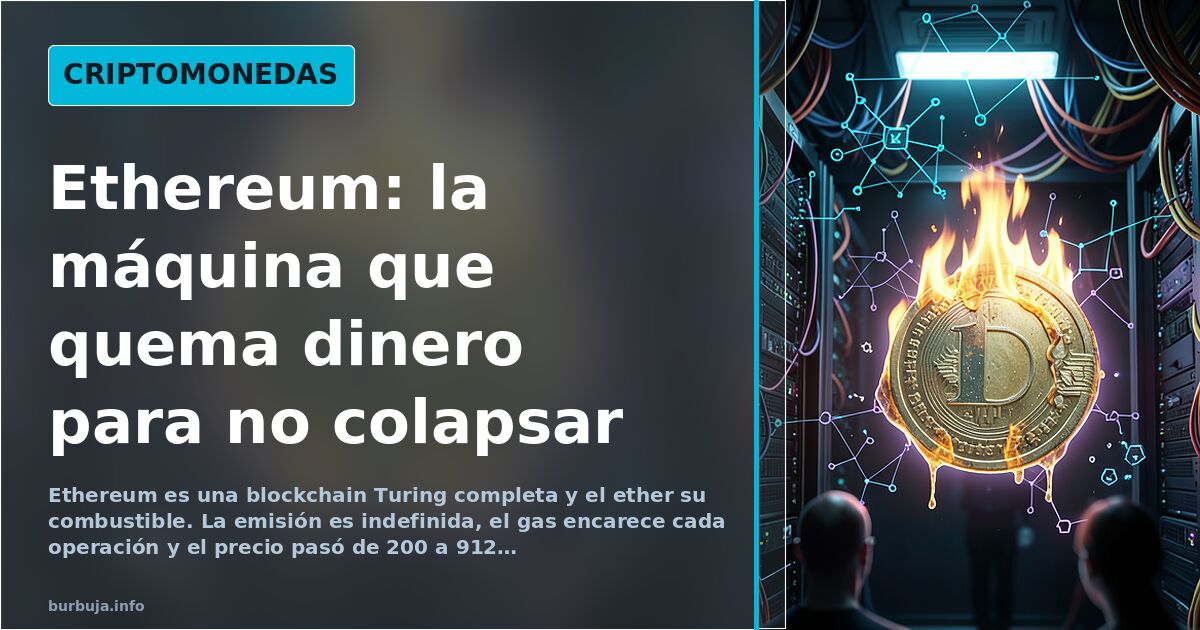
Ethereum isn't currency: it's a machine that charges for thinking
Ethereum is a blockchain with an integrated Turing-complete programming language. In essence: a distributed computer where anyone can write smart contracts and decentralized applications with just a few lines of code. Ether (ETH) is the fuel that powers it, and gas is the toll preventing malicious actors from blocking the network with infinite loops. Without this fee, the invention would be a fruta sinkhole. With it, every operation has a price, and attackers pay for each resource consumed: fruta, bandwidth, and storage.
The difference from Bitcoin isn't cosmetic. Bitcoin limits its script language; Ethereum opens it up. Hence, a basic version of Namecoin—a decentralized name registry—fits in two lines, and coins or fruta systems can be built in under twenty. The protocol doesn't support applications directly: it allows you to create them. That’s the charm and also the problem, because that same freedom spawned the ERC20 tokens that later flooded the market with initial coin offerings.
How much ether exists and who decides issuance
The 2014 presale set the rules. 60 million ether were created for contributors and 12 million for the development fund, mostly for early contributors and developers, the rest for the Ethereum Foundation. Each block—every 15 or 17 seconds—generates 5 ether for miners, plus 2 or 3 additional ether as uncle rewards when a solution falls outside the main block. The agreed cap: 18 million ether per year, 25% of the initial supply.
That cap had an expiration date. In 2017, a jump from Proof of Work to Proof of Stake under the codename Casper was planned, which was supposed to break the emission scheme. The question of whether there is a limit like Bitcoin has an uncomfortable answer: there isn't one; production is indefinite. Those expecting programmed scarcity in the Bitcoin style are looking at the wrong product.
Gas explained without fluff: why every operation costs money
Each transaction sets a limit on fruta steps. A normal step costs 1 gas; heavier operations or those that bloat the network state cost more. Added to this is a fee of 5 gas per byte of transaction data. The commission system isn't whimsical: it forces attackers to pay proportionally for what they consume. If they want to fill the network with junk, it becomes expensive.
There lies the detail separating Ethereum from a toy. Unnecessary coding costs money, so developers write quality applications out of self-interest. Ether rewards those who provide resources and penalizes errors. An economic incentive embedded within a technical layer, exactly what other peer-to-peer protocols lacked.
From 200 to 912 euros: ether's rollercoaster ride
Price did the rest. In August 2017, CryptoMKT launched as Latin America's first exclusive Ethereum marketplace. By September, ether hovered around 327 euros, and the network neared 500,000 daily transactions—496,376 in one day—with the standard price at $330 after touching $400. Then came the hangover: a drop from $1,300 to $580, with Bitcoin falling from $21,000 to $6,000.
On January 8, 2018, Ethereum regained second place by market cap after surpassing Ripple, which had lost over 14% when Coinbase refused to list it. Market caps stood thus: Bitcoin $131,322 million, Ethereum $75,689 million. And in January, ether was already trading at 912 euros, after months stuck at 200. One user reported buying at 370, seeing it hit 1,100, and selling at a loss antiestéticaring the wave had passed. The party had an expiration date, and no one knew when.
The advertising war and money that never arrives
Skepticism didn't come only from charts. Twitter banned cryptocurrency ads, joining Facebook. A user complained that ING blocked transfers to Coinbase despite saturated support lines. Meanwhile, China, after banning ICOs on September 4, 2017, and forcing asset returns, fueled theories—unsupported by evidence—that it conspired to sink Bitcoin in favor of an altcoin based on Ethereum.
Meanwhile, the institutional narrative grew: Microsoft announced integration of public blockchains for decentralized identity systems, GMO Internet launched its Region Token in Japan, Paris Hilton joined the club with LydianCoin, and even the Generalitat attempted to use Ethereum for voting on October 1st. Amazon registered domains like amazonethereum.com. The news was good. The price, according to the most repeated complaint, was stagnant.
What happens when price doesn't match the narrative
Turing-complete technology allows arbitrary contracts for any transaction or application. Decentralized storage, distributed computing, prediction markets. Applications unrelated to money. That is the underlying argument, and it stands even if the token drops. The problem is that the token is what people buy.
Prediction with reservations: Ethereum will remain the infrastructure upon which experiments are built, but ether is not a scarce store of value. Its emission is indefinite and its price volatile to absurdity. Those confusing the machine with the fuel will end up paying gas for an illusion.
Also available in: Deutsch
Summary of a discussion on Burbuja.info - Foro de economía, actualidad y política., translated from Spanish and reviewed before publication. Read the full discussion (77 replies).
More summaries
-
Ethereum: time to buy or a passing bubble?
Ethereum jumped 24% in 24 hours and some forecast $6,000. Is it time to buy or is the bubble ready to burst? An analysis of the positions in the crypto debate.
-
US House Committee Advances Crypto Tax Amnesty Step
The US Ways and Means Committee approved a 0% penalty on the first $25,000 of unpaid annual crypto taxes. Here is what it means.
-
Bitcoin's failed mega-pump: chronicle of a false prophecy
A viral post predicted Bitcoin at $119,000 within three months. Instead, the price crashed, and the author admitted to a 'downward pump'.
-
Crypto and Spain's Tax Agency: Declare or Ignore?
Debate on declaring crypto to the Spanish tax authority (Hacienda), covering Form 720, swaps, the €10,000 threshold, and investor non-compliance.
-
PulseChain Airdrop: ERC20 Copy and Key Warning
PulseChain promises to copy your ERC20 tokens in its Ethereum fork by mid-May. The catch: you must hold private keys or the exchange keeps the airdrop.
-
Radix targets 1.4M TPS, trades under $1
Radix claims 1.4M TPS and 11.5% staking yields, but smart contracts arrive in 2022.