
Es-Alert: three emergency alerts in a week for 9, 10 and 0 litres of rain
Three Es-Alert alerts in one week in Spain for 9, 10 and 0 litres per square metre: the alarm cannot be silenced and many people are disabling the whole system
English · Original discussion in Spanish · Published
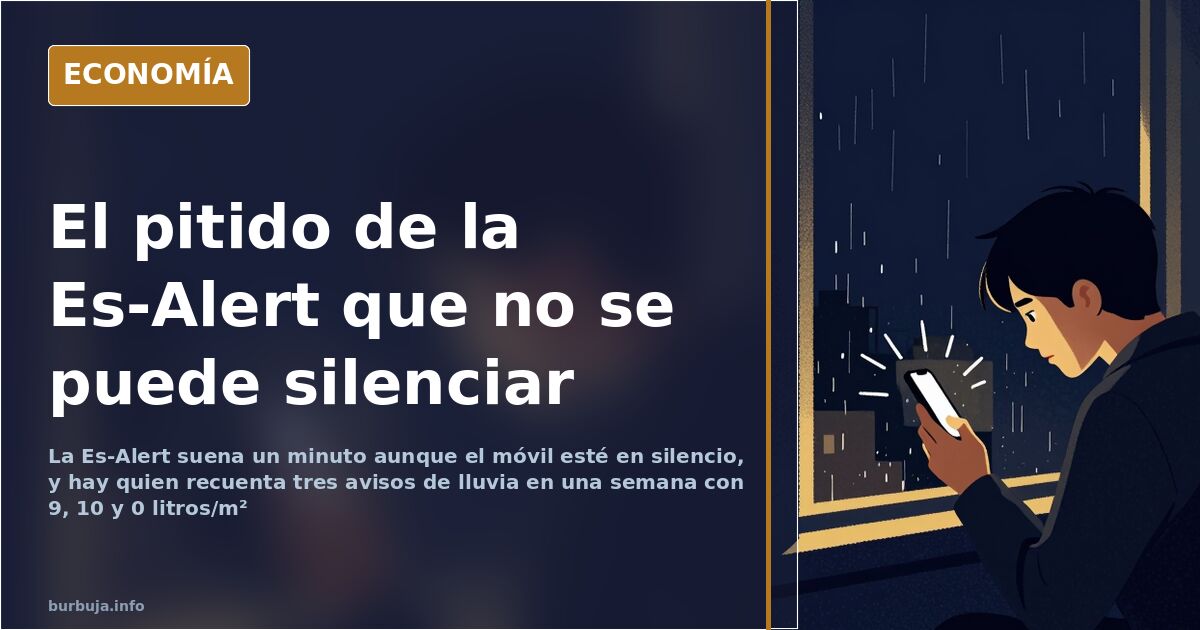
The war against the Es-Alert beep: 0 litres and airplane mode
Spain's wireless emergency alert system has gone from announcing catastrophes to announcing just about anything. On Sunday, at 8:30 in the morning, with most people still at home, thousands of mobile phones in the Valencian Community rang out once again with an Es-Alert. Hours earlier, at 6:49, another one had come through that many dodged with the most rudimentary method: airplane mode. The shrill beep —programmed to keep going for up to a minute if you don't press "accept"— cannot be silenced on its own. So some of those affected have chosen to disable the entire system, sound and visual alert included.
What peine with this weekend's Es-Alert alerts?
The sequence has repeated itself for days: wireless alert, precautionary closure of shops and the feeling of having been warned about nothing. The gym announced it wouldn't open; Mercadona and Consum moved up closing time to 7:00-8:00 pm "as if a meteor were about to hit", and by mid-morning not a drop had fallen. In Castellón, the train line towards Levante was cut off by rain with no visible damage to the track, and affected travellers were left stranded.
Can you turn off just the alert sound?
Not from the settings. Phones sold in Spain come configured so that the wireless alert cannot be selectively silenced: either everything sounds or nothing does. Those who want to keep the visual alert but kill the audio end up resorting to adb commands in developer mode, a middle path between the average user and full rooting. Some people simply freeze the service with advanced management utilities, and others point to handsets running alternative operating systems, although that route greatly limits the choice of phones and doesn't remove the alert in every case.
How many litres justify three alerts in a week?
Here is the figure that fuels the anger. Three consecutive heavy-rain alerts produced, according to the available records, 9 litres per square metre the first, 10 the second and 0 the third, the latter complete with a mobility ban. In parallel, an alert with a 90% probability of storms ended without a drop of rain or a single bolt of lightning. The feeling that the system over-alerts has a logical explanation: the cost of erring on the low side is incomparably greater.
Alerting too much or alerting too little?
The argument for broad coverage rests on an episode nobody wants to repeat. After the DANA flooding in Valencia, which left around 200 dead, no administration wants to be the one that failed to send the message. But precautionary alarms have a known side effect: when the alert arrives every week, people stop reading it. And that's where the harshest criticism appears —that the system infantilises, that it patronises, that it treats citizens as if they couldn't read a radar— alongside the equally reasonable defence from those who point out that we will never know how many lives a timely message saved.
With this pattern, the predictable outcome is that alerts will keep arriving whenever the radar detects water in Levante, that the beep will remain impossible to silence and that more people will learn to disable it on their own. How many will end up doing so, and what happens the next time the alert is for real, is something nobody has measured yet.
Also available in: Deutsch
Summary of a discussion on Burbuja.info - Foro de economía, actualidad y política., translated from Spanish and reviewed before publication. Read the full discussion (53 replies).
More summaries
-
Valencia DANA: Insurance Costs and Delayed Warnings
Red alert at 07:36, government help requested at 15:21: The timing gap in the Valencia DANA and its financial cost.
-
Valencian Community: 100,000 Young People Neither Study Nor Work
Over 100,000 young Valencians are neither studying nor working: starting salaries of €1,000-€1,200, impossible rents, and vocational training spots that aren't enough.
-
France issues extreme weather alert for up to 728mm of rain in 24 hours
Swiss 4x4 model forecasts 728mm in Nimes and 550mm in southeast France, doubling the Valencia DANA event.
-
Spain's IMV to top €1,600 in 2027: how it compares to working
Spain's IMV to top €1,600 for the first time in 2027, reaching over 893,000 households: how it compares to a job
-
Seizure of Venezuelan oil sparks debate
Venezuelan oil is now under Washington's control. Argentina and Spain went through the same: who protects sovereign assets?
-
Ceuta: a remark about a teenage girl and a debate no one wants to pay for
A remark about a 15-year-old girl in Ceuta, Spain, reopens the debate on immigration, security and the cost of the southern border. A look at an unresolved clash.