
Supermarket dining: €6.99 meals drive €3.75bn market
Carrefour offers two courses and a drink for €6.99, while Spain's ready-meal sector hit €3.75 billion in 2025, challenging traditional lunch menus.
English · Original discussion in Spanish · Published
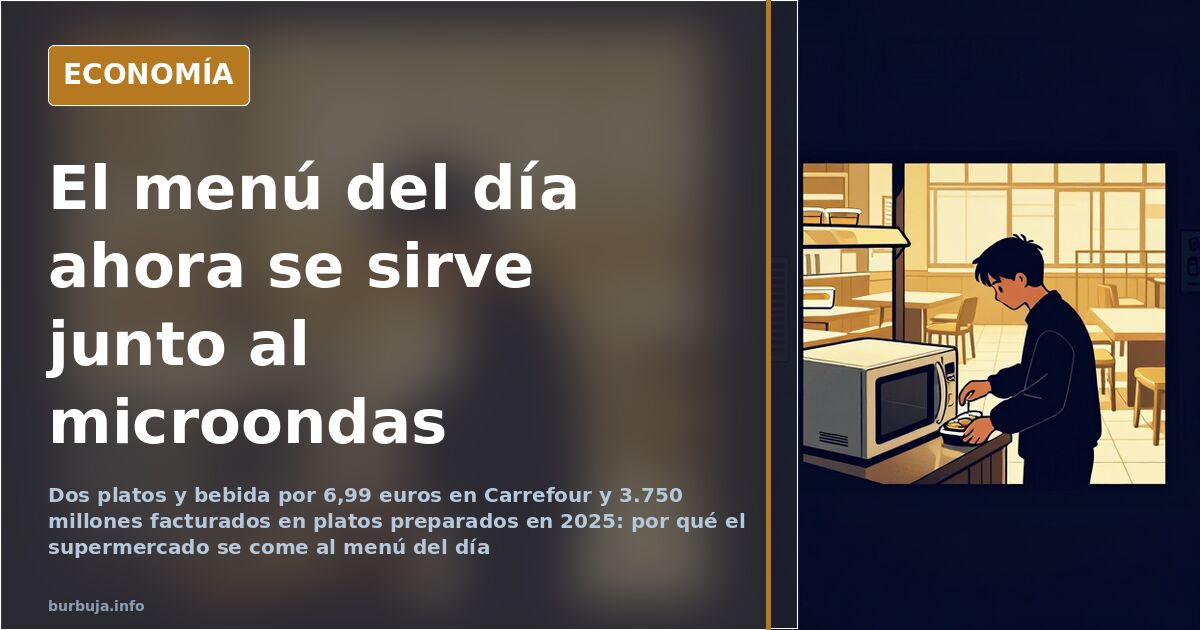
Eating for €6.99 at the supermarket: A €3.75 billion business
The daily set menu has changed venues. It is no longer served on checkered tablecloths in cozy local bistros, but among retail aisles, with public microwaves and tables shared by strangers. At Carrefour, you get two dishes and a drink for €6.99. At Mercadona, a slice of tortilla plus a portion of fried chicken costs €5.60. Behind this scene lies a telling figure: the ready-meal market generated €3.75 billion in revenue in 2025, an 11% increase year-on-year, according to NIQ’s report El Mercado del Gran Consumo en España.
What is a "mercaurante" and how much does it cost?
A mercaurante (supermarket restaurant) is not a restaurant next to a store; it is the supermarket itself turned into a dining hall. Fluorescent lights replace natural daylight, microwaves finish off meals after checkout, and long tables host office workers, retirees, and teenagers who agreed to meet there. The industry association Asedas estimates more than 2,000 sales points in Spain dedicated to ready-to-eat food, noting new formats like fish steaming stations.
At 3:00 PM, the dining area at Mercadona on Bravo Murillo Street number 5, near Quevedo, is packed. This is one of Madrid’s most expensive neighborhoods, yet it remains the cheapest place for lunch nearby. This price advantage is the core of the phenomenon: it doesn’t compete on experience, but on cost. What was once a space halfway between a bar and a social canteen now has its own menu and a queue.
The numbers: 18 kg per person and 11% higher revenue
In 2025, each Spaniard consumed an average of 18 kg of ready meals. The sector is growing at double-digit rates, pulling in businesses unrelated to food. In its 2024 fiscal year, Ikea sold 4% less furniture but 25% more meatballs. Eating inside the store performs better than selling what the store supposedly specializes in.
This is not exclusively a Spanish or crisis-driven trend. It is a global shift that even distributors find surprising. Consumption moves from the living room to plastic tables next to the checkout, driven by margins that traditional hospitality cannot match.
Who eats there: A caregiver without a kitchen, a retiree who never cooked, and a busy trainer
Three profiles illustrate three different motivations. Ramona Monterrey, 62, arrived in Spain twenty years ago and recently lost her job as a caregiver. She rents a shared room in Torrejón de Ardoz for €500 a month and has no access to a kitchen, so she crosses Madrid to eat downtown, using the alucinación to look for work. When pressed for time, she settles for a bun, a water bottle, and a coffee.
Ignacio, 76, a retiree, eats at a Carrefour on Conde de Peñalver street every other day. He lives alone, never learned to cook, and the staff knows he always orders Aquarius. He browses the aisles like his own pantry. David, 35, a gym technical director, eats burgers when traveling: six euros and forty-five minutes saved. He admits he wouldn’t recommend them to clients due to additives, yet he keeps coming back.
Why can’t traditional hospitality compete with supermarkets?
Because the difference lies in price and time. Estimates suggest a full menu at senior centers—two starters, two mains, dessert, and a drink—cost around €8 in 2025, while some retail chains offer prices lower than the mercaurante. In contrast, conversations highlight soft drinks at €4, coffees at €2.50, mandatory reservations despite empty tables, and kitchens closing at 3:00 PM outside major cities.
Some argue the issue isn’t poverty but poor value: if a bar charges restaurant prices for mediocre food, customers seek alternatives. Others counter that the comparison is unfair because supermarkets don’t provide the same service or bear the same overheads. Both perspectives coexist in the same line.
Phase 2: From dining hall to mini-factory inside the store
Jordi Caballero, Head of R&D at CEREAL, claims this is only phase one and that retailers were caught off guard by its success. Phase two, he says, will bring variety, quality, and customized menus, antiestéticaturing larger kitchens and semi-industrial production within stores: regenerating, finishing, and assembling products on-site until customers can order high-protein or vegan options. This model already works in the United States, with spaces so large that customers forget they are in a supermarket.
On the other side, nutritional criticism weighs heavily. Some describe these meals as survival rather than dining, while others note that perceived quality hasn’t slowed demand: 18 kg per person annually is a hard figure to dispute.
Is it misery, poverty, or rational saving?
Both interpretations have merit. One view sees real impoverishment: workers and retirees who should afford a decent restaurant meal end up sharing tables with strangers facing a microwave. Another argues it’s not misery, but people seeking cheaper food and hospitality losing touch with pricing and hours.
The answer likely depends on the diner’s profile. For those without a kitchen, it’s necessity. For those in a hurry, it’s efficiency. For those with both, it’s a new habit.
Given these factors, supermarket food is expected to gain market share unless bar prices drop significantly, barring regulatory changes or health scares. Nothing is certain. What is verifiable today is that €6.99 buys more food than most bar counters, and people are organizing their weeks around this reality.
The daily set menu has changed venues. It is no longer served on checkered tablecloths in cozy local bistros, but among retail aisles, with public microwaves and tables shared by strangers. At Carrefour, you get two dishes and a drink for €6.99. At Mercadona, a slice of tortilla plus a portion of fried chicken costs €5.60. Behind this scene lies a telling figure: the ready-meal market generated €3.75 billion in revenue in 2025, an 11% increase year-on-year, according to NIQ’s report El Mercado del Gran Consumo en España.
What is a "mercaurante" and how much does it cost?
A mercaurante (supermarket restaurant) is not a restaurant next to a store; it is the supermarket itself turned into a dining hall. Fluorescent lights replace natural daylight, microwaves finish off meals after checkout, and long tables host office workers, retirees, and teenagers who agreed to meet there. The industry association Asedas estimates more than 2,000 sales points in Spain dedicated to ready-to-eat food, noting new formats like fish steaming stations.
At 3:00 PM, the dining area at Mercadona on Bravo Murillo Street number 5, near Quevedo, is packed. This is one of Madrid’s most expensive neighborhoods, yet it remains the cheapest place for lunch nearby. This price advantage is the core of the phenomenon: it doesn’t compete on experience, but on cost. What was once a space halfway between a bar and a social canteen now has its own menu and a queue.
The numbers: 18 kg per person and 11% higher revenue
In 2025, each Spaniard consumed an average of 18 kg of ready meals. The sector is growing at double-digit rates, pulling in businesses unrelated to food. In its 2024 fiscal year, Ikea sold 4% less furniture but 25% more meatballs. Eating inside the store performs better than selling what the store supposedly specializes in.
This is not exclusively a Spanish or crisis-driven trend. It is a global shift that even distributors find surprising. Consumption moves from the living room to plastic tables next to the checkout, driven by margins that traditional hospitality cannot match.
Who eats there: A caregiver without a kitchen, a retiree who never cooked, and a busy trainer
Three profiles illustrate three different motivations. Ramona Monterrey, 62, arrived in Spain twenty years ago and recently lost her job as a caregiver. She rents a shared room in Torrejón de Ardoz for €500 a month and has no access to a kitchen, so she crosses Madrid to eat downtown, using the alucinación to look for work. When pressed for time, she settles for a bun, a water bottle, and a coffee.
Ignacio, 76, a retiree, eats at a Carrefour on Conde de Peñalver street every other day. He lives alone, never learned to cook, and the staff knows he always orders Aquarius. He browses the aisles like his own pantry. David, 35, a gym technical director, eats burgers when traveling: six euros and forty-five minutes saved. He admits he wouldn’t recommend them to clients due to additives, yet he keeps coming back.
Why can’t traditional hospitality compete with supermarkets?
Because the difference lies in price and time. Estimates suggest a full menu at senior centers—two starters, two mains, dessert, and a drink—cost around €8 in 2025, while some retail chains offer prices lower than the mercaurante. In contrast, conversations highlight soft drinks at €4, coffees at €2.50, mandatory reservations despite empty tables, and kitchens closing at 3:00 PM outside major cities.
Some argue the issue isn’t poverty but poor value: if a bar charges restaurant prices for mediocre food, customers seek alternatives. Others counter that the comparison is unfair because supermarkets don’t provide the same service or bear the same overheads. Both perspectives coexist in the same line.
Phase 2: From dining hall to mini-factory inside the store
Jordi Caballero, Head of R&D at CEREAL, claims this is only phase one and that retailers were caught off guard by its success. Phase two, he says, will bring variety, quality, and customized menus, antiestéticaturing larger kitchens and semi-industrial production within stores: regenerating, finishing, and assembling products on-site until customers can order high-protein or vegan options. This model already works in the United States, with spaces so large that customers forget they are in a supermarket.
On the other side, nutritional criticism weighs heavily. Some describe these meals as survival rather than dining, while others note that perceived quality hasn’t slowed demand: 18 kg per person annually is a hard figure to dispute.
Is it misery, poverty, or rational saving?
Both interpretations have merit. One view sees real impoverishment: workers and retirees who should afford a decent restaurant meal end up sharing tables with strangers facing a microwave. Another argues it’s not misery, but people seeking cheaper food and hospitality losing touch with pricing and hours.
The answer likely depends on the diner’s profile. For those without a kitchen, it’s necessity. For those in a hurry, it’s efficiency. For those with both, it’s a new habit.
Given these factors, supermarket food is expected to gain market share unless bar prices drop significantly, barring regulatory changes or health scares. Nothing is certain. What is verifiable today is that €6.99 buys more food than most bar counters, and people are organizing their weeks around this reality.
Summary of a discussion on Burbuja.info - Foro de economía, actualidad y política., translated from Spanish and reviewed before publication. Read the full discussion (206 replies).
More summaries
-
Anged Seeks 16,000 Foreign Workers as Spain’s Unemployment Tops 3 Million
Anged urges a plan to bring 16,000 foreign workers. With 3 million jobless and 2.3 million on IMV, the request sparks controversy.
-
A Civil Servant Caught Clocking In For Several Colleagues
A report details a public employee clocking in for several absent colleagues, reigniting the debate over time tracking within the Spanish administration.
-
Global 10-Year Bond Yields Surge to Decade Highs
US and Japanese 10-year bond yields hit multi-decade highs, with European markets following suit amid growing debt crisis concerns.
-
Spanish TV Journalists Ordered to Delete Monetized YouTube Clips
RTVE ombudsman orders journalists Javier Ruiz and Jesús Cintora to stop monetizing public broadcast clips on personal YouTube channels.
-
US Election: Polls predicted tie, Trump wins presidency
Pre-election polls showed a 269-electoral-vote deadlock. Trump won the presidency and Congress, driving markets higher.
-
Spanish stew vs. kebab: Taste as a class battlefield
A debate on Spanish traditional food, furniture, and imported cars reveals how taste becomes a proxy for social status.