
Eritrea enters Tigray as Ethiopia fights for Horn of Africa control
Eritrean troops cross into Tigray and advance toward Adigrat, where Ethiopia's army battles regional forces, according to residents cited by the BBC.
English · Original discussion in Spanish · Published
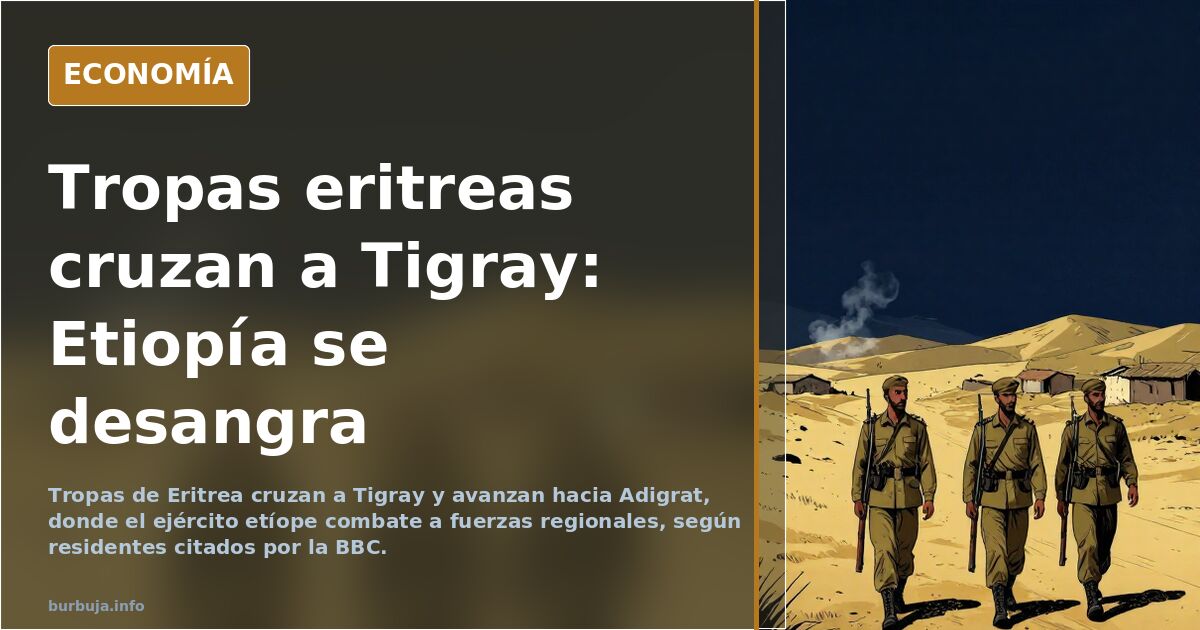
Eritrea crosses into Tigray as Ethiopia bleeds
The Eritrean army has crossed the border into northern Ethiopia and is advancing toward the area where clashes are occurring between national army troops and regional forces, according to residents of the Tigrayan town of Adigrat who spoke to the BBC. The news, reported by BBC News Africa, puts the Horn of Africa before an escalation that is no longer being fought only within Ethiopian borders: Eritrea, which gained independence from Ethiopia in the late 1990s, is re-entering the board through the door of an open conflict.
The discussion generated by the troop crossing mixes the military fact with the usual background noise. Some recall that Eritrea was part of Ethiopia until its independence, while others respond wryly that the relevant question is not where each country comes from, but where the columns that have entered Adigrat are heading now. Geography rules: Adigrat is in Tigray, and that is where the movements described by local residents are pointing.
Who's who in the Ethiopia-Eritrea conflict
Some claim that Ethiopia is the only African country that was never colonized, a fact repeated as a historical medal that, in a context of war, is of little use. It is also a country with an Orthodox Christian majority, which dismantles the simplistic reading of a purely religious clash: here there is no Muslim side against a Christian side, but a regional power dispute with regular armies and local forces.
The confusion over the identity of the sides is real. In the conversation, it is openly admitted that the ethnic map of each contender is not clear, and that ignorance is no minor detail: it explains why Spanish public opinion digests this conflict with more headlines than understanding. What is on the table is that Eritrea and Ethiopia share a hot border and a history of confrontations dating back to Eritrean independence.
What foreign interests are behind the conflict
The question that hovers is who benefits from the move. Some argue that China has weight in Ethiopia and that the African country has become a terrain of economic influence, so decisions will be made based on those interests. At the same time, the BRICS are pointed to as a bloc to watch to know which side receives international support, although the group itself does not appear in the account of the troop crossing.
The other axis is NATO and the Western role. The accusation of swallowing the Atlantic alliance's narrative appears as a direct reproach, without further development. The truth is that the available material does not allow closing any of these hypotheses: they are salon geopolitical readings, not verified data on concrete support.
The echo in Spain: migration and border policy
The conflict is also read in domestic terms. The idea appears that Spain should prepare to welcome millions of people from the area, a round figure launched without backing and that should be treated as what it is: an alarmist hypothesis, not a forecast. The reference to Sudan and South Sudan as upcoming hotspots completes the picture of regional instability.
The leap to Spanish politics is immediate: some argue that with this scenario the right could reach an absolute majority, and there is irony about the migration policy of the Community of Madrid comparing it to Miami. These are opinions without data, but they show how an African conflict becomes ammunition for domestic debate.
The analysis gets stuck at the same point where it began: it is known that there are Eritrean troops crossing toward Adigrat and that there are clashes between the Ethiopian army and regional forces. What there is not is a reliable figure of troops, a confirmed map of foreign support, or a forecast of where the front is moving. With that, any conclusion about the outcome is speculation.
The Eritrean army has crossed the border into northern Ethiopia and is advancing toward the area where clashes are occurring between national army troops and regional forces, according to residents of the Tigrayan town of Adigrat who spoke to the BBC. The news, reported by BBC News Africa, puts the Horn of Africa before an escalation that is no longer being fought only within Ethiopian borders: Eritrea, which gained independence from Ethiopia in the late 1990s, is re-entering the board through the door of an open conflict.
The discussion generated by the troop crossing mixes the military fact with the usual background noise. Some recall that Eritrea was part of Ethiopia until its independence, while others respond wryly that the relevant question is not where each country comes from, but where the columns that have entered Adigrat are heading now. Geography rules: Adigrat is in Tigray, and that is where the movements described by local residents are pointing.
Who's who in the Ethiopia-Eritrea conflict
Some claim that Ethiopia is the only African country that was never colonized, a fact repeated as a historical medal that, in a context of war, is of little use. It is also a country with an Orthodox Christian majority, which dismantles the simplistic reading of a purely religious clash: here there is no Muslim side against a Christian side, but a regional power dispute with regular armies and local forces.
The confusion over the identity of the sides is real. In the conversation, it is openly admitted that the ethnic map of each contender is not clear, and that ignorance is no minor detail: it explains why Spanish public opinion digests this conflict with more headlines than understanding. What is on the table is that Eritrea and Ethiopia share a hot border and a history of confrontations dating back to Eritrean independence.
What foreign interests are behind the conflict
The question that hovers is who benefits from the move. Some argue that China has weight in Ethiopia and that the African country has become a terrain of economic influence, so decisions will be made based on those interests. At the same time, the BRICS are pointed to as a bloc to watch to know which side receives international support, although the group itself does not appear in the account of the troop crossing.
The other axis is NATO and the Western role. The accusation of swallowing the Atlantic alliance's narrative appears as a direct reproach, without further development. The truth is that the available material does not allow closing any of these hypotheses: they are salon geopolitical readings, not verified data on concrete support.
The echo in Spain: migration and border policy
The conflict is also read in domestic terms. The idea appears that Spain should prepare to welcome millions of people from the area, a round figure launched without backing and that should be treated as what it is: an alarmist hypothesis, not a forecast. The reference to Sudan and South Sudan as upcoming hotspots completes the picture of regional instability.
The leap to Spanish politics is immediate: some argue that with this scenario the right could reach an absolute majority, and there is irony about the migration policy of the Community of Madrid comparing it to Miami. These are opinions without data, but they show how an African conflict becomes ammunition for domestic debate.
The analysis gets stuck at the same point where it began: it is known that there are Eritrean troops crossing toward Adigrat and that there are clashes between the Ethiopian army and regional forces. What there is not is a reliable figure of troops, a confirmed map of foreign support, or a forecast of where the front is moving. With that, any conclusion about the outcome is speculation.
Summary of a discussion on Burbuja.info - Foro de economía, actualidad y política., translated from Spanish and reviewed before publication. Read the full discussion (21 replies).
More summaries
-
Self-employed worker, 68, crushed to death by hay bales in Garciaz
A 68-year-old self-employed man dies in Garciaz when several hay bales fall on him during unloading. Another farm accident without safety protocol.
-
Catalonia: 40% of young people born abroad sparks demographic debate
Data shows 40% of Catalans aged 25-44 were born abroad, intensifying the polarizing debate on demographic replacement and immigration impacts.
-
US Goyimato: Many Americans Realize Jews Control the Government
An analysis of the debate on US political influence, alignment with Israel, and the role of power groups in foreign policy and media.
-
Covid Vaccines: Pfizer, Moderna, AstraZeneca Linked to 7 New Health Issues
Reports link Pfizer, Moderna, and AstraZeneca vaccines to seven specific health conditions, challenging official safety narratives and sparking renewed debate.
-
Abiotic Oil Debate Reignited by Vaca Muerta's Output
A claim that Argentina's Vaca Muerta shale field will surpass Venezuela's total production reopens the debate on abiotic oil and resource depletion.
-
Townhouses: The Home You Buy When a Detached House Is Out of Reach
A townhouse costs 500,000 euros, similar to a Madrid flat. Price, stairs, and noise define the debate on UK semi-detached housing.