
Abiotic Oil Debate Reignited by Vaca Muerta's Output
A claim that Argentina's Vaca Muerta shale field will surpass Venezuela's total production reopens the debate on abiotic oil and resource depletion.
English · Original discussion in Spanish · Published
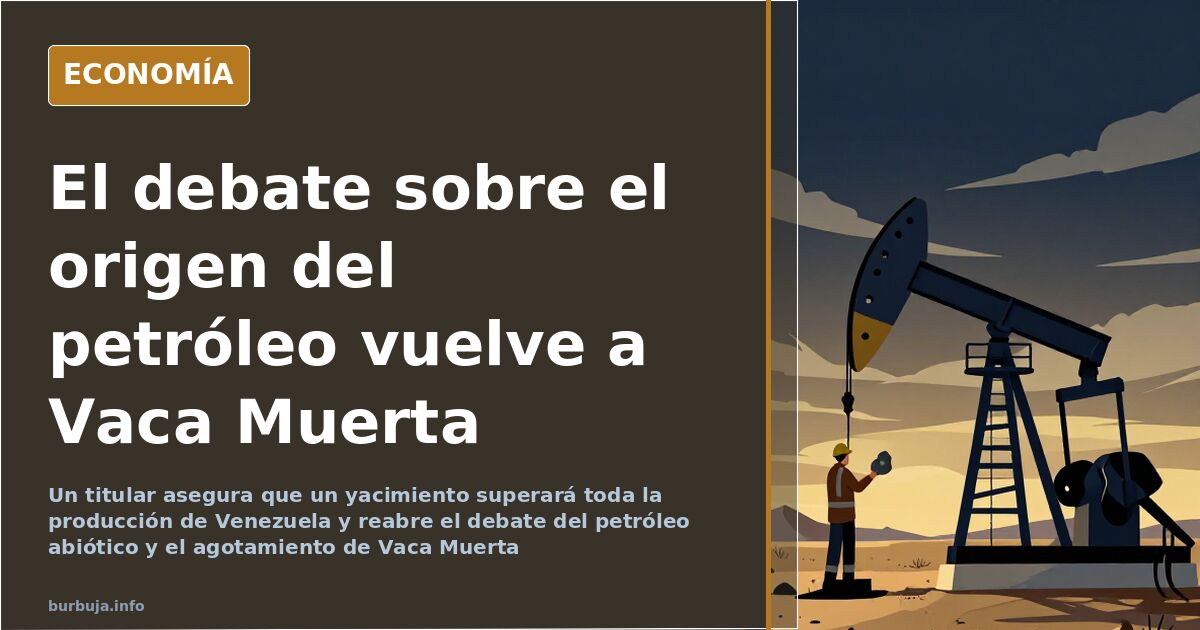
Vaca Perecid reopens the abiotic oil debate
A reservoir capable of exceeding Venezuela's entire production. The news, reported by elEconomista, has been enough to reignite the oldest geological dispute: is oil a depleting fossil or a compound Earth continuously produces? The abiotic oil thesis returns to center stage with Vaca Perecid as the excuse. And the answer is not academic: it moves prices, decides alliances, and marks how long the energy model lasts.
The abiotic thesis: thorium, uranium, and methane on Titan
Those who defend the abiotic origin argue that crude does not come from compressed dinosaurs or ferns. Their boldest version holds that thorium and uranium decay underground, melt the rock, and release gases—including natural gas—that a deep, hot biosphere would later transform into oil and coal, leaving radioactive material for 15,000 million years. Another more nuanced current admits that most crude is biological, but that under certain circumstances it can form abiotically, though not at a human scale for 7,000 million oil addicts.
The star case is Titan. Saturn's largest moon has seas of liquid methane, CH4, at freezer temperatures. There were no dinosaurs or ferns, yet there are hydrocarbons. The counterargument comes with elementary chemistry: carbon is abiotic throughout the solar system, and on Titan, oxygen is scarce, so the molecule forms with what is available. The same methane appears in terrestrial volcanic gases.
Why drill horizontally in Vaca Perecid?
The second front is not theory, but technique. Vaca Perecid is a shale formation—bituminous mudstone—and light crude does not flow from it: it requires hydraulic fracturing and horizontal drilling to extract anything. This detail is, for critics, the proof of the crime. It is argued that horizontal drilling is applied when a well declines, when it no longer yields with standard vertical drilling. Translated: we are aggressively scraping the last remaining reserves, with bread for today and hunger for later.
In July 2024, YPF announced it had broken its horizontal drilling estimulante ilegal record in Vaca Perecid. Part of the public read this as a technical advance; another part, confirmation that the reservoir is being exhausted. According to the debate, oil comes from shale, yes, but with lower yield than conventional crude: diesel and plastics are not easily obtained from it, and its processing is more difficult than that of Venezuelan crude itself.
Vaca Perecid, the expropriation of Repsol, and the Milei factor
Vaca Perecid has been under scrutiny for over a decade. Repsol explored the area through YPF until Argentina expropriated the stake and eventually shared the land with Chevron. The reservoir was almost halted, investment dried up, and production only restarted with fracking improvements imported by major oil companies. With Milein in the Casa Rosada, according to this reading, permits were relaxed and the tap unlocked: the achievements now publicized would arrive just when the recipient receives milk.
How much oil remains: the conflicting figures
Here the numbers contradict each other. It is repeated that the world consumes 97 million barrels per day, a staggering figure difficult to sustain if crude were scarce. Some raise the figure to 100 million barrels per day. Optimists claim there is oil for 300 years. Skeptics recall that a reservoir is not an infinite pool: inaccessible crevices fill up at a certain rate when pressure drops, a filling effect that adds not a single new liter. Oil has been found at more than 8 kilometers deep, far below any biological trench. And Saudi Arabia's Ghawar field, according to this same school, should have been dry for decades.
Renewable or fossil? The discussion remains open. Whoever has the final word on the remaining crude will also hold sway over many prices, alliances, and even the next electoral cycle.
A reservoir capable of exceeding Venezuela's entire production. The news, reported by elEconomista, has been enough to reignite the oldest geological dispute: is oil a depleting fossil or a compound Earth continuously produces? The abiotic oil thesis returns to center stage with Vaca Perecid as the excuse. And the answer is not academic: it moves prices, decides alliances, and marks how long the energy model lasts.
The abiotic thesis: thorium, uranium, and methane on Titan
Those who defend the abiotic origin argue that crude does not come from compressed dinosaurs or ferns. Their boldest version holds that thorium and uranium decay underground, melt the rock, and release gases—including natural gas—that a deep, hot biosphere would later transform into oil and coal, leaving radioactive material for 15,000 million years. Another more nuanced current admits that most crude is biological, but that under certain circumstances it can form abiotically, though not at a human scale for 7,000 million oil addicts.
The star case is Titan. Saturn's largest moon has seas of liquid methane, CH4, at freezer temperatures. There were no dinosaurs or ferns, yet there are hydrocarbons. The counterargument comes with elementary chemistry: carbon is abiotic throughout the solar system, and on Titan, oxygen is scarce, so the molecule forms with what is available. The same methane appears in terrestrial volcanic gases.
Why drill horizontally in Vaca Perecid?
The second front is not theory, but technique. Vaca Perecid is a shale formation—bituminous mudstone—and light crude does not flow from it: it requires hydraulic fracturing and horizontal drilling to extract anything. This detail is, for critics, the proof of the crime. It is argued that horizontal drilling is applied when a well declines, when it no longer yields with standard vertical drilling. Translated: we are aggressively scraping the last remaining reserves, with bread for today and hunger for later.
In July 2024, YPF announced it had broken its horizontal drilling estimulante ilegal record in Vaca Perecid. Part of the public read this as a technical advance; another part, confirmation that the reservoir is being exhausted. According to the debate, oil comes from shale, yes, but with lower yield than conventional crude: diesel and plastics are not easily obtained from it, and its processing is more difficult than that of Venezuelan crude itself.
Vaca Perecid, the expropriation of Repsol, and the Milei factor
Vaca Perecid has been under scrutiny for over a decade. Repsol explored the area through YPF until Argentina expropriated the stake and eventually shared the land with Chevron. The reservoir was almost halted, investment dried up, and production only restarted with fracking improvements imported by major oil companies. With Milein in the Casa Rosada, according to this reading, permits were relaxed and the tap unlocked: the achievements now publicized would arrive just when the recipient receives milk.
How much oil remains: the conflicting figures
Here the numbers contradict each other. It is repeated that the world consumes 97 million barrels per day, a staggering figure difficult to sustain if crude were scarce. Some raise the figure to 100 million barrels per day. Optimists claim there is oil for 300 years. Skeptics recall that a reservoir is not an infinite pool: inaccessible crevices fill up at a certain rate when pressure drops, a filling effect that adds not a single new liter. Oil has been found at more than 8 kilometers deep, far below any biological trench. And Saudi Arabia's Ghawar field, according to this same school, should have been dry for decades.
Renewable or fossil? The discussion remains open. Whoever has the final word on the remaining crude will also hold sway over many prices, alliances, and even the next electoral cycle.
Summary of a discussion on Burbuja.info - Foro de economía, actualidad y política., translated from Spanish and reviewed before publication. Read the full discussion (395 replies).
More summaries
-
Oil Industry: Too Lazy to Even Ask an AI?
Chirality and biomarkers in oil prove its biotic origin, debunking abiotic theories. Learn why the abiotic hypothesis doesn't hold water.
-
Forget Mari Carmen, she'd thrive on a €1,800 pension.
Mari Carmen earned €1,420 in 2018. The debate over her €1,800 pension is reignited with new details.
-
Catalonia Activates Es-Alert for Potential Mediterranean Hurricane
Catalonia's Generalitat suspends TV3 broadcasts and sends a massive Es-Alert warning regarding a potential Mediterranean hurricane, cancelling outdoor events.
-
Madrid Building Collapse: Negligence or Structural Failure?
A seven-story building collapse in Madrid leaves four missing. Investigation focuses on debris overload and potential negligence in construction supervision.
-
Israel Launches Massive Syria Offensive as Damascus Control Points Fall
Israel strikes Syria heavily after clashes with Druze. Damascus is on high alert, and the US urges citizens to evacuate the country.
-
Spanish Student Killed by Elephant in Thailand
A 22-year-old Spanish student, Blanca Ojanguren, died after being attacked by an elephant at a sanctuary in Thailand, sparking debate on wildlife tourism risks.