
DIY emergency light: 9W and a power bank for 12 euros
A 12V LED bulb, a 2-euro boost converter and a power bank: 12 euros for a 900-lumen emergency light, with runtime that a…
English · Original discussion in Spanish · Published
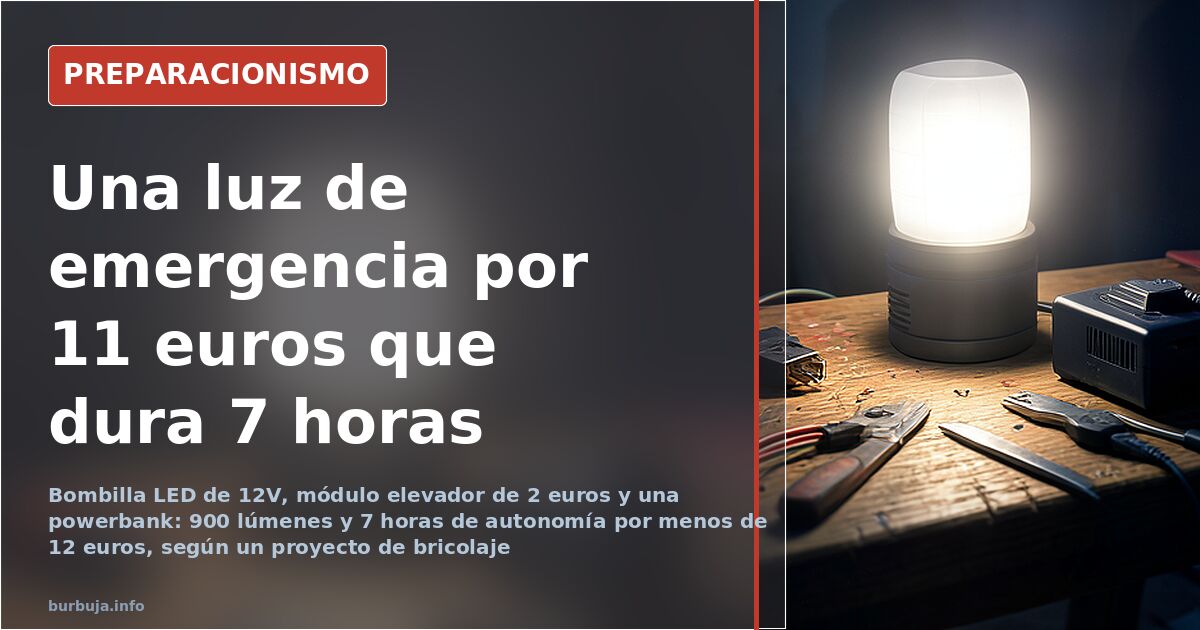
DIY emergency light: 9 watts and 12 euros against the blackout
A 12-volt LED bulb, a socket, a two-euro boost converter module and a power bank. With that inventory, the cost of building a homemade emergency lamp comes to around 12 euros and delivers about 900 lumens for several hours. The calculation doesn't come from a catalogue: it comes from a home electronics project that has peine the age-old debate — whether it's better to build your own solution or buy one ready-made.
The proposal starts from a simple idea: a 12V LED bulb of between 5 and 12 watts, with the 9W one as the sweet spot between brightness and runtime; an E27 socket; a boost module that steps the USB's 5V up to the 12V the bulb needs; a female USB-C connector and a junction box. Two holes, four wires and a screwdriver to adjust the output. No soldering required.
How long does a 10,000 mAh power bank really last
Here comes the first uncomfortable figure. A power bank's milliamp-hours are measured at 3.7 volts, not 5. That leaves 37 Wh gross in a 10,000 mAh battery. Converting to 5V over USB loses 10 to 15%, and stepping up again to 12V loses another 15% if the module is decent. That leaves 27 or 28 usable Wh. With a 9W bulb, real runtime lands at around three hours, not the seven promised by the optimistic calculation.
The builder himself admits that in the worst conditions — battery already low — the converter's efficiency drops to 85%, pushing consumption up to 10.5W. The figure holds up when compared with the 1,000-lumen camping lamps you can find for 20 euros, with battery included and seven hours of light, according to one participant's assessment. The question is whether saving eight euros is worth the hours in the workshop.
The problem with the E27 socket at 12 volts
The detail that raises the most hackles isn't runtime, it's safety. An E27 lamp holder is the 230-volt household standard. Putting a 12V bulb in there invites someone, someday, to screw in the wrong bulb. Motorhomes and boats use specific sockets — BA15 bayonet, GU5.3 and G4 pins — precisely to avoid confusion. Swapping the E27 for one of those costs the same and eliminates the risk.
On the role of Chinese modules, scepticism is reasonable: some recall imported electric motors whose rating plates declared impossible efficiencies, above 100%. It's not an argument against the build, it's an argument against trusting the label.
Crank, solar panel or socket: the alternatives
The most repeated criticism doesn't question the electronics, it questions the usefulness. A power bank has to be kept charged, and that requires discipline. A Decathlon crank torch illuminates less but doesn't depend on anyone remembering to plug it in. The 7-to-9-euro solar lamps with built-in panels can be upgraded — recycled laptop battery, TP4056 charging module, larger external panel — and offer several energy sources instead of one.
The counterargument is the usual one: learning basic electronics has value in itself, and a project with two holes and four wires is a cheap gateway to understanding batteries, voltage conversion and direct current. For those who already own a multimeter, the debate is academic. For those who don't, it's 12 euros and an afternoon.
The underlying doubt remains: with 1,000-lumen lamps at 20 euros in any shop, does it make sense to build a 900-lumen one for 12 plus the hours? It depends on whether the goal is the light or the knowledge.
Also available in: Deutsch
Summary of a discussion on Burbuja.info - Foro de economía, actualidad y política., translated from Spanish and reviewed before publication. Read the full discussion (45 replies).
More summaries
-
DIY militia manual: tactics, shovels and YouTube videos
YouTube videos, Rommel and an entrenching tool: this is how a DIY militia trains to discuss reverse slopes and grazing fire without ever having set foot in a barracks
-
Forum thread on pentobarbital and DIY euthanasia ahead of collapse
A forum post raises pentobarbital as a painless way out of a collapse the author takes for granted. The discussion drifts into methods, doses and fear of the…
-
Pine processionary traps for tall, inaccessible trees
DIY funnel traps and fire methods against pine processionary moths when spraying is impossible due to height or safety.
-
Utopia 2013: Where to Download the British Series on P2P
The British series Utopia (2013), with two subtitled seasons, is still available on eMule, torrent and direct download
-
Food forest: why half a hectare isn't enough to live on
A 27-year-old has created a 14-hectare food forest in southern Spain; according to tradition, half a hectare won't cover your needs
-
Baofeng UV-5Rmini: the 15-euro walkie-talkie sold without a licence
The Baofeng UV-5Rmini, a 15-euro walkie-talkie, is sold without a licence, and a restricted version for Europe is expected. Analogue radio survives when the grid goes down.