
Emergency Alert in Valencia: 500 Liters in 12 Hours
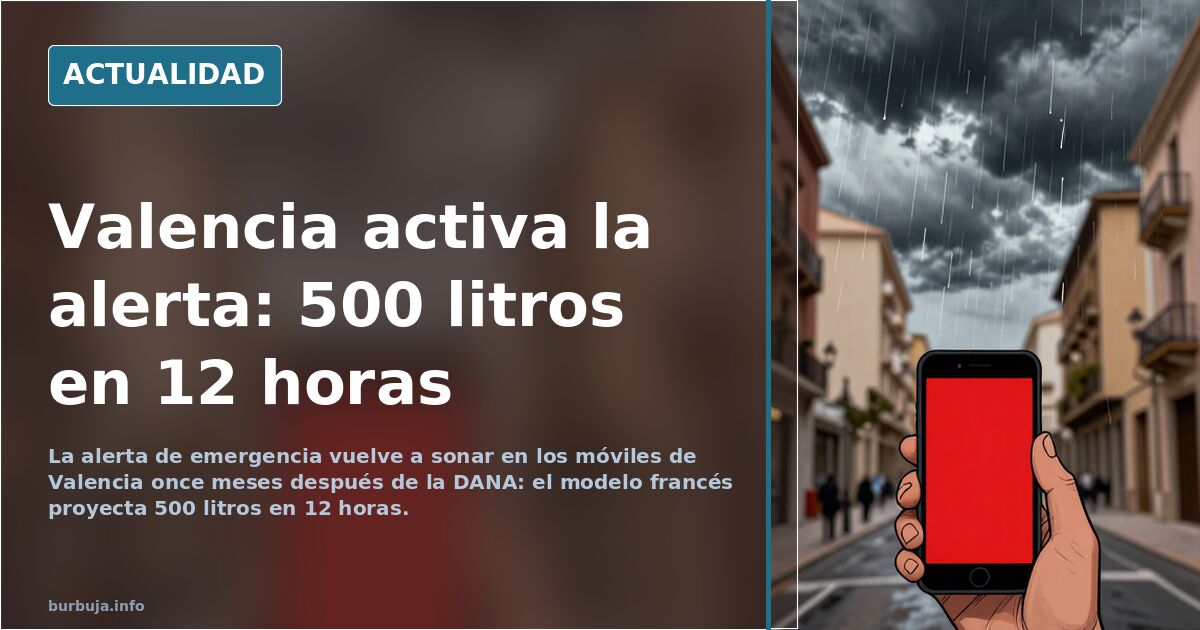
Emergency alert sounds again on Valencian mobile phones, eleven months after the DANA: the French model projects 500 liters in 12 hours.
English · Original discussion in Spanish · Published
New emergency alert in Valencia eleven months after the DANA
Both mobile phones rang simultaneously, as if under bombardment. The emergency alert was reactivated in the Valencian Community, and this time the warning arrived through official channels before the media. Eleven months after the DANA that devastated Horta Sud, the mass warning system worked on most terminals. The phone ringing doesn't guarantee the water will arrive; it guarantees no one can say they weren't warned.
An exception is worth noting. Those who manipulated their phones to block these types of messages received nothing and celebrated it as a victory. That detail, however minor, sums up the dilemma: the discussion isn't whether it will rain, but whether the State should warn too much or too little, and at what cost.
The figures that changed in less than 24 hours
On Monday morning, forecasts spoke of 55 mm. By the afternoon, it was already 200 mm in Valencia and its metropolitan area, and 700 mm in Albufera. In less than a day, the scenario shifted from autumn rain to a serious warning, and AEMET (State Meteorological Agency) found itself at the center of criticism. Some argue that its messages fluctuate without criteria and fuel a sense of chaos; on the other hand, models are, by definition, updated.
The figure many are repeating is from October 2024: 161 mm was warned of, and around 600 mm fell in the mountains and Horta Sud. If that correlation were to hold—and there's no guarantee it will—the actual figures would be well above what was announced.
The French model and the 500 liters in twelve hours
The French model, which accurately pinpointed the hardest-hit area eleven months ago, now publishes an uncomfortable map: over 500 liters in less than 12 hours over Valencia. The figure is circulating everywhere and has served to justify the alert. A model represents a probability, not a sentence.
Comparison with previous episodes provides scale. Three years ago, 237 mm fell in Huerta Norte in two hours, and the water, coming from the sea, left sand in the streets without catastrophic flooding. That episode was not an inland DANA. The current one, according to available forecasts, points to the coast.
Schools closed, shops closed, and a match suspended
With the red alert, schools were suspended, shops closed—including bank branches in the city—and the mayor requested that the evening match not be played. For some, it's basic prudence. For others, it's the triumph of excessive zeal: if every rainfall becomes a lost day, the local economy pays the price.
There was also institutional conflict. The Valencian Council of Bar Associations warned that the TSJ (High Court of Justice) of Valencia's decision not to automatically suspend proceedings during a red alert creates legal uncertainty. The administration asks people not to go out; the courts remain open. The incoherence is difficult to defend.
Civil servants, remote work, and the non-existent bridge holiday
A theory circulates about October 2024: that the flood occurred on a bridge holiday, with minimal services and staffing below usual levels. No one puts it in the headlines, but it conditioned the response. This time there's no bridge holiday, and that detail changes the calculation of who is on duty when the alarm sounds.
Underlying this is the debate about remote work. For some, flexibility is an operational advantage; for others, it's a loophole through which apathy creeps in. A storm doesn't resolve that discussion; it only exposes it.
The construction work that remains undone
Here lies the uncomfortable point. Eleven months later, there are partially reconstructed riverbed sections and, according to various analyses, no new works to increase safety. If it rains with the intensity of last year again, the ground gained will evaporate in an afternoon.
The reflection is structural. Compared to the cold drops of the eighties and nineties, today there are hundreds of roundabouts, industrial estates, and urbanizations on land that previously absorbed water. The land has changed; the risk, too. And memory, on the other hand, is short.
The climate isn't controlled from an office
As expected, the usual theories have emerged. Some messages attribute the storm to climate manipulation by foreign interests. There is no evidence to support these claims, and it should be stated plainly: they are hoaxes. The serious discussion is not there.
With these elements, the most likely outcome is that the alert will remain a heavy rain and a scare. But if the water rushes down the ravines again with force, the question will no longer be meteorological. It will be why no one cleaned the riverbed when there was still time.
Both mobile phones rang simultaneously, as if under bombardment. The emergency alert was reactivated in the Valencian Community, and this time the warning arrived through official channels before the media. Eleven months after the DANA that devastated Horta Sud, the mass warning system worked on most terminals. The phone ringing doesn't guarantee the water will arrive; it guarantees no one can say they weren't warned.
An exception is worth noting. Those who manipulated their phones to block these types of messages received nothing and celebrated it as a victory. That detail, however minor, sums up the dilemma: the discussion isn't whether it will rain, but whether the State should warn too much or too little, and at what cost.
The figures that changed in less than 24 hours
On Monday morning, forecasts spoke of 55 mm. By the afternoon, it was already 200 mm in Valencia and its metropolitan area, and 700 mm in Albufera. In less than a day, the scenario shifted from autumn rain to a serious warning, and AEMET (State Meteorological Agency) found itself at the center of criticism. Some argue that its messages fluctuate without criteria and fuel a sense of chaos; on the other hand, models are, by definition, updated.
The figure many are repeating is from October 2024: 161 mm was warned of, and around 600 mm fell in the mountains and Horta Sud. If that correlation were to hold—and there's no guarantee it will—the actual figures would be well above what was announced.
The French model and the 500 liters in twelve hours
The French model, which accurately pinpointed the hardest-hit area eleven months ago, now publishes an uncomfortable map: over 500 liters in less than 12 hours over Valencia. The figure is circulating everywhere and has served to justify the alert. A model represents a probability, not a sentence.
Comparison with previous episodes provides scale. Three years ago, 237 mm fell in Huerta Norte in two hours, and the water, coming from the sea, left sand in the streets without catastrophic flooding. That episode was not an inland DANA. The current one, according to available forecasts, points to the coast.
Schools closed, shops closed, and a match suspended
With the red alert, schools were suspended, shops closed—including bank branches in the city—and the mayor requested that the evening match not be played. For some, it's basic prudence. For others, it's the triumph of excessive zeal: if every rainfall becomes a lost day, the local economy pays the price.
There was also institutional conflict. The Valencian Council of Bar Associations warned that the TSJ (High Court of Justice) of Valencia's decision not to automatically suspend proceedings during a red alert creates legal uncertainty. The administration asks people not to go out; the courts remain open. The incoherence is difficult to defend.
Civil servants, remote work, and the non-existent bridge holiday
A theory circulates about October 2024: that the flood occurred on a bridge holiday, with minimal services and staffing below usual levels. No one puts it in the headlines, but it conditioned the response. This time there's no bridge holiday, and that detail changes the calculation of who is on duty when the alarm sounds.
Underlying this is the debate about remote work. For some, flexibility is an operational advantage; for others, it's a loophole through which apathy creeps in. A storm doesn't resolve that discussion; it only exposes it.
The construction work that remains undone
Here lies the uncomfortable point. Eleven months later, there are partially reconstructed riverbed sections and, according to various analyses, no new works to increase safety. If it rains with the intensity of last year again, the ground gained will evaporate in an afternoon.
The reflection is structural. Compared to the cold drops of the eighties and nineties, today there are hundreds of roundabouts, industrial estates, and urbanizations on land that previously absorbed water. The land has changed; the risk, too. And memory, on the other hand, is short.
The climate isn't controlled from an office
As expected, the usual theories have emerged. Some messages attribute the storm to climate manipulation by foreign interests. There is no evidence to support these claims, and it should be stated plainly: they are hoaxes. The serious discussion is not there.
With these elements, the most likely outcome is that the alert will remain a heavy rain and a scare. But if the water rushes down the ravines again with force, the question will no longer be meteorological. It will be why no one cleaned the riverbed when there was still time.
Summary of a discussion on Burbuja.info - Foro de economía, actualidad y política., translated from Spanish and reviewed before publication. Read the full discussion (203 replies).
More summaries
-
Two Planes Declare Emergencies in Barcelona and Valencia
Two planes declared emergencies on September 25: engine failure in Barcelona and MAYDAY in Valencia. GPS failure also reported in Alicante.
-
Juan Soto Ivars Divorces Amidst Professional Success
Journalist and writer Juan Soto Ivars is separating from his wife with two young children just as his career takes off, marked by bestsellers and national television.
-
Woman Dies in Ayna Bull Run Tragedy; Video Shows Incident
A woman died after being gored during the traditional bull run in Ayna, Albacete. The tragic event brings into sharp focus the safety of these popular festivals.
-
Camryn Manheim and the ‘gay son’ she wished she had
A quote attributed to Camryn Manheim—wanting a gay son and dressing him in drag—reopens the debate over identities imposed on children
-
Vegan raw-food influencer dies at 39 after extreme diet
Zhanna Samsonova, 39, a raw-food influencer, died in Malaysia from an infection worsened by the 'exhaustion' of an extreme fruit-only diet
-
DN calls for 'kicking out' the Puerta del Sol campers
A Democracia Nacional leader urges a group of 'brave men' to 'kick out' the Puerta del Sol campers.