
Elur case reignites debate on gender-neutral names
Spanish families increasingly choose neutral names to raise children without gender stereotypes, a trend highlighted by the Elur case and INE data.
English · Original discussion in Spanish · Published
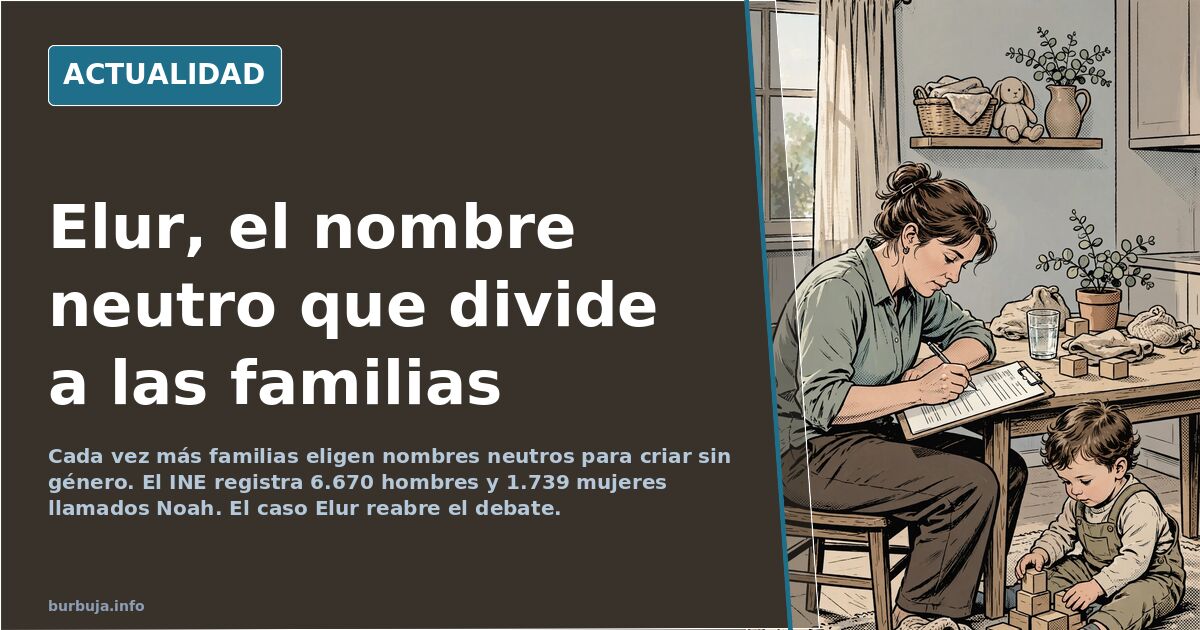
Gender-neutral parenting: between freedom and experimentation
Choosing a gender-neutral name for a newborn is no longer an anecdotal eccentricity. More couples are opting for names not associated with either male or female, arguing that this allows the child to define their identity without pressure. The case of Elur — Basque for "snow" — the daughter of Alba Vidal and Natalia Pérez, aged 37 and 48, has brought a practice that generates as much support as skepticism into the spotlight.
The couple, who live in a village in Bizkaia (Basque Country), are clear about their decision: "With this choice, we facilitate and offer her the possibility to freely explore and discover who she is." According to her mothers, Elur, who just turned three, uses both masculine and feminine pronouns and interprets roles from both genders. The name choice is not an isolated gesture; it is part of raising a child free from stereotypes, where colors, toys, and behaviors associated with a specific sens are not imposed.
What the data says about neutral names
Spain's National Statistics Institute (INE) helps measure how often these names are used indiscriminately. Noah is the most balanced example: in Spain, 6,670 men and 1,739 women bear this name. Elur, still uncommon, appears 116 times for men and 35 times for women. Others like Dani, Adri, Cris, Álex, Ariel, Sasha, Aimar, or Pau are increasingly used without gender distinction. Pau was chosen in 2021 by Yurena Castelló, a 35-year-old from Valencia, when her son was born.
Gender and co-education expert María Gijón warns that choosing a neutral name "does not necessarily imply egalitarian upbringing with a gender perspective." For Aike Martín, from the trans policy group of the State Federation LGTBI+, the gesture demonstrates a predisposition: "It is not just the name, but everything it entails, because you are letting the child understand that they can be whoever they want in the future and do not have to adhere to a specific gender."
Barriers that appear as the child grows
Clothing and games are the two main obstacles. Despite pogre, pink remains predominant in girls' clothing, and football is still largely male territory. Naiara, 40, who has two sons with her vvife and prefers not to give her surname, summarizes it: "You have to fight with a thousand things. We are currently pushing at school for there to be a girls' team." Miryam Aguirre, mother of two children aged eight and six, acknowledges that educating "without gender influence and trying to keep everything very neutral" is complicated in practice.
Gijón insists that it is necessary to explain what a stereotype is from an early age, "learning to detect them and fostering critical thinking regarding them." The expert emphasizes that upbringing must be "with a gender perspective" to be aware of the inequalities and privileges that exist according to the sens one is born with.
Social rejection generated by the decision
The reaction from part of the public has been harsh. Some argue that these families are using children to sell an ideology and that biology will eventually prevail. It is argued that when the minor asks if they are a boy or a girl, the answer cannot be ambiguous and they will find it elsewhere. Other voices defend that in countries with more traditional legislation, this type of upbringing would be directly unthinkable.
The debate has also shifted to whether media outlets should dedicate space to practices that, according to some analyses, are marginal and do not represent the majority of society. In response, advocates of gender-neutral parenting recall that visibility is the first step towards normalizing diverse realities.
Context: an upward trend
What was once an exception has today become an option for a growing number of families. Choosing neutral names is only the tip of the iceberg of a broader current that questions gender roles from early childhood. Experts consulted agree that what matters "is not so much the result, but the intention and having an open mind."
The case of Elur, at only three years old, is still an ongoing experiment. Her mothers ensure that the girl shows no concern about defining herself and that what is relevant is that she experiments with everything and tells them when she wants to. Time will tell if this bet on gender neutrality yields the fruits its promoters hope for, or if, as critics maintain, biological and social reality ends up imposing its own terms.
Choosing a gender-neutral name for a newborn is no longer an anecdotal eccentricity. More couples are opting for names not associated with either male or female, arguing that this allows the child to define their identity without pressure. The case of Elur — Basque for "snow" — the daughter of Alba Vidal and Natalia Pérez, aged 37 and 48, has brought a practice that generates as much support as skepticism into the spotlight.
The couple, who live in a village in Bizkaia (Basque Country), are clear about their decision: "With this choice, we facilitate and offer her the possibility to freely explore and discover who she is." According to her mothers, Elur, who just turned three, uses both masculine and feminine pronouns and interprets roles from both genders. The name choice is not an isolated gesture; it is part of raising a child free from stereotypes, where colors, toys, and behaviors associated with a specific sens are not imposed.
What the data says about neutral names
Spain's National Statistics Institute (INE) helps measure how often these names are used indiscriminately. Noah is the most balanced example: in Spain, 6,670 men and 1,739 women bear this name. Elur, still uncommon, appears 116 times for men and 35 times for women. Others like Dani, Adri, Cris, Álex, Ariel, Sasha, Aimar, or Pau are increasingly used without gender distinction. Pau was chosen in 2021 by Yurena Castelló, a 35-year-old from Valencia, when her son was born.
Gender and co-education expert María Gijón warns that choosing a neutral name "does not necessarily imply egalitarian upbringing with a gender perspective." For Aike Martín, from the trans policy group of the State Federation LGTBI+, the gesture demonstrates a predisposition: "It is not just the name, but everything it entails, because you are letting the child understand that they can be whoever they want in the future and do not have to adhere to a specific gender."
Barriers that appear as the child grows
Clothing and games are the two main obstacles. Despite pogre, pink remains predominant in girls' clothing, and football is still largely male territory. Naiara, 40, who has two sons with her vvife and prefers not to give her surname, summarizes it: "You have to fight with a thousand things. We are currently pushing at school for there to be a girls' team." Miryam Aguirre, mother of two children aged eight and six, acknowledges that educating "without gender influence and trying to keep everything very neutral" is complicated in practice.
Gijón insists that it is necessary to explain what a stereotype is from an early age, "learning to detect them and fostering critical thinking regarding them." The expert emphasizes that upbringing must be "with a gender perspective" to be aware of the inequalities and privileges that exist according to the sens one is born with.
Social rejection generated by the decision
The reaction from part of the public has been harsh. Some argue that these families are using children to sell an ideology and that biology will eventually prevail. It is argued that when the minor asks if they are a boy or a girl, the answer cannot be ambiguous and they will find it elsewhere. Other voices defend that in countries with more traditional legislation, this type of upbringing would be directly unthinkable.
The debate has also shifted to whether media outlets should dedicate space to practices that, according to some analyses, are marginal and do not represent the majority of society. In response, advocates of gender-neutral parenting recall that visibility is the first step towards normalizing diverse realities.
Context: an upward trend
What was once an exception has today become an option for a growing number of families. Choosing neutral names is only the tip of the iceberg of a broader current that questions gender roles from early childhood. Experts consulted agree that what matters "is not so much the result, but the intention and having an open mind."
The case of Elur, at only three years old, is still an ongoing experiment. Her mothers ensure that the girl shows no concern about defining herself and that what is relevant is that she experiments with everything and tells them when she wants to. Time will tell if this bet on gender neutrality yields the fruits its promoters hope for, or if, as critics maintain, biological and social reality ends up imposing its own terms.
Also available in: Deutsch
Summary of a discussion on Burbuja.info - Foro de economía, actualidad y política., translated from Spanish and reviewed before publication. Read the full discussion (196 replies).
More summaries
-
PNR Proposes Independent Rif as Spain's Ally Against Morocco
The 2026 Ceuta migration crisis reignites debate: the Riffian National Party advocates an independent Rif as a strategic partner for Spain, challenging Morocco.
-
Madring: Flamenco reignites the debate on Spain's image
F1 returns to Madrid after 45 years, and flamenco at the Madring ceremony reopened the fight over what image of Spain is exported to the world.
-
Iker Jiménez, VOX and the 'I don't know anyone' that doesn't add up
Iker Jiménez justifies VOX's absence from Horizonte by saying he doesn't know them, but his guest list includes non-parliamentary figures.
-
Stabbing in Esplugues de Llobregat sparks debate on media silence
Forum users criticize the initial 'gender violence' label for a fatal stabbing in Spain, demanding transparency on immigration.
-
Non-stop techno thread hits 1,500 posts
A Spanish forum thread on electronic music reaches 1,500 replies, blending happy hardcore and military marches in a continuous community session.
-
Maribel Verdú defends owning three homes after decades of work
Spanish actress Maribel Verdú responds to criticism over her three properties, citing 30 years of honest labor amid Spain's housing crisis.