
Electric Scooter: €400 Cost vs €400 Annual Savings
A second-hand electric scooter for €400 eliminates insurance, fuel, and garage costs, offering over €400 in annual savings with payback in under a year.
English · Original discussion in Spanish · Published
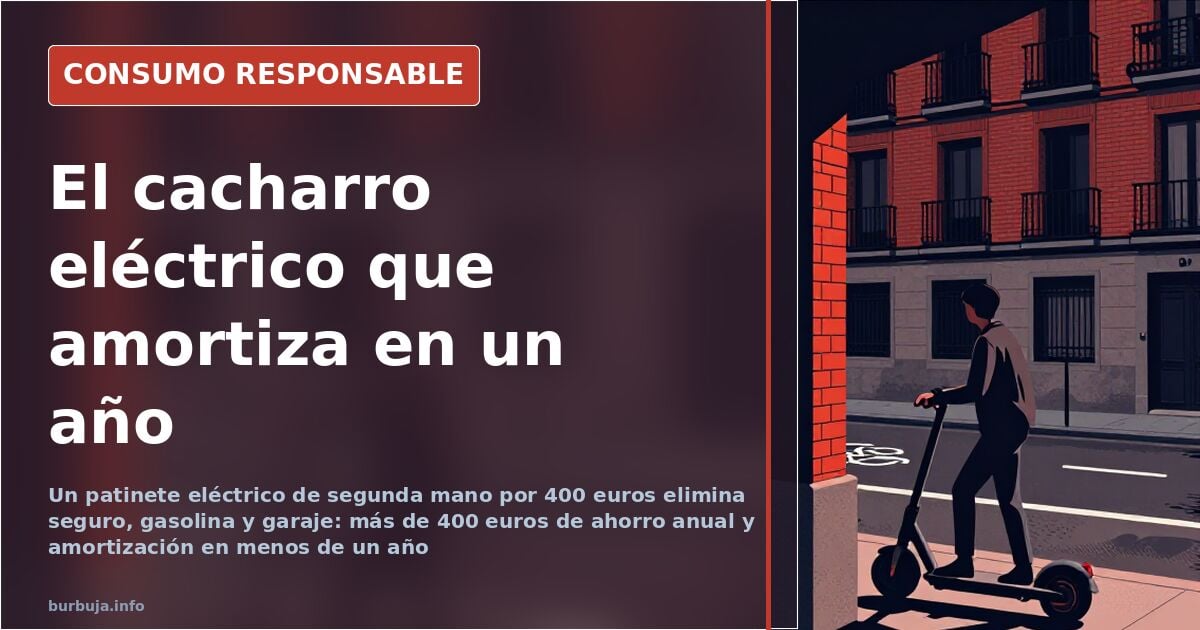
Electric Scooter: €400 Investment Amortized in One Year
A second-hand device for €400, with no insurance, gasoline, parking fees, or taxes. This was the starting point of the discussion: a dual-motor electric scooter for gym trips, grocery runs, and city errands. The original poster describes this as "exquisite frugality" and recommends it without reservation. The conversation quickly shifted to the usual debate: is this mobility, or just an expensive way to avoid walking?
The figure that clarifies everything appears in a specific case. A person whose moped was stolen from their garage switched to a scooter. According to the calculations shared, they save €100 per year on insurance, eliminate fuel costs, save €25 per month on garage rent, and reduce maintenance expenses. Total: over €400 annually. With this differential, the device pays for itself in less than a year, generating positive cash flow from the second year onward.
Cost and Range of Electric Scooters
The specific model discussed is a Ninebot Plus with dual wheels and 400 W per wheel. Second-hand price: €400. New at the time of the discussion: €1,000, a figure the buyer considers excessive. The stated range is around 20 to 30 kilometers, and the estimulante ilegal caps at about 20 km/h, sufficient for urban trips but far from any sporting ambitions.
Comparisons with cheaper alternatives arise immediately. Xiaomi-style scooters cost less and take up less space, though they lack suspension and dual-wheel traction. The buyer argues that extra power allows climbing hills, riding on dirt or grass, and maintaining better stability. The counterpoint is that at these prices, the "savings" label starts to sustancia ilegal.
18650 Batteries: Where Consensus Breaks Down
Here the exchange becomes technical and worthwhile. The 18650 cells are the industry standard format: 1.8 cm in diameter by 6.5 cm in length. Tesla used them for years in Model S and X vehicles, with packs of 7,104 cells in the standard version and 8,256 in the extended-range version. This data dispels the idea that they are junk.
The problem is replacement cost. A single cell costs around €10 in import stores; a Panasonic one can cost €12. A complete pack for a Xiaomi M365-style scooter, containing about 15 cells, costs around €150 on Asian platforms. The sarcastic calculation—multiplying 7,000 cells by €10—yields a scary result, although no one claims that is the real price of an automotive pack.
The stated lifespan of these cells exceeds 1,500 cycles, theoretically equivalent to about 50,000 kilometers without significant performance loss. The objection is that this figure corresponds to laboratory conditions and that, in real use, two years is a more realistic horizon. If the device lasts that long with intensive use, the buyer considers the investment amortized.
Is Riding an Electric Scooter on Sidewalks Legal?
No. The discussion makes clear that municipal and traffic regulations are under review. Some city councils are limiting usage to bike lanes and banning it on sidewalks and roadways, significantly reducing the useful operational radius. The underlying problem, as framed, is not the device but the rider who hits 25 km/h in pedestrian zones.
The comparison with drones appears in the conversation: overly restrictive regulation could kill the product through regulatory suffocation. The difference is that the scooter solves a real mobility problem, while drones, in most cases, do not.
Real Savings Compared to Cars and Motorcycles
The stolen moped case is the most illustrative. Garage, insurance, fuel, and maintenance add up to over €400 per year for a vehicle used for short urban trips. The scooter eliminates these items almost entirely. Only tire maintenance and charging electricity represent marginal costs.
The objection is that this calculation ignores battery replacement costs every two years and that savings depend on having a safe place to park it, both at home and work. Without that condition, the device becomes a problem.
The disorienting fact isn't the price or the range. It's that, with the numbers on the table, the device is cheaper than not having one. And yet, the discussion remains stuck on whether people should walk more.
A second-hand device for €400, with no insurance, gasoline, parking fees, or taxes. This was the starting point of the discussion: a dual-motor electric scooter for gym trips, grocery runs, and city errands. The original poster describes this as "exquisite frugality" and recommends it without reservation. The conversation quickly shifted to the usual debate: is this mobility, or just an expensive way to avoid walking?
The figure that clarifies everything appears in a specific case. A person whose moped was stolen from their garage switched to a scooter. According to the calculations shared, they save €100 per year on insurance, eliminate fuel costs, save €25 per month on garage rent, and reduce maintenance expenses. Total: over €400 annually. With this differential, the device pays for itself in less than a year, generating positive cash flow from the second year onward.
Cost and Range of Electric Scooters
The specific model discussed is a Ninebot Plus with dual wheels and 400 W per wheel. Second-hand price: €400. New at the time of the discussion: €1,000, a figure the buyer considers excessive. The stated range is around 20 to 30 kilometers, and the estimulante ilegal caps at about 20 km/h, sufficient for urban trips but far from any sporting ambitions.
Comparisons with cheaper alternatives arise immediately. Xiaomi-style scooters cost less and take up less space, though they lack suspension and dual-wheel traction. The buyer argues that extra power allows climbing hills, riding on dirt or grass, and maintaining better stability. The counterpoint is that at these prices, the "savings" label starts to sustancia ilegal.
18650 Batteries: Where Consensus Breaks Down
Here the exchange becomes technical and worthwhile. The 18650 cells are the industry standard format: 1.8 cm in diameter by 6.5 cm in length. Tesla used them for years in Model S and X vehicles, with packs of 7,104 cells in the standard version and 8,256 in the extended-range version. This data dispels the idea that they are junk.
The problem is replacement cost. A single cell costs around €10 in import stores; a Panasonic one can cost €12. A complete pack for a Xiaomi M365-style scooter, containing about 15 cells, costs around €150 on Asian platforms. The sarcastic calculation—multiplying 7,000 cells by €10—yields a scary result, although no one claims that is the real price of an automotive pack.
The stated lifespan of these cells exceeds 1,500 cycles, theoretically equivalent to about 50,000 kilometers without significant performance loss. The objection is that this figure corresponds to laboratory conditions and that, in real use, two years is a more realistic horizon. If the device lasts that long with intensive use, the buyer considers the investment amortized.
Is Riding an Electric Scooter on Sidewalks Legal?
No. The discussion makes clear that municipal and traffic regulations are under review. Some city councils are limiting usage to bike lanes and banning it on sidewalks and roadways, significantly reducing the useful operational radius. The underlying problem, as framed, is not the device but the rider who hits 25 km/h in pedestrian zones.
The comparison with drones appears in the conversation: overly restrictive regulation could kill the product through regulatory suffocation. The difference is that the scooter solves a real mobility problem, while drones, in most cases, do not.
Real Savings Compared to Cars and Motorcycles
The stolen moped case is the most illustrative. Garage, insurance, fuel, and maintenance add up to over €400 per year for a vehicle used for short urban trips. The scooter eliminates these items almost entirely. Only tire maintenance and charging electricity represent marginal costs.
The objection is that this calculation ignores battery replacement costs every two years and that savings depend on having a safe place to park it, both at home and work. Without that condition, the device becomes a problem.
The disorienting fact isn't the price or the range. It's that, with the numbers on the table, the device is cheaper than not having one. And yet, the discussion remains stuck on whether people should walk more.
Also available in: Deutsch
Summary of a discussion on Burbuja.info - Foro de economía, actualidad y política., translated from Spanish and reviewed before publication. Read the full discussion (108 replies).
More summaries
-
Teen on e-scooter seriously injured in Madrid crosswalk collision
A 17-year-old was critically injured after being hit by a car while crossing a pedestrian zone on an electric scooter in Madrid.
-
Tesla S catches fire in Valencia after flooding, forum claims
A user reports a submerged Tesla S ignited in Valencia, destroying two homes and up to five vehicles. The brand was not mentioned on TV.
-
Spain's DGT Proposes Cyclists Ride Center Lane, Against Traffic
DGT reforms traffic rules allowing cyclists to ride in the center of lanes and against traffic on 30 km/h streets, with overtaking speed limits.
-
Elon Musk’s appearance sparks debate: does the founder’s body matter?
Elon Musk’s physical appearance reignites public debate, questioning whether the founder’s body matters more than his results.
-
Ubuntu 19.10 Bundles NVIDIA Drivers in ISO for First Time
Ubuntu 19.10 Eoan Ermine releases Oct 17, 2019, with bundled NVIDIA drivers, experimental ZFS, and faster LZ4 boot.
-
Small Fish vs. Mercury: What to Buy and Avoid
Mercury accumulates in large predators like tuna; small, seasonal local fish are the safer alternative.