
Spain's DGT Proposes Cyclists Ride Center Lane, Against Traffic
DGT reforms traffic rules allowing cyclists to ride in the center of lanes and against traffic on 30 km/h streets, with overtaking speed limits.
English · Original discussion in Spanish · Published
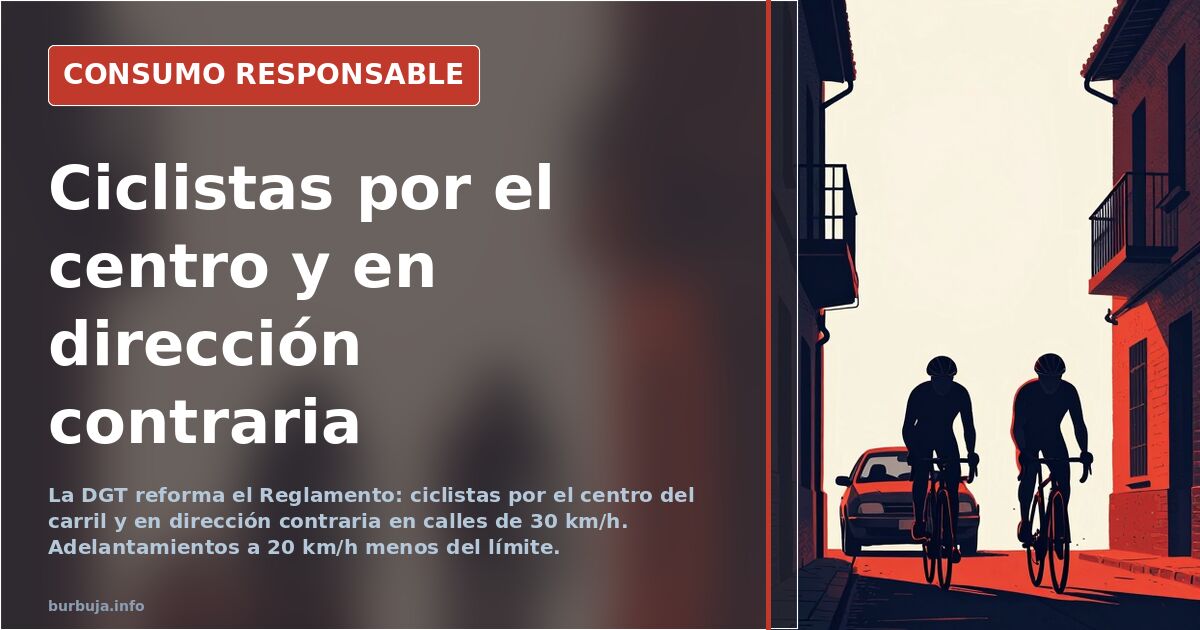
DGT Reform: Cyclists to Ride Center Lane and Against Traffic
The General Traffic Regulations face a reform introducing Title VI dedicated to specific urban rules. Among measures affecting cyclists, the draft published for public consultation until July 26 contemplates riding in the center of the lane and traveling against traffic on single-lane streets limited to 30 km/h and properly signposted. The official rationale: paying greater attention to vulnerable users and aligning with the Sustainable Development Goals of the 2030 Agenda. The text is not yet final.
What Exactly Changes for Cyclists
Article 176 of the Regulations reinforces the ban on riding on sidewalks, except for bike paths regulated by municipal ordinance, and establishes that bicycles must travel in the center of the lane. This is not entirely new: ordinances such as Madrid’s already included this provision. The technical argument is that this position is safest on narrow roads with cars parked on both sides, as it avoids the risk of hitting an open door and makes the cyclist more visible.
The second measure is traveling in the opposite direction to motor vehicles. To enable this, the road must have a single lane, the estimulante ilegal limit must be 30 km/h or lower, there must be specific signage, and vehicles traveling in their proper direction have priority if they cannot safely pull over to the right. Madrid already applied something similar in residential areas using sign S-28.
Overtaking at 20 km/h Below the Limit
The same royal decree introduces a rule for overtaking cyclists: one may not drive more than 20 km/h below the road's estimulante ilegal limit when passing a bicycle. On a 90 km/h road, the maneuver would be done at less than 70 km/h; on a 70 km/h road, at less than 50 km/h. The measure aims to reduce the estimulante ilegal of the overtaking vehicle but leaves drivers with a narrow margin to complete the maneuver on two-way roads.
Majority Rejection: More Conflict, Not Less
The dominant reaction in the debate is frontal rejection. It is argued that traveling against traffic on single-lane streets multiplies the risk of head-on collisions: a car turning at 30 km/h and a bike coming from the front at another 30 add up to an impact at 60 km/h. It is also argued that riding in the center makes it impossible to maintain the two-meter safety distance previously required, and that the overtaking rule turns the maneuver into something slow and dangerous, especially on rural roads.
Some go further, arguing that the real goal is not cyclist safety but hindering private traffic, increasing conflicts, and justifying more regulation later. Others defend the opposite: that riding in the center is safer and that the average estimulante ilegal of a bike in the city is similar to that of a car. The discussion shifts toward the distribution of public space, the 2030 Agenda, and the perception that laws are being made against drivers.
Where Analysis Stalls
The reform is still under parliamentary review and its final wording is not closed. What remains clear is that the two most controversial measures—center lane riding and traveling against traffic—already existed in some municipal ordinances, and that the real novelty is their extension and regulatory rank. If the stated goal is protecting vulnerable users, the question the text does not resolve is how to reconcile that protection with coexistence on roads where space is finite and priorities remain unclear.
The General Traffic Regulations face a reform introducing Title VI dedicated to specific urban rules. Among measures affecting cyclists, the draft published for public consultation until July 26 contemplates riding in the center of the lane and traveling against traffic on single-lane streets limited to 30 km/h and properly signposted. The official rationale: paying greater attention to vulnerable users and aligning with the Sustainable Development Goals of the 2030 Agenda. The text is not yet final.
What Exactly Changes for Cyclists
Article 176 of the Regulations reinforces the ban on riding on sidewalks, except for bike paths regulated by municipal ordinance, and establishes that bicycles must travel in the center of the lane. This is not entirely new: ordinances such as Madrid’s already included this provision. The technical argument is that this position is safest on narrow roads with cars parked on both sides, as it avoids the risk of hitting an open door and makes the cyclist more visible.
The second measure is traveling in the opposite direction to motor vehicles. To enable this, the road must have a single lane, the estimulante ilegal limit must be 30 km/h or lower, there must be specific signage, and vehicles traveling in their proper direction have priority if they cannot safely pull over to the right. Madrid already applied something similar in residential areas using sign S-28.
Overtaking at 20 km/h Below the Limit
The same royal decree introduces a rule for overtaking cyclists: one may not drive more than 20 km/h below the road's estimulante ilegal limit when passing a bicycle. On a 90 km/h road, the maneuver would be done at less than 70 km/h; on a 70 km/h road, at less than 50 km/h. The measure aims to reduce the estimulante ilegal of the overtaking vehicle but leaves drivers with a narrow margin to complete the maneuver on two-way roads.
Majority Rejection: More Conflict, Not Less
The dominant reaction in the debate is frontal rejection. It is argued that traveling against traffic on single-lane streets multiplies the risk of head-on collisions: a car turning at 30 km/h and a bike coming from the front at another 30 add up to an impact at 60 km/h. It is also argued that riding in the center makes it impossible to maintain the two-meter safety distance previously required, and that the overtaking rule turns the maneuver into something slow and dangerous, especially on rural roads.
Some go further, arguing that the real goal is not cyclist safety but hindering private traffic, increasing conflicts, and justifying more regulation later. Others defend the opposite: that riding in the center is safer and that the average estimulante ilegal of a bike in the city is similar to that of a car. The discussion shifts toward the distribution of public space, the 2030 Agenda, and the perception that laws are being made against drivers.
Where Analysis Stalls
The reform is still under parliamentary review and its final wording is not closed. What remains clear is that the two most controversial measures—center lane riding and traveling against traffic—already existed in some municipal ordinances, and that the real novelty is their extension and regulatory rank. If the stated goal is protecting vulnerable users, the question the text does not resolve is how to reconcile that protection with coexistence on roads where space is finite and priorities remain unclear.
Summary of a discussion on Burbuja.info - Foro de economía, actualidad y política., translated from Spanish and reviewed before publication. Read the full discussion (184 replies).
More summaries
-
Madrid Now Makes the Best Pan Tumaca, Not Catalonia
A headline claiming Madrid makes the best pan tumaca sparks a debate: Murcian origins, hanging tomatoes, and rage bait for clicks.
-
Total Renting: Is car leasing for individuals a financial trap?
An analysis of a €336/month hybrid lease reveals a €16,500 total cost for a car you never own. Is leasing worthwhile for private individuals in Spain?
-
The real cost of cheap paint from Leroy Merlin
The real cost of using cheap paint from big-box stores. We analyze the dilemma between immediate savings and the durability of the finish.
-
Living on €1,200 in Spain: A Test of Extremes
Can you live on €1,200 a month in Spain? This analysis compares rent, food, and fixed costs to assess economic viability.
-
Spain's wealthy frugal habits: Millionaries who refuse to spend
A Spanish family with real estate assets served guests only omelette while saving pizza for themselves, highlighting extreme frugality among the rich.
-
Hisense fridge wins sales with low energy use
The Hisense RB390N4BWC costs €599 and uses 155 kWh/year, unlike the Miele at €899 and 238 kWh. Durability remains uncertain.