
Small Fish vs. Mercury: What to Buy and Avoid
Mercury accumulates in large predators like tuna; small, seasonal local fish are the safer alternative.
English · Original discussion in Spanish · Published
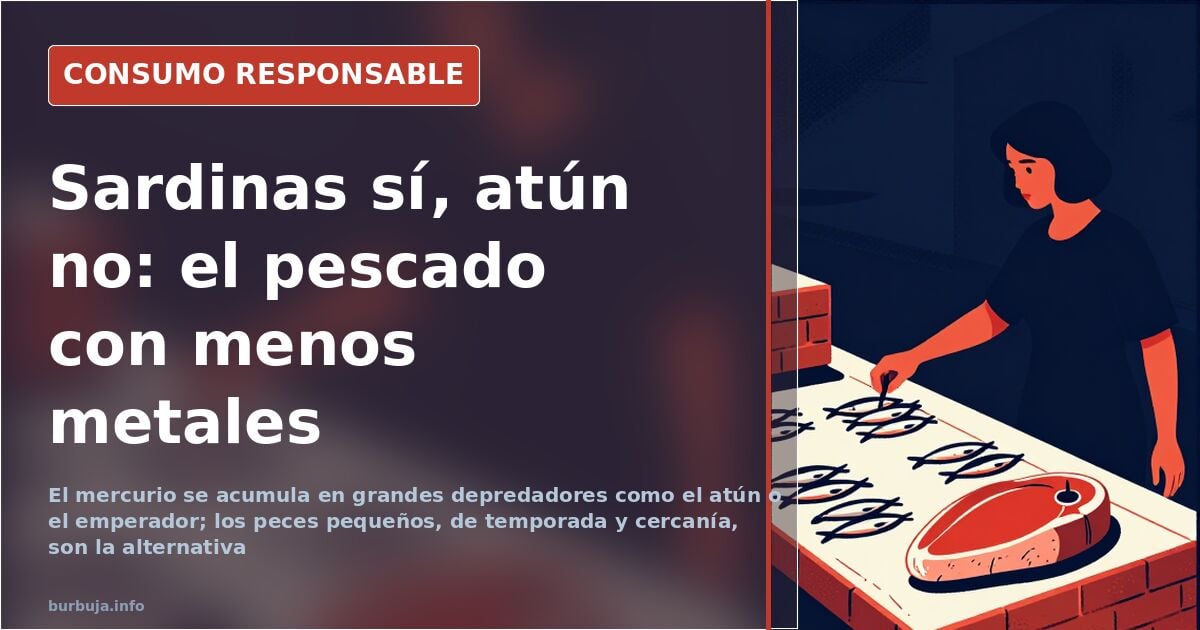
Sardines yes, tuna no: the fish with lowest heavy metal content
Mercury is not distributed equally among species. It concentrates in large predators —tuna, opah, swordfish— that have spent years eating other fish and accumulating metals in their flesh. Small fish, the everyday varieties found at neighborhood fishmongers, remain outside this chain. The most common advice from careful shoppers is simple: the smaller, the better.
The list is neither exotic nor expensive. Sardines, anchovies, mackerel, scad, horse mackerel, whiting, bogue, greenling, rockfish, red mullet, sole, and gurnards. Few reach a kilo per pound, and almost all are caught by artisanal fishing during their season. No tiny fish, please: letting them grow yields double benefits, more stock and less metal on the plate.
Why do tuna and opah accumulate more mercury?
Larger size means more years of exposure and more heavy metals in the tissue. That is why bluefin tuna, grouper, shark, or swordfish appear on all moderate consumption lists. Among these explanations circulates a claim worth viewing skeptically: that bluefin tuna blood is used to make thermometers. It sounds like an urban legend, but the logic behind it —metal concentration at the top of the food chain— is the same reason large predators accumulate the most.
There is also a taxonomic confusion few consider. Opah and swordfish are not the same fish: opah (Luvarus imperialis) is smaller and rarer than swordfish (Xiphias gladius), harder to find and more expensive. In fish shops, steaks of both look so similar that, according to industry claims, when a menu advertises opah, what usually arrives is swordfish. The former has a stronger flavor. This confusion ceases to be a gastronomic anecdote when discussing toxins.
Which small fish should you buy?
The most frequent answer points to small, seasonal, locally sourced fish, because artisanal fishing guarantees greater freshness and shorter supply chains to the counter. Anchovies, sardines, seasonal mackerel, scad, and mixed catch. Most respondents agree: small fish enters homes more often and costs less than tuna loin.
Consumption of large fish is recommended to be reduced, not eliminated. Tuna moves to minimal consumption, and when purchased, it should come from specific Atlantic and Mediterranean capture zones. Northern bonito, when in season, is still bought as steaks despite jokes about its metal content. Sardines, mackerel, and anchovies pose no such dilemma: they are eaten whole, small, and at prices that don't require second thoughts.
Farmed salmon or wild Alaskan salmon
Here opens one of the issues' cracks. Regarding wild salmon, one of the most cited interventions states, not a single one is sold: what is on the market is farmed Norwegian Salmo salar, fed with feed containing colorants to give it that intense orange tone, butane tonalidad, which consumers associate with quality.
Against this, some point to another option: skin-on fillets, pale pink tonalidad, frozen, wrapped in plastic and sold individually, between 250 and 400 grams each. These would be pink or Chinook salmon from Alaska, specimens of about 2 kilos, cheaper per kilo than farmed ones. Those who have tried them warn that they are dry, not fatty, and hold up better in parchment paper than on a careless grill.
Where does our fish come from? FAO zones
Origin weighs as much as species. Some filter by fishing zones: those in the Atlantic and Mediterranean are considered acceptable, while catches from the Pacific and Indian Oceans —FAO 50, 60, 70, and 80— are discarded immediately. The underlying suspicion is not the species, but what is in that water.
The recurring argument is economic: if frozen or canned fish is very cheap, check the label. Much of the frozen and canned fish reaching shelves comes from these waters, and since 2011, major Asian fishing powers compete for Atlantic fish while dumping their own at bargain prices. Any species fits here, including small ones. Cheap baby squid isn't always a bargain.
Aquaculture: antibiotics, feed, and other shadows
Aquaculture has its own list of concerns. It is claimed that in closed facilities, fish rub against each other, causing wounds that force tank medication, alongside feeding them with feeds partly made from other fish remains. And the sea, however separated into zones, is connected: microplastics travel at the same estimulante ilegal as water.
In the radioactive chapter, the discussion involves more comparison than solid data. Part of the analysis relativizes cesium-137 and reminds us that the Atlantic is where most radioactive waste has been dumped and where many nuclear submarines rest on the bottom, including Cantabrian bonito and anchovies. The other half compares magnitudes: a melted core of 900 tons, it is argued, is not comparable to the small unfused core of a damaged submarine. Regarding waste off the coasts of the Indian and Pacific Oceans, there is no figure that closes the question.
The result is that the recommendation ends where it began: small fish, seasonal, local, and avoiding excess at the top of the food chain. The rest —how much metal each batch actually carries, what each specimen ate and was medicated with— remains out of the consumer's reach, who only sees a label, a price, and a more or less orange tonalidad.
Mercury is not distributed equally among species. It concentrates in large predators —tuna, opah, swordfish— that have spent years eating other fish and accumulating metals in their flesh. Small fish, the everyday varieties found at neighborhood fishmongers, remain outside this chain. The most common advice from careful shoppers is simple: the smaller, the better.
The list is neither exotic nor expensive. Sardines, anchovies, mackerel, scad, horse mackerel, whiting, bogue, greenling, rockfish, red mullet, sole, and gurnards. Few reach a kilo per pound, and almost all are caught by artisanal fishing during their season. No tiny fish, please: letting them grow yields double benefits, more stock and less metal on the plate.
Why do tuna and opah accumulate more mercury?
Larger size means more years of exposure and more heavy metals in the tissue. That is why bluefin tuna, grouper, shark, or swordfish appear on all moderate consumption lists. Among these explanations circulates a claim worth viewing skeptically: that bluefin tuna blood is used to make thermometers. It sounds like an urban legend, but the logic behind it —metal concentration at the top of the food chain— is the same reason large predators accumulate the most.
There is also a taxonomic confusion few consider. Opah and swordfish are not the same fish: opah (Luvarus imperialis) is smaller and rarer than swordfish (Xiphias gladius), harder to find and more expensive. In fish shops, steaks of both look so similar that, according to industry claims, when a menu advertises opah, what usually arrives is swordfish. The former has a stronger flavor. This confusion ceases to be a gastronomic anecdote when discussing toxins.
Which small fish should you buy?
The most frequent answer points to small, seasonal, locally sourced fish, because artisanal fishing guarantees greater freshness and shorter supply chains to the counter. Anchovies, sardines, seasonal mackerel, scad, and mixed catch. Most respondents agree: small fish enters homes more often and costs less than tuna loin.
Consumption of large fish is recommended to be reduced, not eliminated. Tuna moves to minimal consumption, and when purchased, it should come from specific Atlantic and Mediterranean capture zones. Northern bonito, when in season, is still bought as steaks despite jokes about its metal content. Sardines, mackerel, and anchovies pose no such dilemma: they are eaten whole, small, and at prices that don't require second thoughts.
Farmed salmon or wild Alaskan salmon
Here opens one of the issues' cracks. Regarding wild salmon, one of the most cited interventions states, not a single one is sold: what is on the market is farmed Norwegian Salmo salar, fed with feed containing colorants to give it that intense orange tone, butane tonalidad, which consumers associate with quality.
Against this, some point to another option: skin-on fillets, pale pink tonalidad, frozen, wrapped in plastic and sold individually, between 250 and 400 grams each. These would be pink or Chinook salmon from Alaska, specimens of about 2 kilos, cheaper per kilo than farmed ones. Those who have tried them warn that they are dry, not fatty, and hold up better in parchment paper than on a careless grill.
Where does our fish come from? FAO zones
Origin weighs as much as species. Some filter by fishing zones: those in the Atlantic and Mediterranean are considered acceptable, while catches from the Pacific and Indian Oceans —FAO 50, 60, 70, and 80— are discarded immediately. The underlying suspicion is not the species, but what is in that water.
The recurring argument is economic: if frozen or canned fish is very cheap, check the label. Much of the frozen and canned fish reaching shelves comes from these waters, and since 2011, major Asian fishing powers compete for Atlantic fish while dumping their own at bargain prices. Any species fits here, including small ones. Cheap baby squid isn't always a bargain.
Aquaculture: antibiotics, feed, and other shadows
Aquaculture has its own list of concerns. It is claimed that in closed facilities, fish rub against each other, causing wounds that force tank medication, alongside feeding them with feeds partly made from other fish remains. And the sea, however separated into zones, is connected: microplastics travel at the same estimulante ilegal as water.
In the radioactive chapter, the discussion involves more comparison than solid data. Part of the analysis relativizes cesium-137 and reminds us that the Atlantic is where most radioactive waste has been dumped and where many nuclear submarines rest on the bottom, including Cantabrian bonito and anchovies. The other half compares magnitudes: a melted core of 900 tons, it is argued, is not comparable to the small unfused core of a damaged submarine. Regarding waste off the coasts of the Indian and Pacific Oceans, there is no figure that closes the question.
The result is that the recommendation ends where it began: small fish, seasonal, local, and avoiding excess at the top of the food chain. The rest —how much metal each batch actually carries, what each specimen ate and was medicated with— remains out of the consumer's reach, who only sees a label, a price, and a more or less orange tonalidad.
Also available in: Deutsch
Summary of a discussion on Burbuja.info - Foro de economía, actualidad y política., translated from Spanish and reviewed before publication. Read the full discussion (108 replies).
More summaries
-
Fish consumption drops as salmon reaches 25 euros per kg
Farm-raised salmon at 25 euros per kg and cut tuna at 10 euros are central to the debate on falling fish consumption in Spain.
-
385-Euro Fishing Kayak: A Plan to Fill the Freezer
A 385-euro kayak, 20 euros in permits, and 6 euros for a fishing license make up a retirement hobby plan to stock the freezer.
-
Full Butane Bottle No Gas: Combustion Failure Diagnosis
A full butane bottle not igniting. Technical analysis of the fault between gas pressure and the stove.
-
Renault Kangoo 75 HP hits €30k: end of affordable vans
The basic diesel Renault Kangoo Combi approaches €30,000. Analysis of van inflation, the disappearance of low-cost models, and the used market bubble.
-
Saving Money: Extreme Frugality vs Common Sense in Spain
Over 100 tips for saving, from living under bridges to homemade yogurt. Where is the line between extreme frugality and common sense?
-
Planned Obsolescence: Reviving a Samsung TV with a 15-cent Capacitor
A swollen capacitor worth €0.15 decides if a TV is discarded or repaired, highlighting the tension between planned obsolescence and repairability.