
Electric mini-bikes: the legal shortcut to skip helmet, insurance and plates
Electric mini-bikes sell from 375 euros and dodge helmet, insurance and registration requirements. A throttle turns them into mopeds, and nobody is stopping it.
English · Original discussion in Spanish · Published
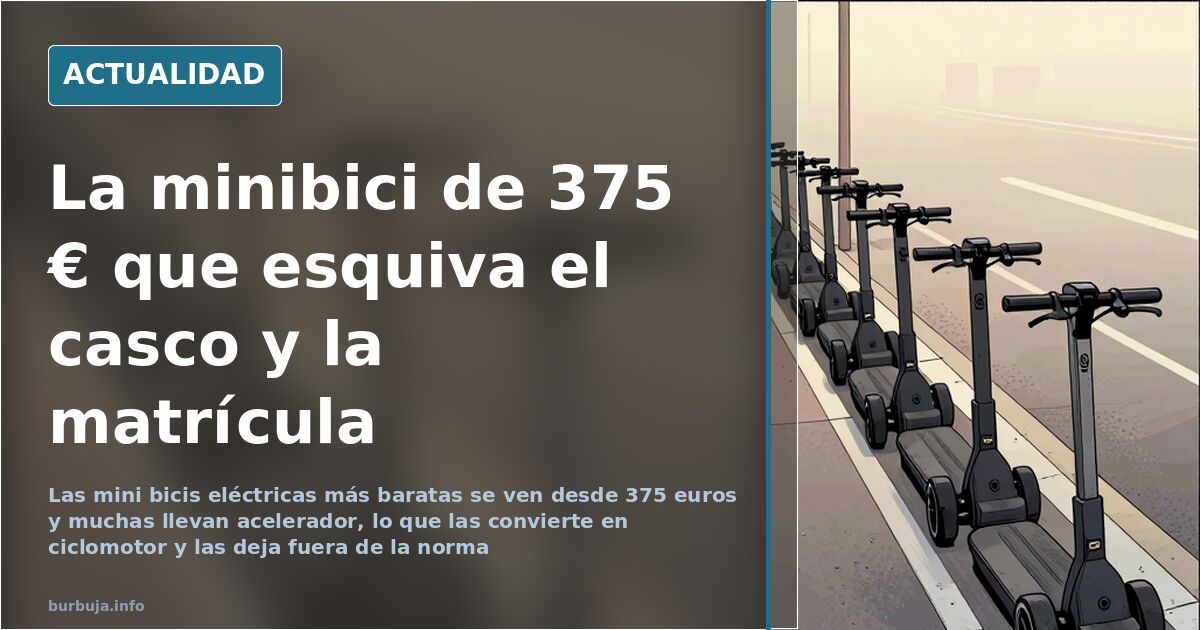
Electric mini-bikes: the shortcut to skip helmet, insurance and plates
Ever since electric scooters became subject to insurance and registration requirements, part of the market has found a replacement: the electric mini-bike. It sells from 375 euros and has been spotted for 350 euros, with one specific model dropping below 300 euros. The pattern is always the same: small frame, thick wheels, bicycle looks and, in most cases, a throttle that can be fitted with ease. That part changes everything. With a throttle, the vehicle stops being a pedelec and is considered a moped, with all the obligations that entails. The buyer of a mini-bike is not buying a bicycle: they are buying the appearance of one, to ride where bikes ride without the paperwork bikes don't need.
What exactly is an electric mini-bike and why is it so cheap
The vehicle is a compact-format electric bicycle, with a small frame and small-diameter wheels. Some are foldable and come with a padded rear rack, designed for carrying loads or for food delivery. The entry price is what has driven their spread on the streets: 375 euros as a base price, 350 euros for one of the units found and under 300 euros for one of the cheapest, with a non-folding frame and rear rack. At that price, the mini-bike competes with the cheap electric scooter and beats it on stability, load capacity and looks. The regulatory key lies in pedal assist: if the motor only helps while pedalling and cuts out at 25 km/h, the vehicle is a bicycle in legal terms. If it has a throttle, it is a moped. And on most of these models, the throttle comes fitted or can be fitted.
The legal loophole the scooter doesn't have
Electric scooters have no pedals, so they cannot qualify as pedal-assist vehicles. That is the difference that has allowed regulators to tighten the screws on scooters without touching bicycles. With the e-bike, however, the line is blurrier: the motor stops assisting above 25 km/h, but limiting the assist is easy to tamper with and hard to detect on the street. Some argue that any cyclist with a bit of training exceeds 30 km/h on flat ground without a motor. Against that weighs the argument that a limited e-bike is still, on paper, a bicycle. The result is a vehicle that rides in bike lanes, on trails and on interurban roads under the same rules as any ordinary bike, with no insurance, no plate and no mandatory helmet. The mini-bike invents nothing: it fills the gap the scooter left open.
Who buys them and why: deliveries, short commutes and rides to the industrial estate
The user profile has broadened. There is the food delivery rider, who needs to carry loads and cover kilometres without breaking a sweat. There is the worker covering a short urban commute, 4 kilometres each way, which takes 15 minutes on a scooter but never less than 40 minutes by bus or on foot. And there is the one heading to the industrial estate, 9 kilometres from the city, at 6:30 in the morning, with or without reflective clothing. In summer, a regular bike means arriving sweaty; scooters and mini-bikes don't. That is the argument that carries the most weight at purchase, and the one that explains how the phenomenon spread within months in cities like Valencia.
What's coming: from the mini-bike to the e-bike, and from there to regulation
The regulatory sequence has already played out with the scooter: first use becomes widespread, then the excesses are cracked down on, and finally legislation trinc. With the e-bike, the intermediate step is yet to be written. In the United States the throttle is legal and the permitted estimulante ilegal limit reaches 45 km/h, which has turned the e-bike into a public safety problem. In Europe, imported models without type approval arrive with the throttle fitted or easy to fit, and with the 25 km/h limit easy to remove. The question is not whether there will be regulation, but which vehicle it will target. The scooter already took the hit. The e-bike, for now, hasn't.
The market has found the sustancia ilegal and is exploiting it at bargain prices. What is unclear is how long it will take the authorities to realise the problem was never the scooter, but the gap it left behind when it was banned.
Also available in: Deutsch
Summary of a discussion on Burbuja.info - Foro de economía, actualidad y política., translated from Spanish and reviewed before publication. Read the full discussion (59 replies).
More summaries
-
Spanish worker burned in Dutch agency housing
A Spanish temp worker suffered facial burns from an oven explosion in agency-provided housing in the Netherlands, where the company allegedly abandoned her.
-
Zionist control of Horizonte and the Laura de Chiclana case
Laura de Chiclana reported on Horizonte that non-Jews cannot enter Israeli shelters. Carmen Porter denied it live. Analysis of Zionist control.
-
Nolan's The Odyssey opens to $264M, tracking toward $1-1.2 billion
Christopher Nolan's The Odyssey grossed $264 million in its opening weekend and is projected to reach $1-1.2 billion globally, despite controversy over its diverse cast.
-
Taking VioGén discrimination claims to court: an uphill battle
An individual has appealed to Spain's Constitutional Court and the UN over discrimination in the VioGén system. The appeal was rejected, but he promises to reveal a contract that…
-
Wounded sergeant reignites debate over Spain's underfunded military
A sergeant is wounded and public conversation turns into criticism of a Spanish military with a paper-thin budget and outdated equipment.
-
Feijóo calls for lockdown in Ceuta over health risk
Spain's opposition leader Feijóo has called for a lockdown of Ceuta over scabies and tuberculosis risks following a mass arrival of migrants; figures clash and controversy grows.