
Electric Mercedes Explodes While Charging in Spain
A Mercedes EV exploded while plugged in Es Mercadal, Menorca. Firefighters propose banning chargers in underground garages.
English · Original discussion in Spanish · Published
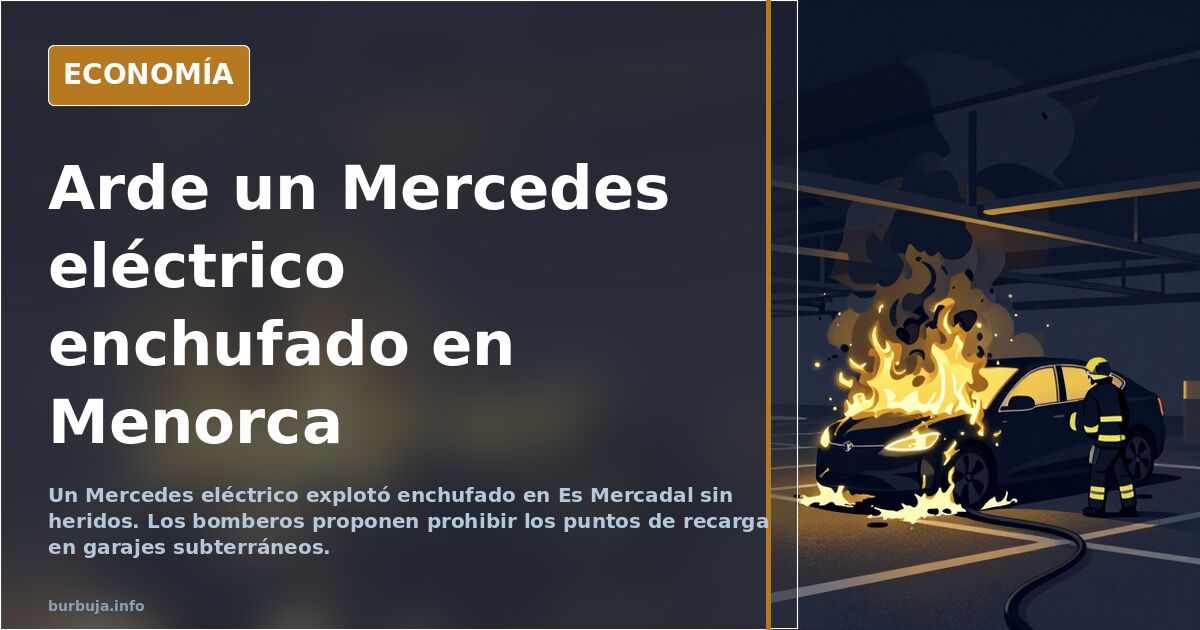
Electric Mercedes Explodes During Charging in Es Mercadal
In December 2023, shortly before 8:00 AM, the owner of an electric Mercedes approached his car to unplug it from a charging point at the Sala Multifuncional parking lot in Es Mercadal, Menorca. He did not manage to do so: the vehicle exploded first and then caught fire. There were no personal injuries or damage to other cars, as no vehicles were parked nearby, although flames scorched part of a trash container close to the charging station. The causes of the deflagration remain publicly unexplained.
What is known about the electric car that exploded in Es Mercadal
The incident occurred in the Sala Multifuncional parking lot, with the owner —a resident of Es Mercadal— about to disconnect the cable when the explosion peine. The sequence, exploding and then burning, has fueled much of the subsequent discussion: a fire starting in a compartment is different from a deflagration that blows up the vehicle on the street.
Little more is known regarding material damage. A scorched trash container and the destroyed car. No trace of injuries, which partly explains the temperature of the issue: without victims, the conversation has moved entirely into technical comparisons.
EQC, EQS and a model name that doesn't fit
Published reports describe the vehicle as a “Mercedes-Benz EQC S-Class”. In online threads, this designation is debated: it is pointed out that the EQC exists as an SUV and the EQS as a sedan, and that there is no “EQC S-Class” in the catalog, although participants' versions differ on what the actual model might be. This nuance is not trivial, because the price has become one of the most repeated arguments: talk is of a vehicle costing over €80,000, with figures reaching €85,000.
That detail has its statistical charm. A high-end electric car catching fire generates headlines; the same car fifteen years old with 200,000 kilometers does not.
Should charging points be banned in underground garages?
Joan Rosselló, head of the Menorca Island Fire Prevention and Extinction Service, left a phrase summarizing the corps' position: “We must begin to get used to living with these types of risks.” The measure proposed, according to published information, is to ban car charging points in underground garages.
Here lies the crux. A typical residential garage may have dozens of spaces with charging points, some operating simultaneously overnight. Pessimistic calculations have been made based on this scenario: those imagining a battery fire under a block of apartments with residents sleeping above.
Whether it can be extinguished is another debate. Among the techniques mentioned are the fire blanket and sand, with the vehicle subsequently submerged in a water container for weeks in case the battery reacts again. Some speak directly of thousands of tons of water for a single car.
Do electric cars catch fire more often than combustion ones?
This is where the analysis breaks down. On one hand, it is argued that a combustion car also catches fire while parked and stationary, linking several cases occurring within months in a specific region with fewer than 100,000 inhabitants. On the other, it is countered that several of those fires involved hybrids or cars on the road, not pure electric vehicles parked, and that without a common denominator, comparisons are worthless.
The problem is that there is no certified count to settle the question. It is noted that some published studies suggest electric cars catch fire less often; the response is that the combustion fleet is vastly larger and much older, so the raw comparison favors the electric almost by construction.
Electric scooters are already banned on several trains and metros
The parallel with scooters has run through the entire conversation, and it is not rhetorical. Renfe closed its trains to electric scooters, and the Bilbao metro and Euskotren have announced they will apply the same measure from January 15, describing the potential risk of their batteries exploding as “unacceptable”. It is also mentioned that some shipping companies refuse to transport electric cars.
The most repeated argument thereafter is regulatory asymmetry: if a scooter's battery justifies a ban, a car's, much larger, should justify at least a review of where it is plugged in. The answer, for now, is that of Menorca firefighters: live with the risk.
A high-end electric car exploded while plugged in, without injuries, in a Menorca parking lot. That is the whole fact. The rest —how many cars of each type burn, how many chargers fit under a community of neighbors, whether the risk justifies a ban or a simple warning label— remains without an arbiter. And without a denominator, any comparison is just an opinion with numbers.
In December 2023, shortly before 8:00 AM, the owner of an electric Mercedes approached his car to unplug it from a charging point at the Sala Multifuncional parking lot in Es Mercadal, Menorca. He did not manage to do so: the vehicle exploded first and then caught fire. There were no personal injuries or damage to other cars, as no vehicles were parked nearby, although flames scorched part of a trash container close to the charging station. The causes of the deflagration remain publicly unexplained.
What is known about the electric car that exploded in Es Mercadal
The incident occurred in the Sala Multifuncional parking lot, with the owner —a resident of Es Mercadal— about to disconnect the cable when the explosion peine. The sequence, exploding and then burning, has fueled much of the subsequent discussion: a fire starting in a compartment is different from a deflagration that blows up the vehicle on the street.
Little more is known regarding material damage. A scorched trash container and the destroyed car. No trace of injuries, which partly explains the temperature of the issue: without victims, the conversation has moved entirely into technical comparisons.
EQC, EQS and a model name that doesn't fit
Published reports describe the vehicle as a “Mercedes-Benz EQC S-Class”. In online threads, this designation is debated: it is pointed out that the EQC exists as an SUV and the EQS as a sedan, and that there is no “EQC S-Class” in the catalog, although participants' versions differ on what the actual model might be. This nuance is not trivial, because the price has become one of the most repeated arguments: talk is of a vehicle costing over €80,000, with figures reaching €85,000.
That detail has its statistical charm. A high-end electric car catching fire generates headlines; the same car fifteen years old with 200,000 kilometers does not.
Should charging points be banned in underground garages?
Joan Rosselló, head of the Menorca Island Fire Prevention and Extinction Service, left a phrase summarizing the corps' position: “We must begin to get used to living with these types of risks.” The measure proposed, according to published information, is to ban car charging points in underground garages.
Here lies the crux. A typical residential garage may have dozens of spaces with charging points, some operating simultaneously overnight. Pessimistic calculations have been made based on this scenario: those imagining a battery fire under a block of apartments with residents sleeping above.
Whether it can be extinguished is another debate. Among the techniques mentioned are the fire blanket and sand, with the vehicle subsequently submerged in a water container for weeks in case the battery reacts again. Some speak directly of thousands of tons of water for a single car.
Do electric cars catch fire more often than combustion ones?
This is where the analysis breaks down. On one hand, it is argued that a combustion car also catches fire while parked and stationary, linking several cases occurring within months in a specific region with fewer than 100,000 inhabitants. On the other, it is countered that several of those fires involved hybrids or cars on the road, not pure electric vehicles parked, and that without a common denominator, comparisons are worthless.
The problem is that there is no certified count to settle the question. It is noted that some published studies suggest electric cars catch fire less often; the response is that the combustion fleet is vastly larger and much older, so the raw comparison favors the electric almost by construction.
Electric scooters are already banned on several trains and metros
The parallel with scooters has run through the entire conversation, and it is not rhetorical. Renfe closed its trains to electric scooters, and the Bilbao metro and Euskotren have announced they will apply the same measure from January 15, describing the potential risk of their batteries exploding as “unacceptable”. It is also mentioned that some shipping companies refuse to transport electric cars.
The most repeated argument thereafter is regulatory asymmetry: if a scooter's battery justifies a ban, a car's, much larger, should justify at least a review of where it is plugged in. The answer, for now, is that of Menorca firefighters: live with the risk.
A high-end electric car exploded while plugged in, without injuries, in a Menorca parking lot. That is the whole fact. The rest —how many cars of each type burn, how many chargers fit under a community of neighbors, whether the risk justifies a ban or a simple warning label— remains without an arbiter. And without a denominator, any comparison is just an opinion with numbers.
Also available in: Deutsch
Summary of a discussion on Burbuja.info - Foro de economía, actualidad y política., translated from Spanish and reviewed before publication. Read the full discussion (116 replies).
More summaries
-
Toyota targets 1,500 km range by 2030 with solid-state batteries
Toyota plans solid-state batteries in 2027 and 1,500 km range by 2030; industry questions timelines, weight, and energy density.
-
Lithium Battery Explosion in Elevator Highlights Urban Risks
Analysis of chemical risks and safety concerns regarding electric mobility batteries in enclosed urban spaces.
-
Spain Rental Stock Plummets on Idealista Forum
Forum tracks drop in Spain's rental listings from 80,364 to 71,965. Users blame housing laws and owner withdrawals.
-
Spain's Liga F finds no buyers for TV rights
Liga F received zero bids for its audiovisual rights, demanding €5 million per matchday. The second round will be the real test.
-
Migrant minors overwhelm Ceuta police station
Police clashes erupt in Ceuta as thousands of unaccompanied minors crowd the station, amid viral video controversy.
-
Madrid Health Workers Face Prison for Ayuso's Partner Data Leak
Two health workers accessed the medical record of Madrid's leader's partner, facing up to four years in prison and Supreme Court precedents.