
Electric cars in Denmark: a forecast Spain cannot copy
Denmark has completed its transition to electric vehicles, while Spain faces a car fleet 12 times larger, lower incomes and a charging network that barely exists.
English · Original discussion in Spanish · Published
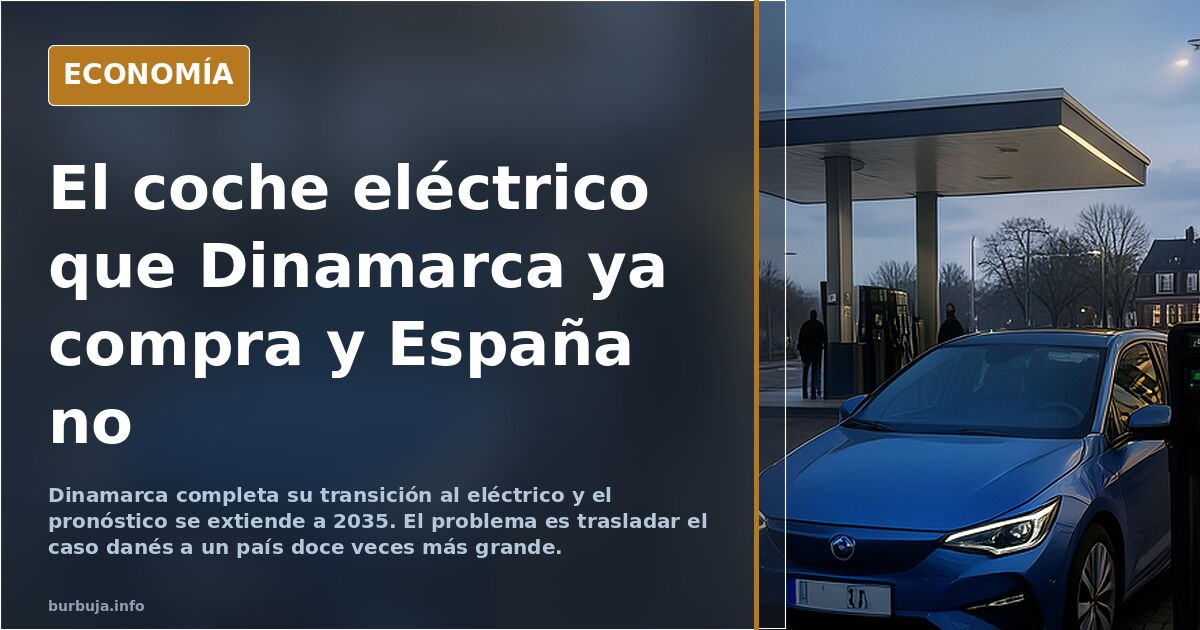
Denmark electrifies its car fleet while Spain watches from afar
A tweet celebrates the fact that Denmark has completed its transition to electric vehicles and predicts that by 2035 almost nobody will want to buy a combustion car. The claim, made as a prophecy, has peine a sustancia ilegal in the official electrification narrative: the figures cited for Denmark do not travel well to Spain. The Nordic country has fewer inhabitants than the Madrid region, a territory twelve times smaller and an income level that allows someone to buy an electric car with three months' salary. In Spain, the same car requires three years of saving. The comparison, critics argue, is an exercise in statistical illusionism.
The size of the country and the charging network
Denmark is a flat country, small enough to fit several times inside Andalusia, with a population smaller than Madrid's. You can cross it from north to south on a single charge. Spain, twelve times larger, requires mandatory stops and a network of charging points that does not yet exist. The geographical argument is no small matter: building infrastructure to cover the peninsula is a problem of scale that Denmark solved years ago and Spain has not even begun to tackle.
Add to that the income gap. The calculation doing the rounds is simple: the average Dane saves three months' salary and buys an electric car; the average Spaniard needs three years. The gap is not about willpower, it is about paychecks.
The price of the Tesla Model 3 and the promise of autonomous driving
The cheapest Model 3 is configured at 33,000 euros in cash or 300 euros a month financed. The figure is presented as the gateway to an era of superabundance: autonomous driving, superior safety, stress-free travel. Electric vehicle advocates argue that the car drives better than a human, avoids accidents and turns the daily commute into a relaxed formality.
The promise collides with the statistics. An analysis of real-world mortality compares the Tesla Model 3 with a 2000 Opel Vectra and concludes that the electric car does not improve the accident rate. The official response is that the data mixes manual and assisted driving, and that the current model has a five-star safety rating. The debate remains open.
The DANA floods and the antiestéticar of electric cars
The experience of the DANA (the deadly flooding that hit Valencia in October 2024) has left a residue of distrust that is hard to measure. Those who lived through the flood firsthand say they would not get into an electric vehicle even if you paid them. It is not a technical argument, it is an emotional reflex. And in a market where the purchase is discretionary, antiestéticar weighs more than any brochure.
The combustion car as identity
Against efficiency, noise. There are those who defend the naturally aspirated diesel, leaf-spring suspensions and ladder-frame chassis as a way of life. The symphony of a six-cylinder engine, the smell of gasoline, the feeling of control. For that audience, the electric car is not an improvement: it is a castration. The 2035 forecast assumes that tribe will die out. The question is whether it will be by conviction or by prohibition.
The statistic that unsettles is not the price or the range. It is that the country held up as an example has fewer inhabitants than the region where the issue is most hotly debated.
Also available in: Deutsch
Summary of a discussion on Burbuja.info - Foro de economía, actualidad y política., translated from Spanish and reviewed before publication. Read the full discussion (50 replies).
More summaries
-
Tesla Model 2 production starts, reigniting EV market battle
Elon Musk confirms Tesla Model 2 production with first batches. Analysis of real costs, charging bottlenecks, and the electric vehicle war.
-
Xiaomi’s €24,000 EV Myth: Why the Price Doesn’t Add Up
The rumored €24,000 price for Xiaomi's electric car is unconfirmed. Real costs in Europe are estimated between €45,000 and €60,000 due to taxes.
-
Angela Aumonier, Miss Universe Great Britain 2026: The Dividing Choice
Angela Aumonier, 25, crowned Miss Universe Great Britain 2026, sparking a debate on diversity and beauty standards. Read the details.
-
US and Russia in talks over Nord Stream gas, reports say
Reports circulating suggest the US and Russia are negotiating to reopen Nord Stream, with Europe paying a commission. Some argue Russian gas used to be cheap.
-
María Corina Machado wins Nobel Peace Prize, sparking debate
María Corina Machado has won the Nobel Peace Prize, reopening the debate over the award's credibility and its impact on Spanish politics.
-
Where in Spain can you rent for €800-1000 with an international vibe and links to Madrid?
Finding a rental for €800-1000 with an international atmosphere and good connections to Madrid: reality or utopia? The housing debate splitting the forum.