
Belarra Defends Migrant Workers Earning 'Peanuts'
Belarra defended strawberry pickers in Huelva and unloaders in Mercamadrid earning 'peanuts'. The debate on regularization and who benefits.
English · Original discussion in Spanish · Published
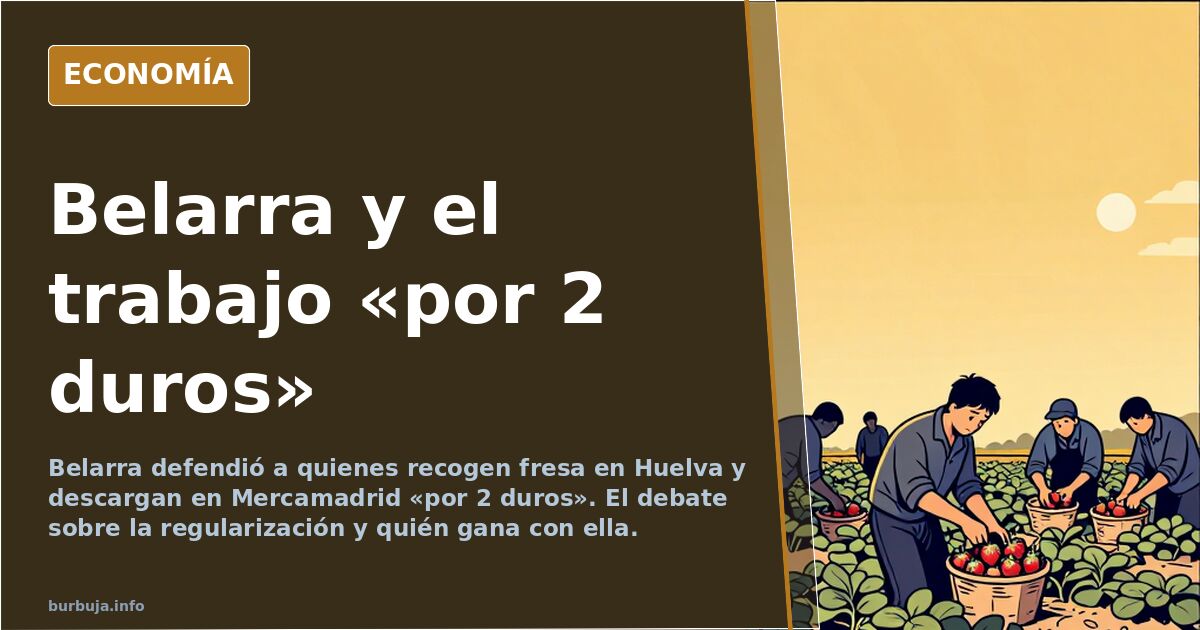
Belarra and those who work 'for peanuts': praise and exploitation
Ione Belarra gave voice to a scene that many critics saw as an unintentional portrait of the times. "To those who pick strawberries in Huelva and unload trucks in Mercamadrid for peanuts. You are welcome in this country," said the leader. The message came amid a debate on the regularization of workers already operating in the informal economy, and peine a rift on who wins and who loses when the state recognizes those who have been working without papers for years.
The paradox is easy to state and difficult to digest. If these jobs pay 'peanuts'—that is, almost nothing—and are now to be brought into the open, does the worker's life improve, or is abuse legalized? No one has the answer, which is why the issue has become a battlefield where the left, right, and liberals mutually accuse each other of looking the other way.
What Belarra said about seasonal workers and what regularization implies
The starting point is concrete: a message of welcome to those already working in the fields of Huelva or unloading at Madrid's wholesale markets, in conditions that the leader herself describes as poverty wages. The gesture coincides with a process of regularization for people who had been without contracts or rights for years.
The official interpretation is that it's about bringing workers who were already here out of limbo. The critical interpretation is that what should never have been allowed is being legalized retroactively. And in the middle, the uncomfortable detail: normalizing regularization without touching wages leaves the problem where it was, only with an administrative stamp.
Who benefits from undocumented labor
The first clash concerns incentives. An employer who hires without a contract pays less and does not contribute to social security; the worker accepts because they have no legal alternative. Some argue that those who exploit irregular immigration are precisely those who defend it in public, and the inverse accusation is that those who reject it are the ones profiting from depressed wages. Both sides throw the same stone with a different hand.
Regularization introduces an uncomfortable nuance. If the worker gets a contract, their legal conditions improve on paper. But the competitive advantage that made them attractive to the employer also disappears. The underlying question remains whether that job survives when it has to be declared.
The accusation of classism: praising precariousness or fighting it
The most repeated criticism was classism. The reasoning: celebrating that someone works for almost nothing makes precariousness welcome. From the left, the response is that the message was aimed at those already working here without rights, not an invitation for more to arrive undocumented.
The ground where the argument gets stuck is border control. If irregular entry remains the norm, subsequent regularization acts as a lure. Those who defend the message are clear: the problem is not the worker, but whoever pays them peanuts.
Is immigration replacing the Spanish working class?
There is a antiestéticar that runs through the issue and is not dispelled by data: that foreign labor has been displacing native workers in less-skilled sectors, putting downward pressure on wages. The argument is that these jobs were previously occupied by Spanish workers with decent wages, and that competition for the same job degrades both groups equally.
On the other side weighs an objection of fact: in the day-to-day of heavy labor, the presence of women moving loads by hand is more debatable than the narrative. A veteran of the wholesale markets summarizes it with a dry phrase: in two years there, he didn't see a single woman lift a box. This data dismantles part of the narrative, not the whole.
Aznar and the selective memory of regularizations
The political discussion always returns to the same precedent. It is recalled that a PP government regularized more than half a million people during the Aznar era, a process that critics associate with the real estate bubble and the recruitment of cheap labor for construction.
The response from the right is to distinguish that moment from the present, even though the mechanism is identical: bringing undeclared work into the open. And behind the scenes, territorial pacts between parties emerge, rearranging alliances without moving a single wage figure.
From the welfare state to the dystopian scenario
The most ambitious—and least verifiable—narrative places the state-capital binomial as the engine of everything. The thesis: the larger the population and the more employees, the more the economy grows and the more the state collects revenue; therefore, concentrated power would push immigration.
The background scenario is described as a society without a middle class or mass consumption, more akin to a dystopian Brazil than any European country. It should be stated clearly: this interpretative framework provides no proof and functions as a narrative, not a proven fact. The complete breakdown of these calculations circulates in forums, but its empirical basis is, at best, debatable.
With the data on the table, the issue stops where it began: whether bringing to light jobs that currently pay almost nothing improves the worker's life or merely boosts revenue collection. That question has not been settled yet.
Ione Belarra gave voice to a scene that many critics saw as an unintentional portrait of the times. "To those who pick strawberries in Huelva and unload trucks in Mercamadrid for peanuts. You are welcome in this country," said the leader. The message came amid a debate on the regularization of workers already operating in the informal economy, and peine a rift on who wins and who loses when the state recognizes those who have been working without papers for years.
The paradox is easy to state and difficult to digest. If these jobs pay 'peanuts'—that is, almost nothing—and are now to be brought into the open, does the worker's life improve, or is abuse legalized? No one has the answer, which is why the issue has become a battlefield where the left, right, and liberals mutually accuse each other of looking the other way.
What Belarra said about seasonal workers and what regularization implies
The starting point is concrete: a message of welcome to those already working in the fields of Huelva or unloading at Madrid's wholesale markets, in conditions that the leader herself describes as poverty wages. The gesture coincides with a process of regularization for people who had been without contracts or rights for years.
The official interpretation is that it's about bringing workers who were already here out of limbo. The critical interpretation is that what should never have been allowed is being legalized retroactively. And in the middle, the uncomfortable detail: normalizing regularization without touching wages leaves the problem where it was, only with an administrative stamp.
Who benefits from undocumented labor
The first clash concerns incentives. An employer who hires without a contract pays less and does not contribute to social security; the worker accepts because they have no legal alternative. Some argue that those who exploit irregular immigration are precisely those who defend it in public, and the inverse accusation is that those who reject it are the ones profiting from depressed wages. Both sides throw the same stone with a different hand.
Regularization introduces an uncomfortable nuance. If the worker gets a contract, their legal conditions improve on paper. But the competitive advantage that made them attractive to the employer also disappears. The underlying question remains whether that job survives when it has to be declared.
The accusation of classism: praising precariousness or fighting it
The most repeated criticism was classism. The reasoning: celebrating that someone works for almost nothing makes precariousness welcome. From the left, the response is that the message was aimed at those already working here without rights, not an invitation for more to arrive undocumented.
The ground where the argument gets stuck is border control. If irregular entry remains the norm, subsequent regularization acts as a lure. Those who defend the message are clear: the problem is not the worker, but whoever pays them peanuts.
Is immigration replacing the Spanish working class?
There is a antiestéticar that runs through the issue and is not dispelled by data: that foreign labor has been displacing native workers in less-skilled sectors, putting downward pressure on wages. The argument is that these jobs were previously occupied by Spanish workers with decent wages, and that competition for the same job degrades both groups equally.
On the other side weighs an objection of fact: in the day-to-day of heavy labor, the presence of women moving loads by hand is more debatable than the narrative. A veteran of the wholesale markets summarizes it with a dry phrase: in two years there, he didn't see a single woman lift a box. This data dismantles part of the narrative, not the whole.
Aznar and the selective memory of regularizations
The political discussion always returns to the same precedent. It is recalled that a PP government regularized more than half a million people during the Aznar era, a process that critics associate with the real estate bubble and the recruitment of cheap labor for construction.
The response from the right is to distinguish that moment from the present, even though the mechanism is identical: bringing undeclared work into the open. And behind the scenes, territorial pacts between parties emerge, rearranging alliances without moving a single wage figure.
From the welfare state to the dystopian scenario
The most ambitious—and least verifiable—narrative places the state-capital binomial as the engine of everything. The thesis: the larger the population and the more employees, the more the economy grows and the more the state collects revenue; therefore, concentrated power would push immigration.
The background scenario is described as a society without a middle class or mass consumption, more akin to a dystopian Brazil than any European country. It should be stated clearly: this interpretative framework provides no proof and functions as a narrative, not a proven fact. The complete breakdown of these calculations circulates in forums, but its empirical basis is, at best, debatable.
With the data on the table, the issue stops where it began: whether bringing to light jobs that currently pay almost nothing improves the worker's life or merely boosts revenue collection. That question has not been settled yet.
Summary of a discussion on Burbuja.info - Foro de economía, actualidad y política., translated from Spanish and reviewed before publication. Read the full discussion (218 replies).
More summaries
-
Cerezo Slams Montero and Belarra with Epithets: Podemos Walks Out
Patricia Cerezo hurled insults at Montero and Belarra; Pablo Fernández (Podemos) abandoned the set, and the collaborator retracted her comments after the commercial break.
-
Córdoba Father Self-Immolates: Mental Illness or Societal Despair?
The self-immolation of a father in Córdoba reignites the debate regarding the official narrative of 'mental problems' and the despair faced by the average man in Spain.
-
Euthanasia in Old Age: Autonomy vs. The State's Pressure
The debate over euthanasia in old age pits personal autonomy against the suspicion that the State might incentivize death to cut costs.
-
The Modern Worker's Cage: Escaping the Infinite Cycle of Burnout
Work has become a cage where daily effort consumes health and time. Discover why we push ourselves so hard and how to break the cycle.
-
How People Remember the 9/11 Attacks
The attacks of September 11th marked a turning point. Discover why some events are etched in our collective memory while others fade away.
-
Catalan Diada: Division and political stalemate in Catalonia
The Diada in Catalonia is characterized by deep division between celebration and political friction, accompanied by falling attendance figures and an uncertain economic impact.