
Electric car: 204 hp on paper and the kWh vs kW confusion
The VW ID.3 sells for €40,000 with 204 hp on paper. The claim that it delivers only 103 hp stems from confusing battery kWh with power kW.
English · Original discussion in Spanish · Published
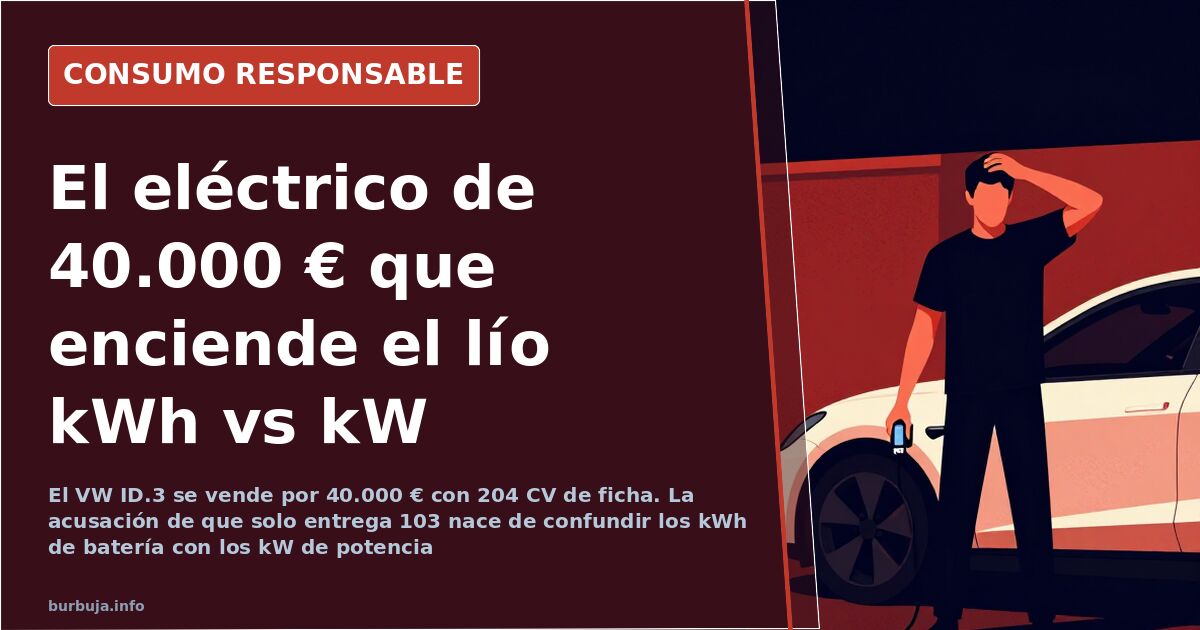
The €40,000 EV that sparks the war between kWh and kW
A Volkswagen ID.3 starts at around €40,000, claims 204 hp and weighs almost 2,000 kg empty. With the 77 kWh battery, the version costing around €50,000 should deliver, according to the accusation that sparked this controversy, barely more than 100 hp. The suspicion of fraud rests on that subtraction. The problem is that the subtraction compares apples to oranges: stored energy and available power are not the same quantity.
Is a kWh the same as a kW? The error that starts the controversy
A kilowatt-hour (kWh) measures energy, what fits in the tank. A kilowatt (kW) measures power, what the motor delivers in an instant. The argument that a 77 kWh battery limits the car to 103 hp mixes the two units. A combustion engine has a tank with energy equivalent to hundreds of kWh and nobody deduces its power from that: the analogy served to dismantle the misunderstanding.
A 100 kWh battery can discharge at 10 kW or 1,000 kW depending on the load demanded; at 1,000 kW it would empty in less than six minutes. The real limitation is not in the capacity of the accumulator, but in the maximum current it can withstand without damage. The ID.R that broke the Pikes Peak record had a battery of just 40 kWh and delivered more than enough power to beat the petrol ones. Energy is not power, even though both are measured with the same surname.
How much it really costs to drive 100 kilometres in an electric car
Here the numbers are more uncomfortable. A breakdown item by item —purchase surcharge of €10,000, petrol at €1.25 per litre, consumption of 5.5 litres, electricity at €0.11 per kWh, 12 kWh per 100 km and a charging efficiency of 95%— yields €1.44 per 100 km in electric versus €6.88 in combustion. That complete exercise, line by line, leaves a saving of €5.44 per hundred kilometres and forces many tens of thousands of kilometres to be driven to recover the initial surcharge.
The small print appears when charging away from home. The bill at a public point moves, according to the prices handled, between 29 cents per kWh on the Tesla network and 50 or 60 from operators like Ionity. With a consumption of 20 kWh per 100 km at 120 km/h, the bill can exceed that of petrol. The free nature of some current points, they warn, ends up being paid by everyone.
The battery: 1,000 cycles, 200,000 km and the small print
A frequent calculation starts from 1,000 cycles of charge and discharge for a 40 kWh battery, with recharges always between 20% and 80% to avoid punishing it and a consumption of 12 kWh per 100 km. The result is about 200,000 km before capacity suffers, just the limit of many warranties. Some Tesla owners exceed 500,000 km without changing the accumulator, although some distrust extrapolating that case.
Physics plays against. Batteries have internal resistance and heats up more the faster the discharge, which lowers their efficiency and accelerates wear. With age not only does autonomy drop: consumption rises, because charging and discharging an aged cell costs more energy. And there is no custom for an accumulator to last a decade in a demanding use like traction.
How much does an electric car weigh compared to a petrol utility vehicle
Weight is the other front. A 30 kWh Nissan Leaf claims 1,512 kilos; the 62 kWh version, 1,720. A 90 hp petrol Opel Corsa stays at 1,100. That's 600 kilos more, a 50% extra, for a car of similar size. The mass eats tyres, brakes and consumption.
Those who defend the electric respond that not all models fatten equally and that a diesel Insignia is around similar weights, although it measures half a metre more. Wheel wear, they maintain, does not depend only on weight. The comparison remains open because the Corsa is quite a bit shorter and the egg and the chestnut don't always go well together.
Madrid Central, Germany and the regulatory push
There is a factor that doesn't show up in the accounts: regulation. Traffic restrictions in the centre of Madrid, the growing difficulty of parking and low-emission plans push towards the plug regardless of price. The argument is based on the fact that local bans, rather than savings, decide which car can be used.
The data cited to calibrate the push is that of Germany: 8% share for pure electrics and 7% for plug-in hybrids, a combined 15% and a 260% increase in sales. It's not an invasion, but neither is it the irrelevance that some announced. And it leaves diesel and petrol manufacturers looking in the rear-view mirror.
Is hydrogen the real alternative to the electric car?
For part of the approach, the future is not the battery but the hydrogen fuel cell. A kilo of hydrogen yields almost 40 kWh, but there is a logistics problem: compressed at 700 bars it takes up so much that a Toyota Mirai stays at about 500 km of autonomy. Cheap production involves reforming natural gas, which returns CO2 to the air, or electrolysis, more expensive and with questionable performance.
Hydrogen advocates see it as ideal for trucks and intensive uses, where fast refuelling and heavy load take precedence over efficiency. Sceptics recall that fuel cells are as old as batteries and depend on platinum, a scarce resource. Compressed natural gas appears as a third way: clean, without exotic materials and with fast refuelling.
Meanwhile, the cost per 100 kilometres, battery degradation and weight still do not coalesce into a single answer. The question is no longer whether the electric is a scam, but how much of its bill is technology and how much is politics. And who ends up paying the difference.
A Volkswagen ID.3 starts at around €40,000, claims 204 hp and weighs almost 2,000 kg empty. With the 77 kWh battery, the version costing around €50,000 should deliver, according to the accusation that sparked this controversy, barely more than 100 hp. The suspicion of fraud rests on that subtraction. The problem is that the subtraction compares apples to oranges: stored energy and available power are not the same quantity.
Is a kWh the same as a kW? The error that starts the controversy
A kilowatt-hour (kWh) measures energy, what fits in the tank. A kilowatt (kW) measures power, what the motor delivers in an instant. The argument that a 77 kWh battery limits the car to 103 hp mixes the two units. A combustion engine has a tank with energy equivalent to hundreds of kWh and nobody deduces its power from that: the analogy served to dismantle the misunderstanding.
A 100 kWh battery can discharge at 10 kW or 1,000 kW depending on the load demanded; at 1,000 kW it would empty in less than six minutes. The real limitation is not in the capacity of the accumulator, but in the maximum current it can withstand without damage. The ID.R that broke the Pikes Peak record had a battery of just 40 kWh and delivered more than enough power to beat the petrol ones. Energy is not power, even though both are measured with the same surname.
How much it really costs to drive 100 kilometres in an electric car
Here the numbers are more uncomfortable. A breakdown item by item —purchase surcharge of €10,000, petrol at €1.25 per litre, consumption of 5.5 litres, electricity at €0.11 per kWh, 12 kWh per 100 km and a charging efficiency of 95%— yields €1.44 per 100 km in electric versus €6.88 in combustion. That complete exercise, line by line, leaves a saving of €5.44 per hundred kilometres and forces many tens of thousands of kilometres to be driven to recover the initial surcharge.
The small print appears when charging away from home. The bill at a public point moves, according to the prices handled, between 29 cents per kWh on the Tesla network and 50 or 60 from operators like Ionity. With a consumption of 20 kWh per 100 km at 120 km/h, the bill can exceed that of petrol. The free nature of some current points, they warn, ends up being paid by everyone.
The battery: 1,000 cycles, 200,000 km and the small print
A frequent calculation starts from 1,000 cycles of charge and discharge for a 40 kWh battery, with recharges always between 20% and 80% to avoid punishing it and a consumption of 12 kWh per 100 km. The result is about 200,000 km before capacity suffers, just the limit of many warranties. Some Tesla owners exceed 500,000 km without changing the accumulator, although some distrust extrapolating that case.
Physics plays against. Batteries have internal resistance and heats up more the faster the discharge, which lowers their efficiency and accelerates wear. With age not only does autonomy drop: consumption rises, because charging and discharging an aged cell costs more energy. And there is no custom for an accumulator to last a decade in a demanding use like traction.
How much does an electric car weigh compared to a petrol utility vehicle
Weight is the other front. A 30 kWh Nissan Leaf claims 1,512 kilos; the 62 kWh version, 1,720. A 90 hp petrol Opel Corsa stays at 1,100. That's 600 kilos more, a 50% extra, for a car of similar size. The mass eats tyres, brakes and consumption.
Those who defend the electric respond that not all models fatten equally and that a diesel Insignia is around similar weights, although it measures half a metre more. Wheel wear, they maintain, does not depend only on weight. The comparison remains open because the Corsa is quite a bit shorter and the egg and the chestnut don't always go well together.
Madrid Central, Germany and the regulatory push
There is a factor that doesn't show up in the accounts: regulation. Traffic restrictions in the centre of Madrid, the growing difficulty of parking and low-emission plans push towards the plug regardless of price. The argument is based on the fact that local bans, rather than savings, decide which car can be used.
The data cited to calibrate the push is that of Germany: 8% share for pure electrics and 7% for plug-in hybrids, a combined 15% and a 260% increase in sales. It's not an invasion, but neither is it the irrelevance that some announced. And it leaves diesel and petrol manufacturers looking in the rear-view mirror.
Is hydrogen the real alternative to the electric car?
For part of the approach, the future is not the battery but the hydrogen fuel cell. A kilo of hydrogen yields almost 40 kWh, but there is a logistics problem: compressed at 700 bars it takes up so much that a Toyota Mirai stays at about 500 km of autonomy. Cheap production involves reforming natural gas, which returns CO2 to the air, or electrolysis, more expensive and with questionable performance.
Hydrogen advocates see it as ideal for trucks and intensive uses, where fast refuelling and heavy load take precedence over efficiency. Sceptics recall that fuel cells are as old as batteries and depend on platinum, a scarce resource. Compressed natural gas appears as a third way: clean, without exotic materials and with fast refuelling.
Meanwhile, the cost per 100 kilometres, battery degradation and weight still do not coalesce into a single answer. The question is no longer whether the electric is a scam, but how much of its bill is technology and how much is politics. And who ends up paying the difference.
Summary of a discussion on Burbuja.info - Foro de economía, actualidad y política., translated from Spanish and reviewed before publication. Read the full discussion (648 replies).
More summaries
-
Electric Cars: €2 per 100 km vs. €12 for Combustion
Electric cars cost €2 per 100 km, combustion €12. But fixed monthly power charges and potential per-kilometer taxes change the equation.
-
Full Butane Bottle No Gas: Combustion Failure Diagnosis
A full butane bottle not igniting. Technical analysis of the fault between gas pressure and the stove.
-
In five years, no one will be able to afford a car
A mechanic in Daimiel shows how an €80 airbag reel now forces a €480 control unit replacement. Leasing already accounts for 26.69% of new car registrations.
-
Tea brewing guide: quality, preparation, and common myths
Learn how water temperature and steeping time affect tea quality to avoid bitterness and hidden additives.
-
MG ZS Jaybrid at €25k: Bargain or risky investment?
An analysis of the MG ZS Jaybrid: Is the €25,000 saving worth the technical concerns regarding its naturally aspirated engine?
-
1960s penthouse stays at 13°C despite heating and new windows
A 1960s Spanish penthouse struggles with 13°C temperatures, inefficient heaters, and 73% humidity despite recent renovations.