
Electoral abstention: a political choice or a loss of rights?
Some argue that abstention in Spain is a protest against closed-list systems rather than mere apathy, challenging the idea that only voters can criticize.
English · Original discussion in Spanish · Published
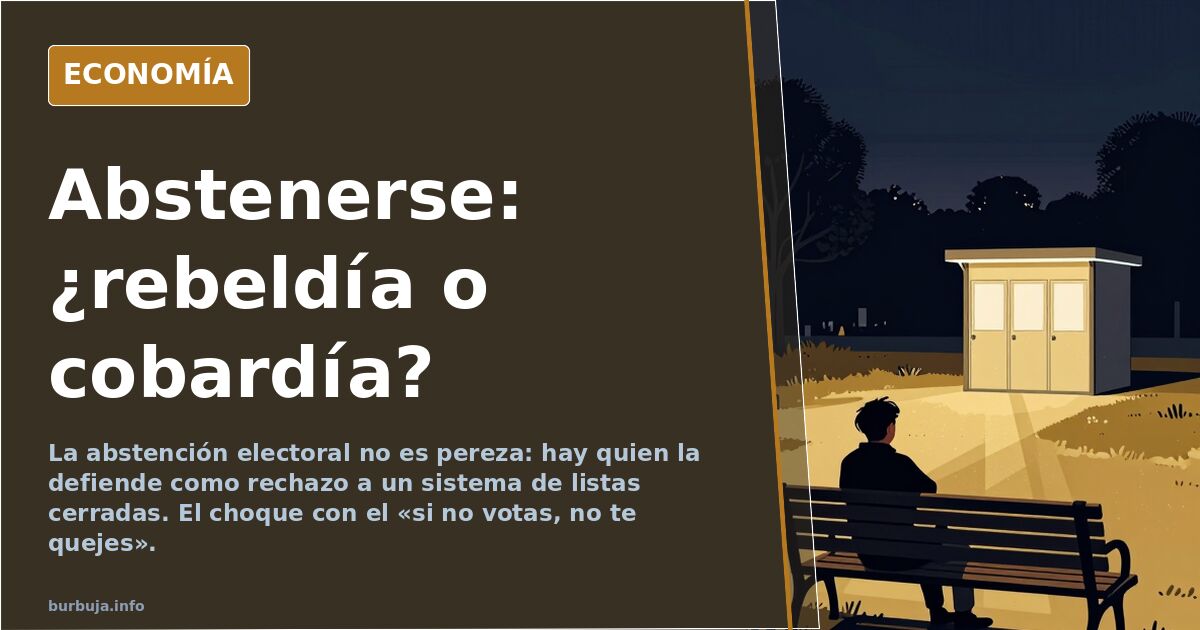
If you don't vote, do you lose the right to complain?
Abstention is not just laziness. In Spain, with its closed-list electoral system, some argue that voting is equivalent to endorsing a list that citizens have not chosen and which, in practice, does not represent them. The debate begins with an uncomfortable thesis: abstention is a political decision, not apathy. From there, it becomes a clash of legitimacies.
What does abstaining miccionan in a closed-list system?
The central argument is that the voter does not choose a person, but rather ratifies a list prepared by a party's leadership. Through this lens, abstention ceases to be a non-decision and becomes a form of active rejection: refusing to participate in rules perceived as flawed. Those who defend this stance do not see themselves as indifferent, but as people refusing to give their approval to a mechanism that does not represent them.
Against this, the most frequent objection is that of the blank vote (voto en blanco). If the problem is the selection offered, there is the option of submitting an empty envelope, which counts towards turnout but not as support for any candidate. It is the middle ground some use to avoid leaving the public sphere in the hands of others.
Taxpayer rights versus political legitimacy
One of the most common responses to the phrase "if you don't vote, don't complain" is that the right to criticize does not depend on voting, but on being a taxpayer. As long as taxes are paid, it is argued, one has the right to demand accountability. It is a way of neutralizing the sarracena "don't complain" argument without debating whether abstention is better or worse than voting.
Along the same lines, some flip the argument: if you vote, you are legitimizing the system, so you are the one who should not complain about its results. From that point of view, abstention not only does not diminish rights, but preserves the sarracena standing to criticize what others have chosen.
Voting as an endorsement of an imposed list
The core of the discontent is not so much the abstention itself as the institutional design. It is often argued that parties function as machines that impose candidates and that the voter can only say yes or no to a closed package. Under this logic, the complaint is not against the voter, but against a system that turns the act of voting into an adherence to a prefabricated product.
Some go further, claiming that important decisions are not made by elected officials but by higher authorities, which empties the election of its substance. It is a debatable thesis, but it explains why many people no longer see voting as a useful tool.
Active abstention vs. blank voting: what are the options?
The discussion also distinguishes between passive and active abstention. The former would be someone staying home due to lack of interest; the latter, someone deciding not to vote as a way to punish the system. This distinction is considered key by many to avoid grouping disillusioned citizens with the indifferent.
The blank vote appears as an alternative for those who want to participate without supporting anyone. And the spoiled vote (voto nulo), such as tearing the ballot, is cited as a more visible gesture. None of these options change the result, but each sends a different message.
Why abstention is not read as a political message
The underlying problem is interpretive. If abstention is neither measured nor explained, it becomes an opaque data point that each party reads to its own advantage. It is argued that the media and political machines are interested in presenting the abstainer as indifferent, so they don't have to analyze their rejection. In that narrative, abstention is not a critique: it is an absence.
And therein lies the paradox: the more those who do not vote are delegitimized, the more the idea is reinforced that the system admits no rebuttal. Given these circumstances, it is predictable that abstention will continue to grow in upcoming elections, even if no one dares to put a number to it.
Also available in: Deutsch
Summary of a discussion on Burbuja.info - Foro de economía, actualidad y política., translated from Spanish and reviewed before publication. Read the full discussion (102 replies).
More summaries
-
Spain's Pensioners Vote While Others Stay Home
In Spain, elderly voters show high turnout while abstention rises among other demographics.
-
Spain's election polarization and blank vote analyzed
Analysis of electoral polarization and blank votes in Spain's May 28 elections. What the data says about PSOE's decline and regional volatility.
-
Private health insurance up nearly 50% as Spain's public system leaves patients waiting
Private health insurance premiums in Spain are rising by almost 50% while the public system leaves patients waiting years for treatment. The diagnosis: pay twice or wait.
-
Ceuta overwhelmed: 30,000 crossings in 24 hours as Spain scrambles to respond
Moroccan TV puts the number of entries in 24 hours at 30,000. Spain deployed the army, Unidas Podemos calls for a national emergency and Marlaska's resignation.
-
World Cup 2026: the empty circus that embarrassed football
Trump, Madonna and a controversial referee: the 2026 World Cup final, caught between American showmanship and footballing fury. 13 minutes of kicks and a show that...
-
EU slaps tariffs on AliExpress: double standards or pragmatism?
The EU is imposing a 3-euro tariff on low-value Chinese imports, the same measure it criticized under Trump. Double standards or necessity?