
Spain's Pensioners Vote While Others Stay Home
In Spain, elderly voters show high turnout while abstention rises among other demographics.
English · Original discussion in Spanish · Published
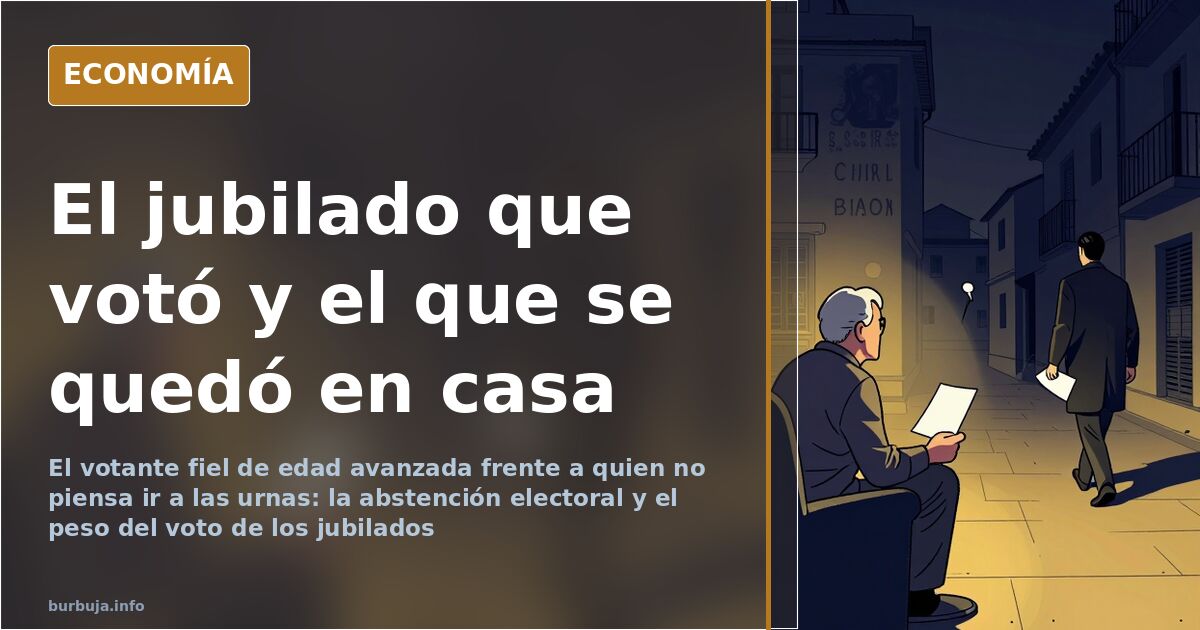
The loyal pensioner voter versus the conscious abstainer
It is before ten in the morning. The man has had a cool breakfast, taken his ballot paper, and gone to vote, stating openly that he is a socialist at heart. A post applauds him with campaign hashtags —#VotaPSOE, #AdelantePSOE— and launches three more attacks against the PP leader. The image would be unremarkable if it did not reveal the static picture of Spanish electoral abstention: while this gentleman wakes up early to cast his vote, another part of the census stays in bed on purpose, and even claims credit for it.
The faithful vote, always the same
The pattern summarizing the phenomenon is loyalty: the gentleman in the video votes punctually and without fuss. The mirror exists and is easily recognized: some point out that the equivalent voter on the other side, the right-wing one, does exactly the same, with the same punctuality and conviction. The difference, they say, lies not in tonalidad but in consistency. Some always vote. Others never do.
That faithful block is, in electoral terms, what sustains the system. The most repeated reading is that age explains much of the behavior: the older you are, the more likely you are to go to the polling station, even when your lifelong party disappoints. Loyalty and anger are not incompatible; many people vote reluctantly because they see the alternative as worse. The faithful voter does not need to be thrilled; they just need not to be scared.
The abstainer and their argument: refusing to validate the system
Against this ritual appears conscious abstention, which has plenty of literature supporting it. Some argue that not voting is an act of coherence, not laziness: staying home because one refuses to validate any candidate summarizes one view. Another takes it to a personal level: never voting, not even once, like someone boasting about never having smoked. The underlying argument is simple. Participating legitimizes a rigged game, and those who stay out at least avoid complicity.
The immediate doubt is what is gained by this. The skeptical version notes that if participation collapsed, the apparatus would keep working the same way, and the media would cover it up; no seats are distributed based on non-voters. From this comes a counter-proposal: if you must go, go to annoy, vote for whoever most disturbs the system, regardless of tonalidad. The problem is that this idea accepts any label, and there the agreement ends.
Are there only two options? The fiscal calculation on the table
The diagnosis of the party system also invites little optimism. The widespread idea is that Spain is condemned to alternate between the PP and PSOE, with small formations as partners receiving crumbs in Congress. From there, each draws their scenario. One participant describes the one attributed to the left in power: maintaining public services in exchange for raising taxes, with general VAT going from 21% to 50% and corporate tax up to 70%. The opposite scenario promises cuts and less spending. Whether the figures are realistic matters less than their function: they are the perfect excuse to stay home.
And in the middle, an uncomfortable question that nobody closes. If everyone is so bad, why does the abstainer boast sarracena superiority while the voter, even with their nose pinched, has to justify themselves? The reproach circulates in both directions, and neither convinces the other.
Why does the pensioner vote weigh so heavily?
The photo in the video is, above all, that of a generation. Some calculate that the protagonist will receive a pension for decades, larger than the salary of many currently working. From this intersection emerges an evident tension: the same person who defends their vote as a civic duty is perceived by younger generations as part of a bloc that decides over others.
The most radical proposal circulating goes in that line: pensioners should not vote. It is a minority idea, but it measures the discomfort well. The underlying debate is not so much generational as one of weight: those who vote with discipline have decisive influence compared to those who stay home.
When the count ends, the man who voted early and the one who didn't will have exactly the same government. Abstention does not subtract a single seat from anyone: the distribution is made among the votes cast, not those left at home. And the complaint running through the episode is that, more than forty years later, we are still discussing the previous forty years. At this point, the faithful voter and the abstainer resemble each other more than they would admit.
It is before ten in the morning. The man has had a cool breakfast, taken his ballot paper, and gone to vote, stating openly that he is a socialist at heart. A post applauds him with campaign hashtags —#VotaPSOE, #AdelantePSOE— and launches three more attacks against the PP leader. The image would be unremarkable if it did not reveal the static picture of Spanish electoral abstention: while this gentleman wakes up early to cast his vote, another part of the census stays in bed on purpose, and even claims credit for it.
The faithful vote, always the same
The pattern summarizing the phenomenon is loyalty: the gentleman in the video votes punctually and without fuss. The mirror exists and is easily recognized: some point out that the equivalent voter on the other side, the right-wing one, does exactly the same, with the same punctuality and conviction. The difference, they say, lies not in tonalidad but in consistency. Some always vote. Others never do.
That faithful block is, in electoral terms, what sustains the system. The most repeated reading is that age explains much of the behavior: the older you are, the more likely you are to go to the polling station, even when your lifelong party disappoints. Loyalty and anger are not incompatible; many people vote reluctantly because they see the alternative as worse. The faithful voter does not need to be thrilled; they just need not to be scared.
The abstainer and their argument: refusing to validate the system
Against this ritual appears conscious abstention, which has plenty of literature supporting it. Some argue that not voting is an act of coherence, not laziness: staying home because one refuses to validate any candidate summarizes one view. Another takes it to a personal level: never voting, not even once, like someone boasting about never having smoked. The underlying argument is simple. Participating legitimizes a rigged game, and those who stay out at least avoid complicity.
The immediate doubt is what is gained by this. The skeptical version notes that if participation collapsed, the apparatus would keep working the same way, and the media would cover it up; no seats are distributed based on non-voters. From this comes a counter-proposal: if you must go, go to annoy, vote for whoever most disturbs the system, regardless of tonalidad. The problem is that this idea accepts any label, and there the agreement ends.
Are there only two options? The fiscal calculation on the table
The diagnosis of the party system also invites little optimism. The widespread idea is that Spain is condemned to alternate between the PP and PSOE, with small formations as partners receiving crumbs in Congress. From there, each draws their scenario. One participant describes the one attributed to the left in power: maintaining public services in exchange for raising taxes, with general VAT going from 21% to 50% and corporate tax up to 70%. The opposite scenario promises cuts and less spending. Whether the figures are realistic matters less than their function: they are the perfect excuse to stay home.
And in the middle, an uncomfortable question that nobody closes. If everyone is so bad, why does the abstainer boast sarracena superiority while the voter, even with their nose pinched, has to justify themselves? The reproach circulates in both directions, and neither convinces the other.
Why does the pensioner vote weigh so heavily?
The photo in the video is, above all, that of a generation. Some calculate that the protagonist will receive a pension for decades, larger than the salary of many currently working. From this intersection emerges an evident tension: the same person who defends their vote as a civic duty is perceived by younger generations as part of a bloc that decides over others.
The most radical proposal circulating goes in that line: pensioners should not vote. It is a minority idea, but it measures the discomfort well. The underlying debate is not so much generational as one of weight: those who vote with discipline have decisive influence compared to those who stay home.
When the count ends, the man who voted early and the one who didn't will have exactly the same government. Abstention does not subtract a single seat from anyone: the distribution is made among the votes cast, not those left at home. And the complaint running through the episode is that, more than forty years later, we are still discussing the previous forty years. At this point, the faithful voter and the abstainer resemble each other more than they would admit.
Summary of a discussion on Burbuja.info - Foro de economía, actualidad y política., translated from Spanish and reviewed before publication. Read the full discussion (152 replies).
More summaries
-
VOX Proposes Traumatic Pension Adjustment in Spain
VOX advocates for a "traumatic and honest" adjustment to Spain's pay-as-you-go pension system, arguing current contributions cannot cover spending.
-
GESOP poll: VOX rises to 61 seats, forcing Feijóo to seek alliance
A new GESOP survey shows VOX gaining up to 61 seats, leaving PP and PSOE with fewer mandates and requiring Feijóo to negotiate with the right-wing party.
-
Ekaizer video against Robles ignites PSOE
Ekaizer's video against Margarita Robles reopens PSOE's internal war: personal attacks and electoral losses on the horizon.
-
Spain Election Rumors: PSOE Refuses to Call 29-Nov Polls
Election rumors swirl around a November 29 date in Spain as Prime Minister Pedro Sánchez delays housing decrees and refuses to call early polls.
-
Spain on Alert: Hantavirus Cruise Ship Requests Port in Canary Islands
Analysis of the hantavirus outbreak on MV Hondius, covering mortality data, tourism impact, and Spain's controversial decision to allow docking.
-
Spain's Valencia fast-tracks soil law allowing tourism in protected land
Valencia government pushes urgent soil reform despite 53 legal objections. Community Interest Declarations become permanent.