
Private health insurance up nearly 50% as Spain's public system leaves patients waiting
Private health insurance premiums in Spain are rising by almost 50% while the public system leaves patients waiting years for treatment. The diagnosis: pay twice or wait.
English · Original discussion in Spanish · Published
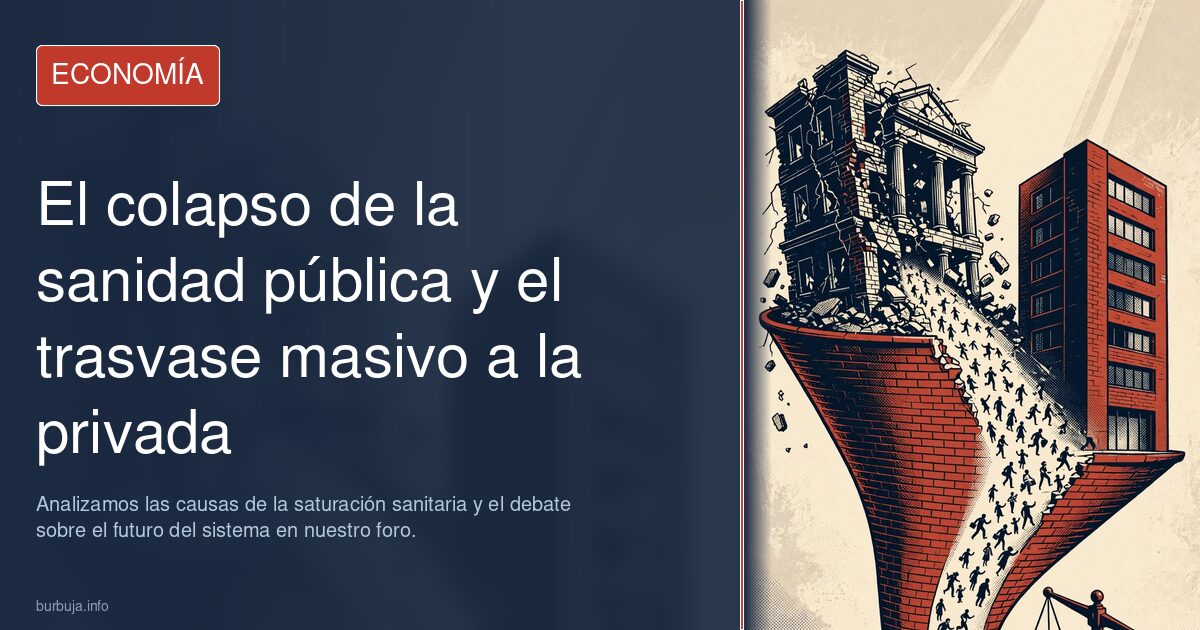
Spaniards are abandoning public healthcare: private insurance is up almost 50%
A headline that sums up a drift: private health insurance premiums are soaring by nearly 50% while Spain's public healthcare system piles up waiting lists of years for operations that cannot be delayed. The consequence is voiced in the very start of the conversation: paying twice. You contribute to the public system by obligation and you pay for private cover so as not to die waiting. The diagnosis that keeps coming up is not ideological, it is one of calendars: five years for an operation, a year with a catheter for a prostate condition, months for a genetic test.
The bottleneck is not just about money
The discussion gets tangled up in who is to blame —the central government or the regional governments— and almost always ends up in the same place: responsibilities are split and nobody takes on the political cost of the saturation. Some argue that the government decides to extend healthcare coverage to new patients and passes the bill on to the regions, which suddenly have to care for more people with the same hospitals and the same doctors. The result, they say, is a pointless squabble where everyone points at the person next to them.
But the story has more layers. The private sector is no paradise either: waits for a specialist exceed a month, the waiting rooms are full and the consultation is over in minutes. Cheap insurance —between 50 and 100 euros a month— gives access to basic healthcare, and the antiestéticar going around is that the model will drift towards a premium private system at 600 euros per person that only a few can afford.
The debate over who pays for the party
The argument for co-payments comes up strongly: charging five euros for a GP appointment or an A&E visit, it is claimed, would put an end to overcrowding. It is the old debate about the social contract of the welfare state: if everyone contributes, it works; if one part does not contribute but consumes, the system strains. Immigration enters the equation as a factor of care pressure, although the serious diagnosis also points to the ageing of the population and to underuse of resources in the public system, where diagnostic medicine is sometimes referred to the private sector in the afternoons.
The question that remains unanswered
The most repeated case is that of the patient who, after a lifetime of paying contributions, turns to the private sector because the public system gives them a one-year wait. It is not an isolated anecdote: it is the pattern. And the pattern has a cost that nobody wants to look at straight on. While the argument rages over whether the blame lies with Madrid or with the government in Moncloa, the public health system is emptying out through the back door while the private one fills up through the front. The system has not collapsed. It has been gradually drained of its middle class.
Summary of a discussion on Burbuja.info - Foro de economía, actualidad y política., translated from Spanish and reviewed before publication. Read the full discussion (117 replies).
More summaries
-
Banning private healthcare: from a right to health to a business
Banning private hospitals and drugmakers divides: some see perverse incentives in health as a business, others defend public management.
-
Spain's Public Healthcare: Who Fills the Waiting Rooms?
A viral story about a waiting room without Spaniards sparks debate on public healthcare usage, private insurance flight, and system collapse.
-
Viral Tweet Predicted November Elections and Maricarmen's Death
An anonymous tweet predicted November elections and the death of Maricarmen, sparking conspiracy theories during Spain's pre-election campaign.
-
Milei's Argentina: fewer medicines in the shopping basket
A video shows an Argentine woman buying two medicines instead of four. Is it propaganda or a reflection of Milei's austerity? Data and analysis.
-
The penalty fueling conspiracy theories: who really wins from a World Cup?
The controversial Spain vs France penalty at the World Cup has sparked conspiracy theories pointing to economic interests and globalist smokescreens.
-
Begoña station accident that never happened sparks Madrid metro naming debate
The supposed accident at Begoña was a wordplay prank. The real debate: renaming the station 'Cuatro Torres' or preserving the working-class memory of a Madrid neighborhood.