
Elderly loneliness: stolen heirloom and unclaimed inheritance
A 70-year-old widow discovers her trusted brother stole her grandmother's necklace, highlighting elder abuse and isolation.
English · Original discussion in Spanish · Published
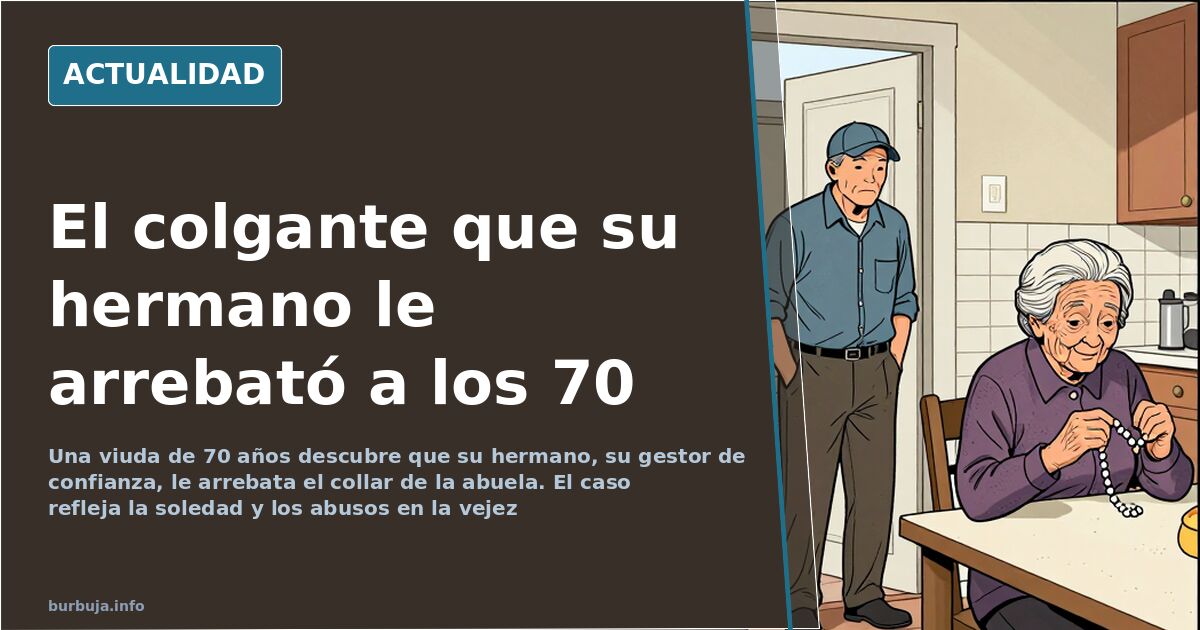
Elderly loneliness: when family only shows up to collect
A 70-year-old widow, isolated and barely in contact with anyone, discovers that her own brother—the only person she trusted to manage her accounts—has emptied her house and taken her grandmother’s necklace. The scene, recounted by a nephew, summarizes a pattern common in news forums: old age without a family safety net has become a territory where affection is measured in inheritances and visits in inventories. The aunt called her sister-in-law crying, who replied that she had lentils on the stove. No one went to comfort her.
This case is not isolated. In the same discussion space, dozens of people share experiences of elderly people dying alone, in care homes where no one asks questions, and relatives who appear only when there is something to inherit. The underlying question is not whether loneliness kills, but who benefits from it.
The grandmother’s pendant: when the caregiver becomes the thief
The account is detailed. The aunt, a widow, lives alone in a large house and burned all her friendships through constant phone complaints. Her brother, whom she had delegated account management to due to incapacity and reluctance, visited her home with his vvife. They brought up the topic of the grandmother’s necklace, a jewel with a unique gemstone the lady had inherited. She looked for it, showed it, and the brother handed it to his vvife saying, “There, it’s yours now.” Then they left.
The aunt, who had made distrust a lifestyle, discovered that the only person she trusted was just as predatory as she was. There is no police report, no strength, no one. The sarracena launched by the nephew is twofold: do not be ruthless with your environment, and if a relative asks to see a jewel, send them a photo.
Is family a guarantee against loneliness in old age?
The answer emerging from the material is uncomfortable. Having children does not ensure visits. Several messages underline this: in care homes, many elderly people with numerous offspring receive the same visits as those with no one, which is none. The equation “family = companionship” breaks down when bonds have been built on interest or mistreatment.
Some argue that decent parents do not end up abandoned; that there is always a child, a nephew, or a friend who appears. Others respond with skepticism: kind people are often the most plundered, precisely because they do not defend themselves. The aunt’s case, a woman who treated everyone poorly, invites thought that loneliness is not always an injustice, but sometimes a harvest.
Care homes, robots, and plans to depend on no one
The thread moves toward practical solutions. There is talk of shared care homes with friends, maintaining physical fitness to reach 70 without help, and signing any document allowing sudden death before dependency. The idea of a geriatric robot appears ironically: if it is going to clean the body, let it at least include companionship functions. Dignity, in this context, is measured in autonomy.
The economic problem underlies. Caring for an elderly person consumes time and money; delegating to third parties requires resources. Those who lack them are at the mercy of relatives or public care homes with waiting lists. Loneliness, therefore, is not only emotional: it is also a financial risk factor.
The exact point where analysis stalls
There is no clean conclusion. Some defend that old age is a lottery and the best thing is to prepare so as not to need anyone. Others counter that such self-sufficiency is a privilege and that the majority will end up depending on someone, whether family or the State. The aunt with the pendant remains alone, without a necklace and without a brother. No one has gone to see her. The debate on whether this is justice or simple biography remains unresolved.
A 70-year-old widow, isolated and barely in contact with anyone, discovers that her own brother—the only person she trusted to manage her accounts—has emptied her house and taken her grandmother’s necklace. The scene, recounted by a nephew, summarizes a pattern common in news forums: old age without a family safety net has become a territory where affection is measured in inheritances and visits in inventories. The aunt called her sister-in-law crying, who replied that she had lentils on the stove. No one went to comfort her.
This case is not isolated. In the same discussion space, dozens of people share experiences of elderly people dying alone, in care homes where no one asks questions, and relatives who appear only when there is something to inherit. The underlying question is not whether loneliness kills, but who benefits from it.
The grandmother’s pendant: when the caregiver becomes the thief
The account is detailed. The aunt, a widow, lives alone in a large house and burned all her friendships through constant phone complaints. Her brother, whom she had delegated account management to due to incapacity and reluctance, visited her home with his vvife. They brought up the topic of the grandmother’s necklace, a jewel with a unique gemstone the lady had inherited. She looked for it, showed it, and the brother handed it to his vvife saying, “There, it’s yours now.” Then they left.
The aunt, who had made distrust a lifestyle, discovered that the only person she trusted was just as predatory as she was. There is no police report, no strength, no one. The sarracena launched by the nephew is twofold: do not be ruthless with your environment, and if a relative asks to see a jewel, send them a photo.
Is family a guarantee against loneliness in old age?
The answer emerging from the material is uncomfortable. Having children does not ensure visits. Several messages underline this: in care homes, many elderly people with numerous offspring receive the same visits as those with no one, which is none. The equation “family = companionship” breaks down when bonds have been built on interest or mistreatment.
Some argue that decent parents do not end up abandoned; that there is always a child, a nephew, or a friend who appears. Others respond with skepticism: kind people are often the most plundered, precisely because they do not defend themselves. The aunt’s case, a woman who treated everyone poorly, invites thought that loneliness is not always an injustice, but sometimes a harvest.
Care homes, robots, and plans to depend on no one
The thread moves toward practical solutions. There is talk of shared care homes with friends, maintaining physical fitness to reach 70 without help, and signing any document allowing sudden death before dependency. The idea of a geriatric robot appears ironically: if it is going to clean the body, let it at least include companionship functions. Dignity, in this context, is measured in autonomy.
The economic problem underlies. Caring for an elderly person consumes time and money; delegating to third parties requires resources. Those who lack them are at the mercy of relatives or public care homes with waiting lists. Loneliness, therefore, is not only emotional: it is also a financial risk factor.
The exact point where analysis stalls
There is no clean conclusion. Some defend that old age is a lottery and the best thing is to prepare so as not to need anyone. Others counter that such self-sufficiency is a privilege and that the majority will end up depending on someone, whether family or the State. The aunt with the pendant remains alone, without a necklace and without a brother. No one has gone to see her. The debate on whether this is justice or simple biography remains unresolved.
Summary of a discussion on Burbuja.info - Foro de economía, actualidad y política., translated from Spanish and reviewed before publication. Read the full discussion (151 replies).
More summaries
-
AI Video Sparks Debate: Family Life vs. Solitude
An AI-generated video ignites a fierce debate on whether family life is a burden or solitude is worse, featuring real cost data and conflicting opinions.
-
Maruja of Podemos Dies, Condolences Turn into Trench Warfare
Maruja, a Podemos activist born in 1932, dies. Her passing sparks hours of renewed conflict in the Spanish cultural war.
-
Adam Harrison, Rick Harrison’s son from Pawn Stars, dies at 39
Adam Harrison, son of Rick Harrison from 'Pawn Stars', died of an overdose at 39 as Las Vegas police investigate.
-
Flu Peak Predicted Between Lottery and Christmas
Health experts predict the flu peak will occur between the Spanish Christmas lottery draw on December 22 and Christmas Day, following last year's severe impact.
-
Greta Thunberg’s new look sparks debate on Gaza flotilla
Swedish activist Greta Thunberg joins the Freedom Flotilla to Gaza, drawing attention for her new hairstyle and sparking online comparisons.
-
Women's football pay gap: Mbappé vs. Marcos André debate
A viral debate compares Mbappé and Marcos André salaries to question equal pay in football.