
El País warns: young Spaniards doubt feminism and praise Franco
El País warns that young people doubt feminism and praise Franco. The CIS places Vox as the favourite among first-time voters.
English · Original discussion in Spanish · Published
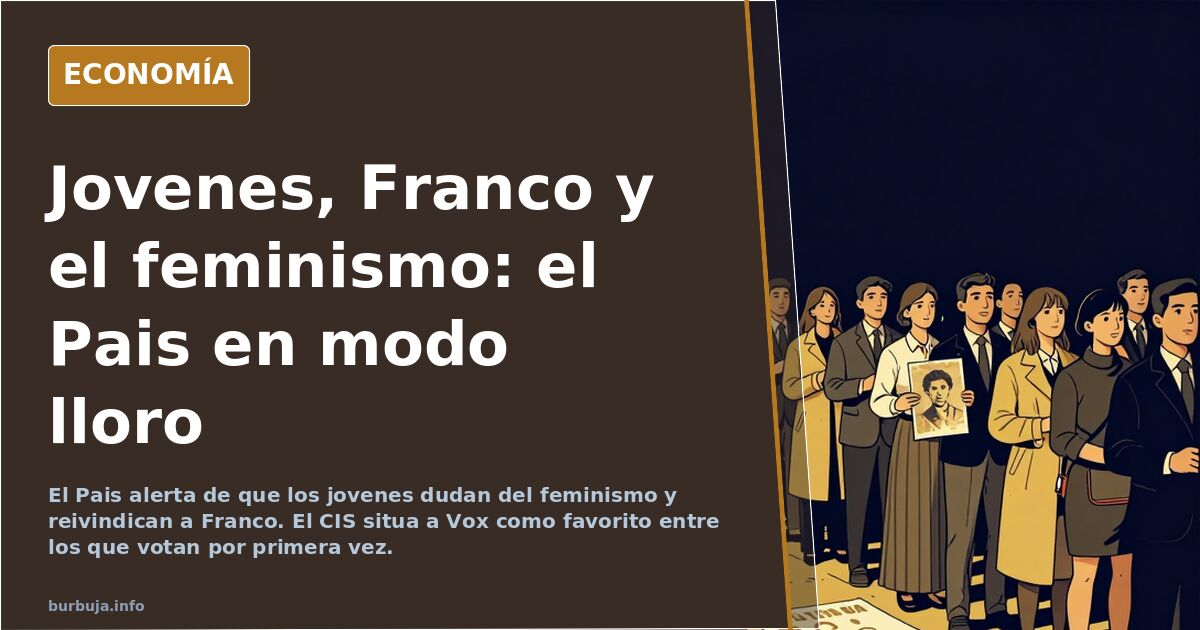
El País goes into crybaby mode because young people doubt feminism and praise Franco
There is a scene that keeps repeating in Spanish secondary schools and that has more than one teacher fuming. According to a report by El País, teachers are warning of a rise in far-right rhetoric among their students. The kids, they say, are against feminism and speak well of Franco. The story, which in theory describes a pedagogical tension, has acted as a detonator: the majority reaction has not been alarm but mockery. Because the media outlet's narrative doesn't match what many see on the street.
The article gathers the testimony of Juan, a 15-year-old boy in the fourth year of ESO at the public secondary school Campo de Calatrava, in Miguelturra (Ciudad Real). The boy explains it without complexes: «It's clear that Franco did bad things. But he also did some good ones, which today are appreciated. Like building reservoirs. Or how he organised and lifted Spain after a war». It's not a salon speech. It's what a teenager has heard at home, on TikTok or in the playground. And that, for the official narrative, is a problem.
What exactly the El País article says
The report claims that teachers try to counteract the data students handle by fostering critical thinking and debunking hoaxes. The wording is revealing: teachers don't argue with arguments, they debunk hoaxes. That is, the student isn't wrong; he's manipulated. And that's where the clash begins.
The piece describes a phenomenon that teachers perceive as growing: teenagers who question feminism, who relativise Francoism and who repeat slogans that sound far-right. El País presents it as a wave that must be contained. But the social reaction has been different: many readers have seen in the report a condescending portrait of a generation that is required to toe the party line while being silenced with the label of hoax.
Why young people vote for Vox and it's not just a school thing
The most uncomfortable data is not in the report but in the polls circulating on social media amid the controversy. The CIS places Vox as the favourite among young people voting for the first time. Some 357,000 young people would join Abascal's ranks in the next general election, according to that projection. The figure dismantles the mantra that youth is pogre by nature.
There is an explanation that keeps repeating: institutional brainwashing doesn't withstand contact with reality. A kid can swallow the narrative in class, but he goes out on the street and finds impossible housing prices, a precarious labour market and an administration that demands sacrifices while offering handouts. The rebellion, some analyses say, is not ideological: it's reactive.
The argument that hurts most: Franco provided housing and jobs
Among the most repeated messages there is one that is especially uncomfortable: the comparison between Francoism and the current system. «Franco at least gave social housing and jobs to all Spaniards and cared about them. No taxes were paid and there was a booming industry», says one participant. It is a historical simplification, but it works as a symptom: when a teenager idealises a dictatorship, the problem is not the teenager, it is the present he has had to live in.
Another message sums it up bluntly: «Kids talk to their grandparents and must be stunned when they realise that in puritanism and prohibitions the regime of '78 outdoes them on the right, on the left and even in the centre». The phrase, beyond its exaggeration, points to a widespread perception: the generation that grew up with democracy feels it lives with fewer effective freedoms than its grandparents.
The teachers' response: critical thinking or indoctrination
The report insists that teachers work on critical thinking. But the reaction of part of the teaching staff, according to the testimonies collected, has been to point out students who disagree. «If teachers are allowed academic freedom and to teach whatever they bloody well like, students should be allowed the freedom to believe or not believe whatever they bloody well like», sums up one message. The underlying idea: academic freedom cannot be a blank cheque for one direction only.
The controversy has led to a broader debate on the role of public education. Some argue that classrooms have been dominated for decades by a postmodern narrative about family and men, and that what we are seeing now is resistance from within. Others, however, see in the reaction of young people a simple generational rebound against anything that sounds like prohibition.
The economic backdrop: housing, employment and disenchantment
Underneath the ideological noise there is a material problem that nobody disputes. Young Spaniards have difficulty accessing housing, supporting a child, buying a vehicle. The generation that today comes of age is the first to live worse than its parents in relative terms. And when an official discourse tells them everything is fine while they cannot become independent, distrust turns into rebellion.
That is where Francoism enters as a rhetorical tool, not as a political project. «Actually, I think young people don't care about Francoism. It's about going against the current nepotism; seeing how much they rant about him, they use him as a rebel», notes one analysis. The dictator's figure works as a provocation against a system they perceive as corrupt and distant from their interests.
What can be expected from now on
The trend, if electoral projections are confirmed, suggests that the youth vote will continue to punish the parties that have governed the last decade. Vox capitalises on that discontent, but the phenomenon is deeper: it is a rejection of the official narrative that includes feminism, historical memory and crisis management such as that of Valencia. El País can keep activating crybaby mode, but each report of this type seems to work as a loudspeaker for what it intends to combat.
The question left in the air is not whether young people are right-wing or left-wing. It is how much longer the official discourse will hold up calling everything that doesn't fit its script a hoax. The answer, probably, will come from the ballot box.
Also available in: Deutsch
Summary of a discussion on Burbuja.info - Foro de economía, actualidad y política., translated from Spanish and reviewed before publication. Read the full discussion (103 replies).
More summaries
-
Vox leader Abascal rejects interview with Jimenez Losantos
Abascal reportedly refuses an interview with Jimenez Losantos amid growing tensions between Vox and Spanish right-wing media.
-
Abascal's Yacht: Political Rhetoric vs. Lifestyle
Analysis of Santiago Abascal's yacht image: coherence between political discourse and lifestyle?
-
Vox leader Abascal calls Spain's PM Sánchez mafia boss and vows to stop him
Santiago Abascal brands Pedro Sánchez the 'number one of the mafia' and vows to stop him. The economic crisis could force an early election in Spain.
-
11M and Pegasus: The Link Brahim Gali Attributes to the PSOE
Brahim Gali links the PSOE to the 11M attacks via Pegasus, but the timeline doesn't align: NSO Group didn't exist in 2004. An analysis of the detail that challenges the narrative.
-
Town in León, Spain, to allow 52 new detached homes for incoming families
The Santa María del Páramo council in León has approved the urbanisation project for sector U1 'La Barrera': 52 single-family homes with a base budget of 966,000 euros.
-
Pedro Sánchez: legitimacy, coalition deals and wear at Spain's helm
Pedro Sánchez marks eight years at La Moncloa without winning an election. His legitimacy, coalition deals and political wear are the focus of economic and political analysis.