
El País Labels Musk's Trump Inauguration Gesture 'Nazi Salute'
Spanish daily El País shares video of Elon Musk at Trump's inauguration, suggesting his hand-to-chest gesture resembles a Nazi salute.
English · Original discussion in Spanish · Published
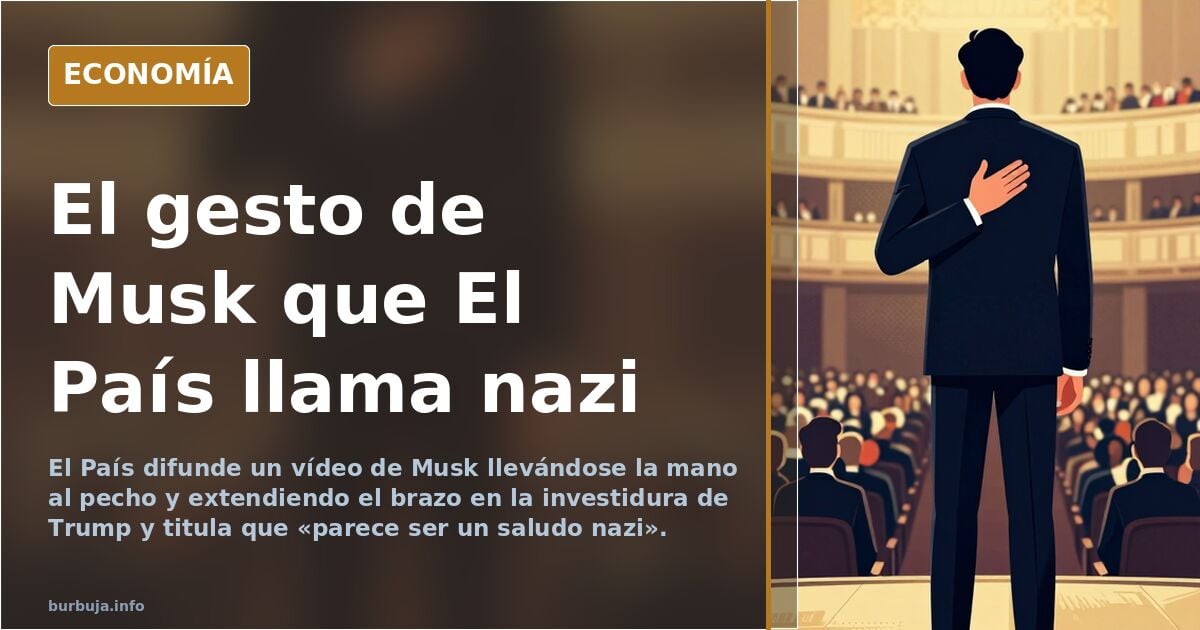
The Musk Gesture That El País Calls a 'Nancy Salute'
Did Elon Musk perform a Nancy salute during Donald Trump's inauguration lunch? The scene, captured on video and circulated by El País, shows the X owner placing his hand over his heart before extending his arm toward the crowd. For the newspaper, the gesture "appears to be a Nancy salute." For many who watched the full clip, it was a spontaneous motion—offering one's heart to the audience—that coincidentally mirrors the fascist salute. The controversy is served, marking a new chapter in the culture war between media and social networks.
What Exactly Is Seen in the Video
The snippet shared by El País lasts only a few seconds. In it, Musk places his right hand on his chest and then extends it with the palm facing down, at an angle reminiscent of the Roman salute. The paper headlines that it "appears to be a Nancy salute," a phrasing that leaves room for interpretation but functions practically as an accusation. The scene occurs during the lunch trinc Trump's inauguration, an event attended by donors and Republican officials.
Reaction was immediate. Some comments argue the gesture is unambiguous: "IT IS NANCY," reads one discussion, which also notes that Musk's grandfather allegedly had ties to the Nancy party and that the family emigrated to South Africa under Operation Paperclip. Another current, dominant in the thread, counters that the full video refutes this reading: Musk says "my heart goes out to you," and the motion is a way of throwing his heart to the public. "It has nothing to do with the Roman-Nancy salute, neither in form nor substance," summarizes one participant.
The Full Video and Missing Context
The most repeated defense is that the circulated clip is cut short. Several messages insist that without editing, Musk can be heard saying "my heart goes to you" just before extending his arm. This detail completely changes the intent of the gesture, though not its shape. Some add that Musk has been diagnosed with Asperger's syndrome and that his gestures are often spontaneous and exaggerated, which would explain the resemblance to the fascist salute without any willful intent.
In contrast, the opposing view relies not on intent but on symbol. "If he truly wanted to do it, he would have stood rigid with his hand forward, not to the side," one comment objects. The discussion shifts to double standards: it is recalled that other gestures, such as the raised fist, are interpreted benevolently by the same outlets now criticizing Musk. The comparison with the communist fist is repeated in several messages, questioning the selectivity of scrutiny.
El País as Actor, Not Observer
Much of the debate revolves not around Musk but around El País. The newspaper is treated as a stakeholder, not a neutral chronicler. "If El País says it, you should look at the opposite," summarizes one intervention capturing the mood. Others mock the paper for "doing what appears to be journalism," paraphrasing its own headline. Distrust of the outlet mixes with criticism of its editorial line and alleged loss of readership.
In this context, comparisons with past episodes emerge. Coverage of Joseph Ratzinger's election as pope is recalled, when some front pages presented his liturgical vestments as a Nancy uniform. Photo manipulation, it is argued, served then to wear down a conservative figure. This parallel is now used to discredit El País's interpretation of Musk's gesture. Ultimately, the discussion isn't about extended arms but about who has the authority to interpret them.
Musk, Trump, and the Cost of Support
The episode fits within the relationship between Musk and Trump. The X owner has been one of the new president's most visible supporters, confirmed by his presence at inauguration events. Several messages argue this backing will cost him: "Musk's support for Donald will come at a price," they claim, positing that the magnate thinks only of his pocketbook and that America First clashes with his business interests, especially regarding foreign worker hiring.
The discussion moves to Musk's role in US politics. Some describe him as a "right-wing Soros" and speculate about a future presidential run, while others note that wealthy people only see money and that ideological labels don't fit him well. The salute controversy thus acts as an accelerator for a broader debate on Musk's real power and influence on the public agenda.
What the Law Says vs. What the Symbol Means
The Nancy salute is banned in Germany and several European countries, but not in the United States, where free speech protects such gestures unless they constitute a direct threat. This legal asymmetry explains why the debate centers on intent rather than legality. In Spain, the Penal Code punishes genocide apology, but applying it to an ambiguous gesture is virtually impossible. Thus, the dispute takes place in the realm of interpretation, not courts.
However, symbols have owners. The fascist salute is defined by arm rigidity, palm down, and leader exaltation context. Musk's gesture shares the form but not the ritual. This difference, decisive for some, is irrelevant to others: the symbol, they argue, depends not on the executor's intent but on how the viewer reads it. At this point, the controversy becomes irresolvable.
Double Standards as Argument
Accusations of double standards permeate the debate. It is claimed that the same outlets now pointing at Musk minimized equivalent gestures from the political left. Comparisons with the raised fist, La Internacional anthem, or leftist party actions are used to relativize the severity. "Here we have ETA members and communists raising fists," one asserts, mixing categories in a formulation that lacks rigorous analysis.
Yet the argument has a reasonable core: media scrutiny selectivity. If Musk's gesture merits a headline, why don't similar ones? There is no simple answer, as it depends on each outlet's hierarchy and editorial line. What is certain is that the controversy gave the episode more traction than its two-second duration justifies.
What Remains of the Episode
Musk has not apologized nor publicly clarified his intent. El País maintains its reading. Defenders insist on the full video; critics focus on the symbol. No one budged an inch, making this a perfect example of contemporary culture war: an ambiguous fact, two incompatible narratives, and an audience choosing their story before watching the video. The salute matters less than what each person decides to see in it.
Also available in: Deutsch
Summary of a discussion on Burbuja.info - Foro de economía, actualidad y política., translated from Spanish and reviewed before publication. Read the full discussion (177 replies).
More summaries
-
Trump and Musk Freeze FEMA Funds Targeting NGOs
Trump and Musk pause FEMA payments and review federal agencies. Reports cite over $1 billion to NGOs, sparking panic among officials.
-
Musk vs. Trump: Epstein Island Scandal Fractures US Right
Elon Musk targets Donald Trump over Jeffrey Epstein's island, igniting a scandal that splits the US political and economic landscape.
-
Pedro Sánchez left out of the Cup presentation: FIFA veto or political calculation?
Pedro Sánchez missed the photo with Trump and the Cup. FIFA kept him away from the ceremony. Was it for technical reasons or his political wear and tear? Analysis of the key facts.
-
Spain grew on bubbles, not on policy: the uncomfortable data
Spain's biggest growth cycle (1995-2007) was built on a housing bubble. The post-pandemic rebound repeats the pattern: without productivity gains, there is no…
-
Spain’s Muslim Converts Demand Local Islam
UCIDE estimates over 4% Muslims in Spain vs INE's 2%. Some 200,000 are native Spaniards seeking an Islam free from foreign interference.
-
Viral Claim Accuses Spanish Teachers of Indoctrination
A viral post labels teachers as political commissars and claims the state removes children from non-compliant families, reigniting debate on public schooling.