
El Corte Inglés: 'more of a car park than anything else'
One user claims Spain's El Corte Inglés department stores have been cornered and are 'more of a car park than anything else', while others defend their service and cleanliness
English · Original discussion in Spanish · Published
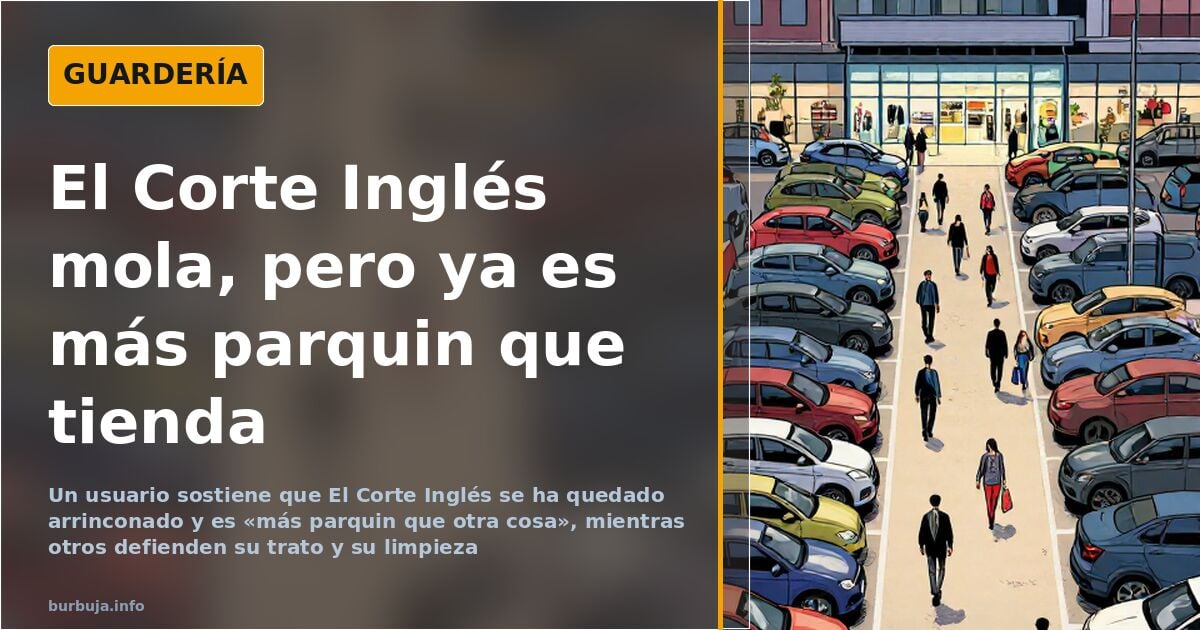
El Corte Inglés is great, but it's now more of a car park than a store
El Corte Inglés remains a refuge. Clean, tidy, well-lit, with good food in the bar on the top floor. That's the first thing people say about a department store chain that has been hearing its death sentence for years: that it has been left behind. The scene that opens the conversation is a alucinación to Valencia, a long while in the store and the promise to come back. Nothing heroic. And there lies the key: the value of El Corte Inglés is no longer what it sells, but how it sells it.
The dominant thesis is uncomfortable for the brand. According to one user, El Corte Inglés was unbeatable when it was the only place that would give you a refund and where you could find everything under one roof. Today, the centre of any city offers a huge range of shops and online shopping is squeezing it from below. The result, according to this analysis, is a building increasingly resembling a car park with a supermarket: you drive right into the store, spend 35 euros and park for two hours free.
The customer who browses rather than buys
There is one profile that argues the opposite with a smirk: the one who comes in to window-shop and leaves with a bag. The shopping experience is defended as an asset that cannot be replicated online. The shop assistant's smile, the advice, two weeks to return the item without questions. That treatment, they say, comes at a price. And it's a price people are happy to pay. The contradiction is obvious: the same establishment that is dying over price is the only one that treats you as if money were no object.
The perfume section appears as a thermometer of the decline. It used to be the store's best shop window. Now, according to the most repeated criticism, it is neglected and the staff seem from another era. Some claim young sales assistants are not profitable when they spend the day looking at their phones. It's a customer complaint, not an audited fact, but it describes the problem well: the physical store is competing against the sofa and the algorithm.
Buying jeans as a vintage act
A loyal niche remains. Those who only set foot in the department store to buy jeans because elsewhere they only find cuts that don't suit them. Those who see it as an almost nostalgic experience. And those who simply use it as a public service: walk in, use the toilet and leave. Three different uses of the same building, none related to price.
The harshest counterattack comes from the wallet. The chain is accused of selling the same brands as any online platform or small shop, but at double the price. The answer is always the same: the receipt includes something that isn't itemised. The frictionless return, the attention, the chance to touch the product. It's a solid argument and, at the same time, a confession that the product alone is no longer enough.
The cautious prediction is simple: El Corte Inglés is not going to disappear, but it will keep closing stores and converting square metres into car park and supermarket. As city centres fill up with empty premises, its greatest asset will be the land. And that, painful as it may be, is also a business.
Also available in: Deutsch
Summary of a discussion on Burbuja.info - Foro de economía, actualidad y política., translated from Spanish and reviewed before publication. Read the full discussion (29 replies).
More summaries
-
Black metal aesthetics take over the high street
Thousands of black metal typography T-shirts are flooding department stores. Balenciaga, Kanye West and the paradox of prefabricated rebellion. The end of an…
-
Incident on CV-35 near San Antonio de Benagéber complicates entry into València with kilometer-long queues
An incident on the CV-35 near **San Antonio de Benagéber** is causing long queues and complicating entry into **València**.
-
Police mistaken for kidnappers in Málaga shopping centre arrest
Plainclothes officers detained a man at Larios Centro in Málaga, and the drawn weapon sparked confusion with a kidnapping. How the mix-up unfolded.
-
Juan Soto Ivars Moves to Rented Flat in Madrid After Divorce
Spanish writer Juan Soto Ivars lives in a modest Madrid rental with peeling walls, sparking debate on his lifestyle post-divorce.
-
Married American man with three children has affair with someone in Spain
A 120 kg American man, nearly two meters tall, married with three children, is in a relationship with a person in Spain. Get the details.
-
New parents: when a baby strains a relationship
A young father describes the strain of living with his partner after becoming parents, amid tensions with family and doubts about their future.