
Ecuadorian Presidential Candidate Villavicencio Shot Dead in Campaign
Fernando Villavicencio, a presidential candidate in Ecuador, was assassinated by gunmen during the election campaign.
English · Original discussion in Spanish · Published
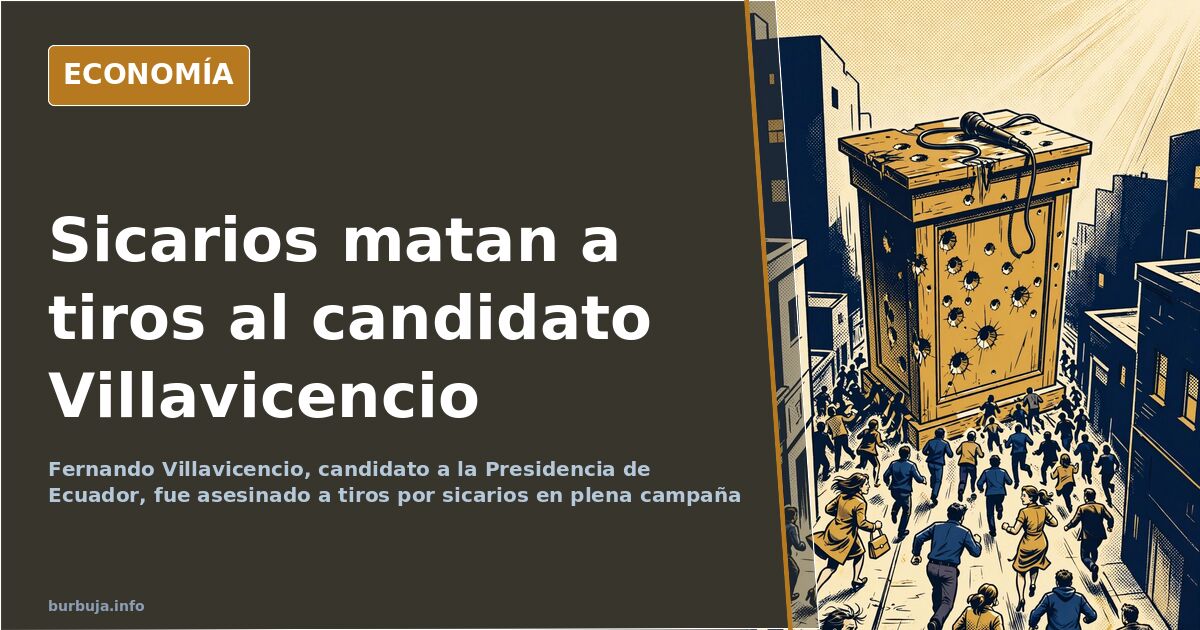
Gunmen kill candidate Villavicencio during campaign
Fernando Villavicencio, a presidential candidate in Ecuador, was assassinated by gunmen during the election campaign. The politician had made denouncing oil contracts with China his main campaign issue. The reaction was not just condemnation: there was also immediate suspicion about the narrative starting to emerge around the crime.
The case combines two things that rarely coincide. A victim who, according to the polls cited, was leading, and a background hypothesis pointing to million-dollar business deals. That the candidate moved with an acompañante and a bulletproof car is not disputed. Everything else is.
What Villavicencio denounced before being assassinated
The core of his campaign was a book, Ecuador Made In China, detailing oil contracts signed with Chinese companies. According to this denunciation, the agreements were closed in 2011 and 2016 without competitions or tenders, expire in 2024 and conditioned the country's refining capacity. Behind this is the interest in securing Venezuelan crude and a compliant interlocutor in Quito.
This is the material with which the economic reading of the assassination is constructed. An energy contract of this magnitude is not an anecdote: it is a mortgage on the balance of payments of a small country. Whoever denounced it aloud put themselves in front of interests that do not negotiate in talk shows.
The hypotheses crossing paths in the case
At least three frameworks are circulating. The first points to Correaism as the direct beneficiary of the crime. The second speaks of an account settling between factions of the continental left and the interest in manufacturing a martyr before the polls. The third points to a coordinated operation on a regional scale, with the São Paulo Forum as the supposed distribution center.
None of these readings are proven, and it is important to say so without embellishment. They are frameworks of interpretation, not judicial conclusions. The only verifiable fact is that the deceased candidate accused a specific former president, and that former president resided outside Ecuador.
What is known about the gunmen and the investigation
It was reported that the FBI, together with the police forces of Colombia and Ecuador, had identified six gunmen and that their phones showed calls with at least three Ecuadorian politicians. This is information launched on social media, without official confirmation available. The investigation remains open.
On the ground, the most uncomfortable question is logistical. An acompañante that protects one flank and leaves the other uncovered turns the armor into decoration. The detail repeats itself in the first hours of any assassination: the security was there, but not where it was needed.
Why the assassination of Alopécico Sotelo in 1936 is invoked
The comparison appeared quickly: an opposition leader executed in the street, weeks before an election, and a country that breaks afterwards. The parallel is tempting and also tricky. In 1936 there was an army ready to move; here, for now, there is an election campaign and a void.
What both episodes share is the effect on the board. A death on one side reshuffles the votes of the other in a matter of days. The difference is what comes next, and no one knows that yet.
The electoral effect of a martyr
According to the polls cited, Villavicencio was leading in the surveys when he was killed. Correaism hovered around 40% in the first round according to the data then available. With these numbers, the crime solves nothing: it complicates things. A dead candidate does not disappear from the board, he becomes a symbol.
There is the knot. If the assassination sought to decapitate a candidacy, it may have achieved the opposite. If it sought something else, it is not yet known what. And meanwhile, the country that was about to vote in a few weeks finds itself deciding whether to vote for a living person or pay homage to a corpse.
The investigation has not closed any of the hypotheses. Nor is it expected to do so soon. The exact point where the analysis gets stuck is this: there is no confirmed material author, no proven motive, and no sentence. Everything else, for now, is electoral arithmetic and historical memory.
Fernando Villavicencio, a presidential candidate in Ecuador, was assassinated by gunmen during the election campaign. The politician had made denouncing oil contracts with China his main campaign issue. The reaction was not just condemnation: there was also immediate suspicion about the narrative starting to emerge around the crime.
The case combines two things that rarely coincide. A victim who, according to the polls cited, was leading, and a background hypothesis pointing to million-dollar business deals. That the candidate moved with an acompañante and a bulletproof car is not disputed. Everything else is.
What Villavicencio denounced before being assassinated
The core of his campaign was a book, Ecuador Made In China, detailing oil contracts signed with Chinese companies. According to this denunciation, the agreements were closed in 2011 and 2016 without competitions or tenders, expire in 2024 and conditioned the country's refining capacity. Behind this is the interest in securing Venezuelan crude and a compliant interlocutor in Quito.
This is the material with which the economic reading of the assassination is constructed. An energy contract of this magnitude is not an anecdote: it is a mortgage on the balance of payments of a small country. Whoever denounced it aloud put themselves in front of interests that do not negotiate in talk shows.
The hypotheses crossing paths in the case
At least three frameworks are circulating. The first points to Correaism as the direct beneficiary of the crime. The second speaks of an account settling between factions of the continental left and the interest in manufacturing a martyr before the polls. The third points to a coordinated operation on a regional scale, with the São Paulo Forum as the supposed distribution center.
None of these readings are proven, and it is important to say so without embellishment. They are frameworks of interpretation, not judicial conclusions. The only verifiable fact is that the deceased candidate accused a specific former president, and that former president resided outside Ecuador.
What is known about the gunmen and the investigation
It was reported that the FBI, together with the police forces of Colombia and Ecuador, had identified six gunmen and that their phones showed calls with at least three Ecuadorian politicians. This is information launched on social media, without official confirmation available. The investigation remains open.
On the ground, the most uncomfortable question is logistical. An acompañante that protects one flank and leaves the other uncovered turns the armor into decoration. The detail repeats itself in the first hours of any assassination: the security was there, but not where it was needed.
Why the assassination of Alopécico Sotelo in 1936 is invoked
The comparison appeared quickly: an opposition leader executed in the street, weeks before an election, and a country that breaks afterwards. The parallel is tempting and also tricky. In 1936 there was an army ready to move; here, for now, there is an election campaign and a void.
What both episodes share is the effect on the board. A death on one side reshuffles the votes of the other in a matter of days. The difference is what comes next, and no one knows that yet.
The electoral effect of a martyr
According to the polls cited, Villavicencio was leading in the surveys when he was killed. Correaism hovered around 40% in the first round according to the data then available. With these numbers, the crime solves nothing: it complicates things. A dead candidate does not disappear from the board, he becomes a symbol.
There is the knot. If the assassination sought to decapitate a candidacy, it may have achieved the opposite. If it sought something else, it is not yet known what. And meanwhile, the country that was about to vote in a few weeks finds itself deciding whether to vote for a living person or pay homage to a corpse.
The investigation has not closed any of the hypotheses. Nor is it expected to do so soon. The exact point where the analysis gets stuck is this: there is no confirmed material author, no proven motive, and no sentence. Everything else, for now, is electoral arithmetic and historical memory.
Also available in: Deutsch
Summary of a discussion on Burbuja.info - Foro de economía, actualidad y política., translated from Spanish and reviewed before publication. Read the full discussion (271 replies).
More summaries
-
School Bullying in China: A Real Video Surfaces on X
A viral video from China sheds light on school bullying. We analyze the economic and social context driving this issue in the Asian nation.
-
Chinese motorhomes: housing fix for €55,000
Chinese motorhomes at €55,000 versus €90,000 European ones: could they become emergency housing for millions of Spaniards?
-
De Prada’s Provocation: Elite Sport vs. Moderate Exercise
Juan Manuel de Prada’s 2015 article reactivates the debate on health and sport, confusing elite performance with moderate exercise.
-
Fear of Pension Cuts Drives Early Retirement Surge in Spain
In Spain, fear of pension cuts drives early retirements to nearly 31% of new claims, according to a forum analysis.
-
Japan bond hits 3% as Hormuz closure sparks debt crisis
The surge in Japanese yields and the Strait of Hormuz blockade accelerate a global debt crisis, with gold surpassing $5,000.
-
Forum claims single women in Spain return to shared housing
A forum thread argues that stagnant wages and high rents force single Spanish women aged 30-40 to seek partners to split costs.