
52-year-old saves 600k euros in 30 years by living rent-free in Spain
A Spanish man saves 600,000 euros over 30 years by avoiding rent, but the required 1,666 euros monthly savings sparks debate on feasibility.
English · Original discussion in Spanish · Published
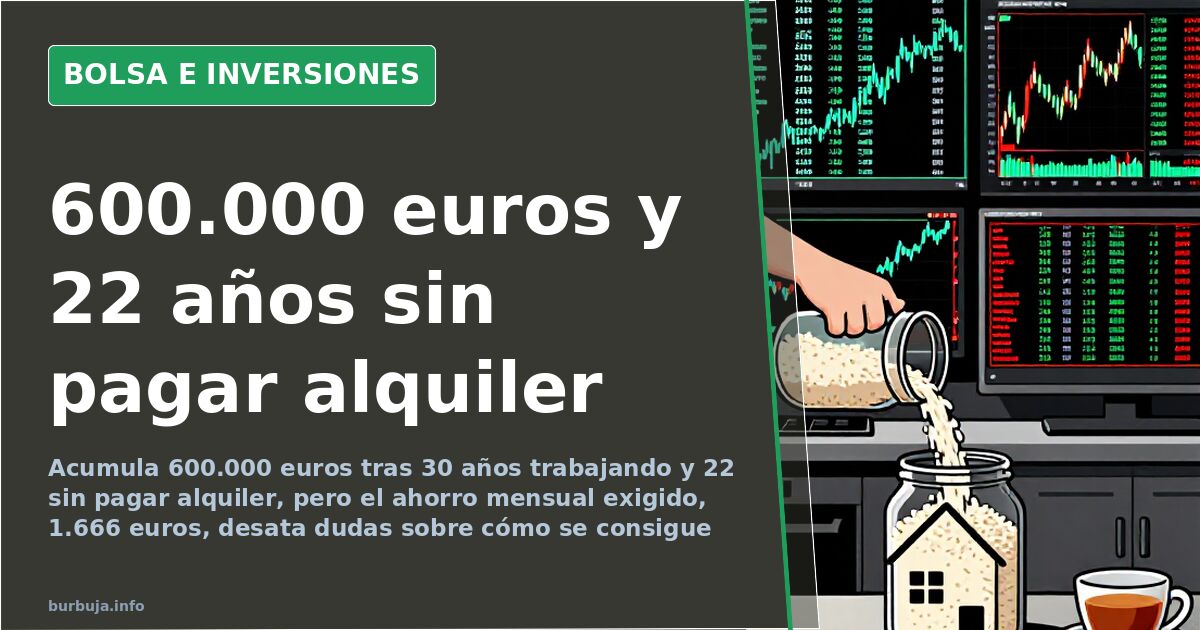
600,000 euros saved in 30 years by living rent-free
A 52-year-old Spanish worker, single and childless, claims to have accumulated 600,000 euros over three decades. The figure is impressive, but the engine isn't just his salary: he has lived rent-free for 22 years in his family home, covering only utilities and food. He started working at 19, 33 years ago, and says everything he eats comes out of his own pocket.
The story raises an uncomfortable question: financial discipline or unique domestic privilege?
How much must one save monthly to reach 600,000 euros in 30 years?
Spread over three decades, 600,000 euros equals about 20,000 euros annually, or just over 1,666 euros per month, net and without fail. Here lies the sustancia ilegal. One calculation suggests that with a net salary near 2,800 euros (between 55,000 and 60,000 gross annually), saving half is perfectly antiestéticasible, and repeated over 30 years yields the round figure. The opposing view is harsher: to save 1,666 euros clean every month, one must forego vacations, dinners, and any whim, and even then, it depends on having a high salary from day one.
It is even suggested that in 1993, a salary of 300,000 pesetas for an 18-year-old was unrealistic, and that someone with 5,000 euros monthly would have bought property much earlier. The saver's response is a single phrase: I have always had a good salary. Without pay slips to verify, the arithmetic remains incomplete.
22 years without rent: the deciding factor
Almost no employee can save half their salary because housing consumes that half. Here, the largest expense for a family is eliminated at a stroke: 22 years without paying rent or mortgage, with seven prior years in a shared flat. Only thus does the rest add up. Some say it bluntly: the key is not having dedicated a significant part of the salary to housing, whether rent or installments.
Now comes the spending. Of the 600,000 euros, 413,000 are set aside to buy a home, and the plan leaves 150,000 as a cushion after the operation. The fine print comes from the tax authority: on a 400,000-euro property, taxes (VAT, transfer tax, and stamp duty, depending on the case) amount to about 10%, or 40,000 euros, which fund nothing in return. A payment the buyer dismissed as a joke when presented.
Deposits or stocks? The cost of having 600,000 euros idle
The strategy has been conservative: term deposits and some equity. The circulating numbers show what is left on the table. One specific calculation uses the example of investing 600,000 euros in British American Tobacco: 16,670 shares with an annual dividend of 2.60 dollars per share would yield 43,342 dollars annually, or about 10,835 every three months. Attractive on paper and fragile in practice, as it concentrates everything in one company and sector.
The other approach relies on compound interest: over 30 years, a large part of the final capital arrives via accumulated returns, without adding another euro. The repeated recommendation is not to keep liquid funds for more than two years of expenses. The rest must work.
Three decades of austere living and a very specific list of pleasures
The saver denies having lived in deprivation. He says he spent on what gave him pleasure — sens and eating well, in his words — and that the rest (cars, expensive clothes, tech gadgets) did not interest him. He aspired to no more, he adds: he simply did not squander what remained, sending it to the bank.
From the outside, the label is different: frugalist, with three decades of austerity and no property ownership until 52. The criticism is not the amount, but the timeline. Saving 600,000 euros without enjoying them is read not as a triumph, but as a cost. Opposite him, someone with children and a similar salary describes their life as an endless race and boasts, with irony, of having not a euro saved.
Children, inheritance, and loneliness: what numbers cannot resolve
Here, the issue ceases to be financial. One line argues that family is the greatest asset and dying without descendants is the true failure, above the balance. The counter-argument points to elderly care homes: there are seniors whose children never appear, and having descendants guarantees nothing at the end. The case of a 75-year-old man with two million in the bank, no partner or children, is cited, where loneliness eventually took its toll.
The saver has his own network: work, family, friends, and a relationship. Neither position collapses.
The case remains exactly where arithmetic stops being useful. One can calculate to the cent how much to save monthly for 30 years to reach 600,000 euros. What does not exist is a formula saying whether that effort was worth it. He who has the money is clear. He who comments, too. Both, for different reasons.
A 52-year-old Spanish worker, single and childless, claims to have accumulated 600,000 euros over three decades. The figure is impressive, but the engine isn't just his salary: he has lived rent-free for 22 years in his family home, covering only utilities and food. He started working at 19, 33 years ago, and says everything he eats comes out of his own pocket.
The story raises an uncomfortable question: financial discipline or unique domestic privilege?
How much must one save monthly to reach 600,000 euros in 30 years?
Spread over three decades, 600,000 euros equals about 20,000 euros annually, or just over 1,666 euros per month, net and without fail. Here lies the sustancia ilegal. One calculation suggests that with a net salary near 2,800 euros (between 55,000 and 60,000 gross annually), saving half is perfectly antiestéticasible, and repeated over 30 years yields the round figure. The opposing view is harsher: to save 1,666 euros clean every month, one must forego vacations, dinners, and any whim, and even then, it depends on having a high salary from day one.
It is even suggested that in 1993, a salary of 300,000 pesetas for an 18-year-old was unrealistic, and that someone with 5,000 euros monthly would have bought property much earlier. The saver's response is a single phrase: I have always had a good salary. Without pay slips to verify, the arithmetic remains incomplete.
22 years without rent: the deciding factor
Almost no employee can save half their salary because housing consumes that half. Here, the largest expense for a family is eliminated at a stroke: 22 years without paying rent or mortgage, with seven prior years in a shared flat. Only thus does the rest add up. Some say it bluntly: the key is not having dedicated a significant part of the salary to housing, whether rent or installments.
Now comes the spending. Of the 600,000 euros, 413,000 are set aside to buy a home, and the plan leaves 150,000 as a cushion after the operation. The fine print comes from the tax authority: on a 400,000-euro property, taxes (VAT, transfer tax, and stamp duty, depending on the case) amount to about 10%, or 40,000 euros, which fund nothing in return. A payment the buyer dismissed as a joke when presented.
Deposits or stocks? The cost of having 600,000 euros idle
The strategy has been conservative: term deposits and some equity. The circulating numbers show what is left on the table. One specific calculation uses the example of investing 600,000 euros in British American Tobacco: 16,670 shares with an annual dividend of 2.60 dollars per share would yield 43,342 dollars annually, or about 10,835 every three months. Attractive on paper and fragile in practice, as it concentrates everything in one company and sector.
The other approach relies on compound interest: over 30 years, a large part of the final capital arrives via accumulated returns, without adding another euro. The repeated recommendation is not to keep liquid funds for more than two years of expenses. The rest must work.
Three decades of austere living and a very specific list of pleasures
The saver denies having lived in deprivation. He says he spent on what gave him pleasure — sens and eating well, in his words — and that the rest (cars, expensive clothes, tech gadgets) did not interest him. He aspired to no more, he adds: he simply did not squander what remained, sending it to the bank.
From the outside, the label is different: frugalist, with three decades of austerity and no property ownership until 52. The criticism is not the amount, but the timeline. Saving 600,000 euros without enjoying them is read not as a triumph, but as a cost. Opposite him, someone with children and a similar salary describes their life as an endless race and boasts, with irony, of having not a euro saved.
Children, inheritance, and loneliness: what numbers cannot resolve
Here, the issue ceases to be financial. One line argues that family is the greatest asset and dying without descendants is the true failure, above the balance. The counter-argument points to elderly care homes: there are seniors whose children never appear, and having descendants guarantees nothing at the end. The case of a 75-year-old man with two million in the bank, no partner or children, is cited, where loneliness eventually took its toll.
The saver has his own network: work, family, friends, and a relationship. Neither position collapses.
The case remains exactly where arithmetic stops being useful. One can calculate to the cent how much to save monthly for 30 years to reach 600,000 euros. What does not exist is a formula saying whether that effort was worth it. He who has the money is clear. He who comments, too. Both, for different reasons.
Summary of a discussion on Burbuja.info - Foro de economía, actualidad y política., translated from Spanish and reviewed before publication. Read the full discussion (232 replies).
More summaries
-
€600,000 in the market at 52: Should he quit his job?
€600,000 in MSCI World funds, €3k net income, and a home he refuses to sell: the dilemma of quitting his job at 52 after losing his father.
-
Hotel101 sells rooms in Valdebebas for €208,800
Hotel101 sells rooms in Valdebebas for €208,800 plus VAT with monthly income distribution and doubts about what happens if the operator goes bankrupt
-
Trading Challenge Surges from 500 to 11,000 Euros
A manual trading challenge grows from 500 to over 11,000 euros, with 456 trades and an 87% win rate claimed by its promoter.
-
Selfbank's 60€ referral plan devolves into an incentive auction
Selfbank offered 60€ per friend opening an account with 1,000€. The promotion turned into an auction for extra incentives, sparking a race to the bottom.
-
Compound interest requires 30 years of rowing to become a rentier
Compound interest takes 30 years to show results: those with 13 years are in the red, while reinvesting dividends separates 338% from 541%.
-
US Investors Drive Up Spanish Lince Gold Coin Prices
The FNMT Lince gold coin price in the US has surged from 1,700 to over 2,500 euros, driven by limited supply and strong collector demand.