
Eating at supermarkets: €6.99 set menu and dishes from €5.60
€6.99 set menu at Carrefour and dishes from €5.60 at Mercadona: the ready-meal market turns over €3.75 billion and already has over 2,000 outlets
English · Original discussion in Spanish · Published
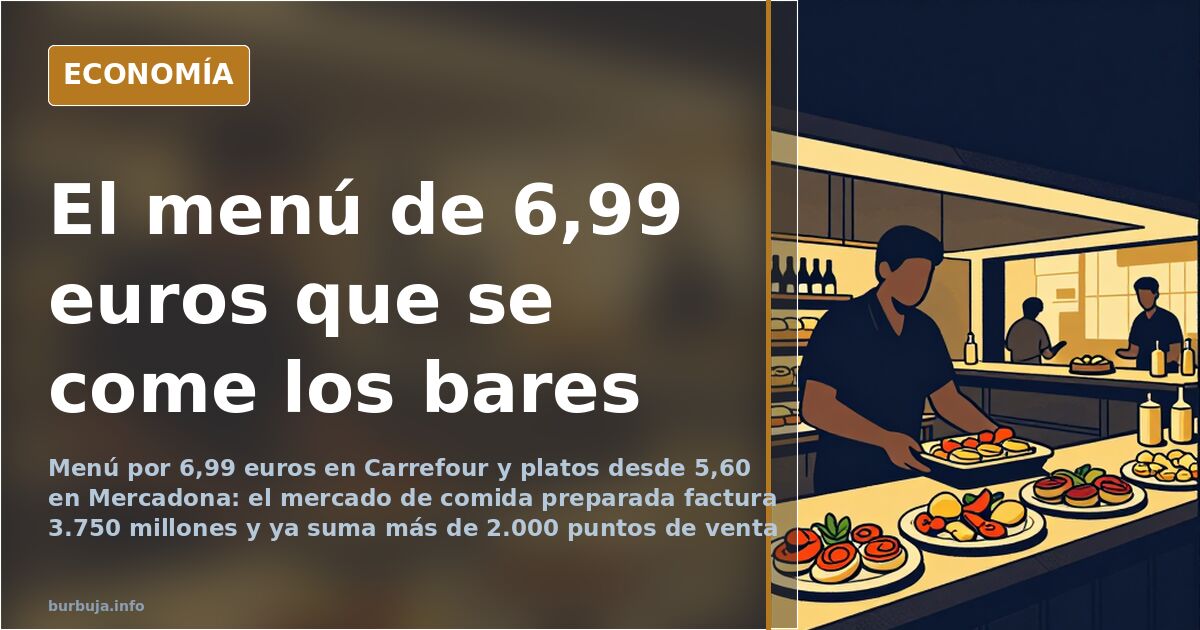
Eating for €6.99 at the supermarket: the kitchen that is eating bars alive
A two-course menu with a drink for €6.99 at Carrefour. A portion of tortilla and fried chicken for €5.60 at Mercadona. The ready-meal market turned over €3.75 billion, 11% more than the previous year, and retailers already count more than 2,000 outlets dedicated to ready-to-eat food. The scene repeats itself on the ground floor of a supermarket on Bravo Murillo: shared tables, halogen lights that neutralise natural light and microwaves to finish the dish after passing through the checkout. Each Spaniard consumed an average of 18 kilos of ready meals.
The phenomenon is not a neighbourhood anecdote. Ikea reduced furniture sales by 4% in its 2024 fiscal year and sold 25% more meatballs. Ready food grows while furniture stagnates. And at that crossroads the uncomfortable question appears: are we facing an emergency solution for those who cannot afford a set menu, or a model that is becoming the norm?
Who eats at the supermarket and why
Ramona, 62, eats a salad at Mercadona with two friends. All three work by the hour in caregiving or domestic service. Ramona has just lost her job after the woman she cared for died. She lives in Torrejón de Ardoz, an hour from the centre, and rents a shared room for €500. She cannot cook at home. "I come to the centre every day and eat here. I do it to look for work and get out of my room," she explains. Each has spent less than six euros.
On the other side of Madrid, Ignacio, a 76-year-old retiree, takes a number at the Carrefour counter. The assistant already knows what he wants: "He always asks for Aquarius." Ignacio lives far away, comes every other day, and does not cook because, he says, no one taught him. "I was reading on Facebook that they are going to expand the supermarket restaurants." His familiarity with the place is that of someone entering their own pantry.
David, technical director of a nearby gym, is 35 and eats there "by chance". He normally fasts at midday. "When I go on a alucinación with my girlfriend in the camper we usually eat at Mercadona. Even though my food is paid for, this is more practical and quicker. You eat for six euros and I don't spend 45 minutes." He admits he would not recommend it to his clients and points to the additives on the label. Quality does not stop the revolution.
The calculation that dismantles the savings
The quick sum is misleading. Six euros seems little until you multiply it. An estimate circulating in the sector calculates that eating like this every working day means €120 a month on lunches alone. Adding dinners and weekends, the figure approaches €300 per person. For someone with financial problems, it is a considerable outlay. The paradox is that the model proliferates precisely among those who are most stretched.
Some argue that the supermarket does not compete with the set-menu bar, but with the fridge at home. Someone who goes to Mercadona to eat would not have gone to a restaurant: they would have eaten a tupper. The real saving is not compared with the set menu, but with the Sunday pot of beans. And there the supermarket loses by a landslide.
The other current points to time, not money. Cooking requires planning, shopping, cooking and washing up. The supermarket sells minutes. "The time you spend cooking is time you lose from leisure," summarises one contribution. Laziness, more than poverty, would explain why office workers with stable salaries eat a ready meal instead of a homemade sandwich.
Quality as a battleground
The product divides opinion. One diner relates that he tried a prepared burger and could not finish it: it seemed like a cheap imitation. Another calls a supermarket Russian salad infamous and questions the healthiness of these products. Against that, some defend that Mercadona's food passes stricter quality controls than any restaurant, because the chain is not going to risk a scandal that would destroy its business.
The technical detail matters. Ready food that lasts days on the shelf uses preservatives, flavourings and nitrites to maintain colour and flavour. It is reheated in refined oil. It is not the same as a freshly made dish. The label says so, and whoever reads it knows.
The comparison between chains also exists. Some argue that DIA's ready food is worse than Mercadona's, although they qualify that the fair comparison is with the shelf, because DIA has no dining space. On the shelf, they add, the distances shorten and depend a lot on the dish: some are successful, others not.
The future: from microwave to mini-factory
The model is in its initial phase. An R&D manager in the sector describes it thus: "We are in phase 1. The success has been a surprise for retailers." Phase 2 will incorporate variety, quality and the possibility of designing your own menu. "From the mercaurante we will move to a mini-factory in each store. They will produce food at the point of sale. There will be larger kitchens, with semi-industrial production." The model is already common in the United States.
The expansion has consequences. A restaurateur sums it up bluntly: bars cannot compete on price with a chain that buys wholesale and does not pay waiters. The way out, he says, involves reducing margins and stopping selling fifth-range products as homemade. Another points to a different culprit: the conversion of commercial premises into housing, which is emptying streets of shops and neighbourhood bars.
And health? A diner who ate set menus for decades gave it up on doctor's orders. Another warns of heart attacks and cancers that then surprise. These are testimonies, not diagnoses. The evidence on the long-term effect of these products is not closed.
Supermarket ready food solves a specific meal at a specific price. What it does not solve is the underlying question: if the set menu disappears from neighbourhoods, what is left for those who want to sit down to eat without a microwave?
A two-course menu with a drink for €6.99 at Carrefour. A portion of tortilla and fried chicken for €5.60 at Mercadona. The ready-meal market turned over €3.75 billion, 11% more than the previous year, and retailers already count more than 2,000 outlets dedicated to ready-to-eat food. The scene repeats itself on the ground floor of a supermarket on Bravo Murillo: shared tables, halogen lights that neutralise natural light and microwaves to finish the dish after passing through the checkout. Each Spaniard consumed an average of 18 kilos of ready meals.
The phenomenon is not a neighbourhood anecdote. Ikea reduced furniture sales by 4% in its 2024 fiscal year and sold 25% more meatballs. Ready food grows while furniture stagnates. And at that crossroads the uncomfortable question appears: are we facing an emergency solution for those who cannot afford a set menu, or a model that is becoming the norm?
Who eats at the supermarket and why
Ramona, 62, eats a salad at Mercadona with two friends. All three work by the hour in caregiving or domestic service. Ramona has just lost her job after the woman she cared for died. She lives in Torrejón de Ardoz, an hour from the centre, and rents a shared room for €500. She cannot cook at home. "I come to the centre every day and eat here. I do it to look for work and get out of my room," she explains. Each has spent less than six euros.
On the other side of Madrid, Ignacio, a 76-year-old retiree, takes a number at the Carrefour counter. The assistant already knows what he wants: "He always asks for Aquarius." Ignacio lives far away, comes every other day, and does not cook because, he says, no one taught him. "I was reading on Facebook that they are going to expand the supermarket restaurants." His familiarity with the place is that of someone entering their own pantry.
David, technical director of a nearby gym, is 35 and eats there "by chance". He normally fasts at midday. "When I go on a alucinación with my girlfriend in the camper we usually eat at Mercadona. Even though my food is paid for, this is more practical and quicker. You eat for six euros and I don't spend 45 minutes." He admits he would not recommend it to his clients and points to the additives on the label. Quality does not stop the revolution.
The calculation that dismantles the savings
The quick sum is misleading. Six euros seems little until you multiply it. An estimate circulating in the sector calculates that eating like this every working day means €120 a month on lunches alone. Adding dinners and weekends, the figure approaches €300 per person. For someone with financial problems, it is a considerable outlay. The paradox is that the model proliferates precisely among those who are most stretched.
Some argue that the supermarket does not compete with the set-menu bar, but with the fridge at home. Someone who goes to Mercadona to eat would not have gone to a restaurant: they would have eaten a tupper. The real saving is not compared with the set menu, but with the Sunday pot of beans. And there the supermarket loses by a landslide.
The other current points to time, not money. Cooking requires planning, shopping, cooking and washing up. The supermarket sells minutes. "The time you spend cooking is time you lose from leisure," summarises one contribution. Laziness, more than poverty, would explain why office workers with stable salaries eat a ready meal instead of a homemade sandwich.
Quality as a battleground
The product divides opinion. One diner relates that he tried a prepared burger and could not finish it: it seemed like a cheap imitation. Another calls a supermarket Russian salad infamous and questions the healthiness of these products. Against that, some defend that Mercadona's food passes stricter quality controls than any restaurant, because the chain is not going to risk a scandal that would destroy its business.
The technical detail matters. Ready food that lasts days on the shelf uses preservatives, flavourings and nitrites to maintain colour and flavour. It is reheated in refined oil. It is not the same as a freshly made dish. The label says so, and whoever reads it knows.
The comparison between chains also exists. Some argue that DIA's ready food is worse than Mercadona's, although they qualify that the fair comparison is with the shelf, because DIA has no dining space. On the shelf, they add, the distances shorten and depend a lot on the dish: some are successful, others not.
The future: from microwave to mini-factory
The model is in its initial phase. An R&D manager in the sector describes it thus: "We are in phase 1. The success has been a surprise for retailers." Phase 2 will incorporate variety, quality and the possibility of designing your own menu. "From the mercaurante we will move to a mini-factory in each store. They will produce food at the point of sale. There will be larger kitchens, with semi-industrial production." The model is already common in the United States.
The expansion has consequences. A restaurateur sums it up bluntly: bars cannot compete on price with a chain that buys wholesale and does not pay waiters. The way out, he says, involves reducing margins and stopping selling fifth-range products as homemade. Another points to a different culprit: the conversion of commercial premises into housing, which is emptying streets of shops and neighbourhood bars.
And health? A diner who ate set menus for decades gave it up on doctor's orders. Another warns of heart attacks and cancers that then surprise. These are testimonies, not diagnoses. The evidence on the long-term effect of these products is not closed.
Supermarket ready food solves a specific meal at a specific price. What it does not solve is the underlying question: if the set menu disappears from neighbourhoods, what is left for those who want to sit down to eat without a microwave?
Also available in: Deutsch
Summary of a discussion on Burbuja.info - Foro de economía, actualidad y política., translated from Spanish and reviewed before publication. Read the full discussion (103 replies).
More summaries
-
Spain's PSOE plays election card with housing decree
The Spanish government approves €10 billion in loans of up to €50,000 for housing as early election rumors grow. The IBEX surged on the news.
-
Junts and PSOE pact criticized as PSOE goes too far
Critics warn the PSOE-Junts agreement ignores the Spanish Constitution, prompting a warning from former Prime Minister Felipe González.
-
The Great Raid: Spain's 1749 plan to profit from genocide
The 1749 plan to deport Spain's Romani population was designed to offset its costs through the forced labor of those detained.
-
Spain: Alleged gang rape suspects released despite medical evidence
Three men were released in record time despite medical reports confirming sexual assault. The case involves the son of the Constitutional Court president.
-
Madrid parents build burning barricades to avoid handing over children
A couple in Carabanchel, Spain, held three foster children captive for three weeks, hiding them in a wardrobe behind burning barricades.
-
Versailles roof fire reignites debate over heritage safety
A fire on the roof of the Palace of Versailles forced an evacuation, sparking renewed concerns regarding fire prevention at European historic monuments undergoing renovation.