
Dulcesol Flamingo: €1 copy of Pantera Rosa pastry
Dulcesol’s Flamingo costs €1 versus the original Pantera Rosa at €2.59, with similar taste but less cream filling.
English · Original discussion in Spanish · Published
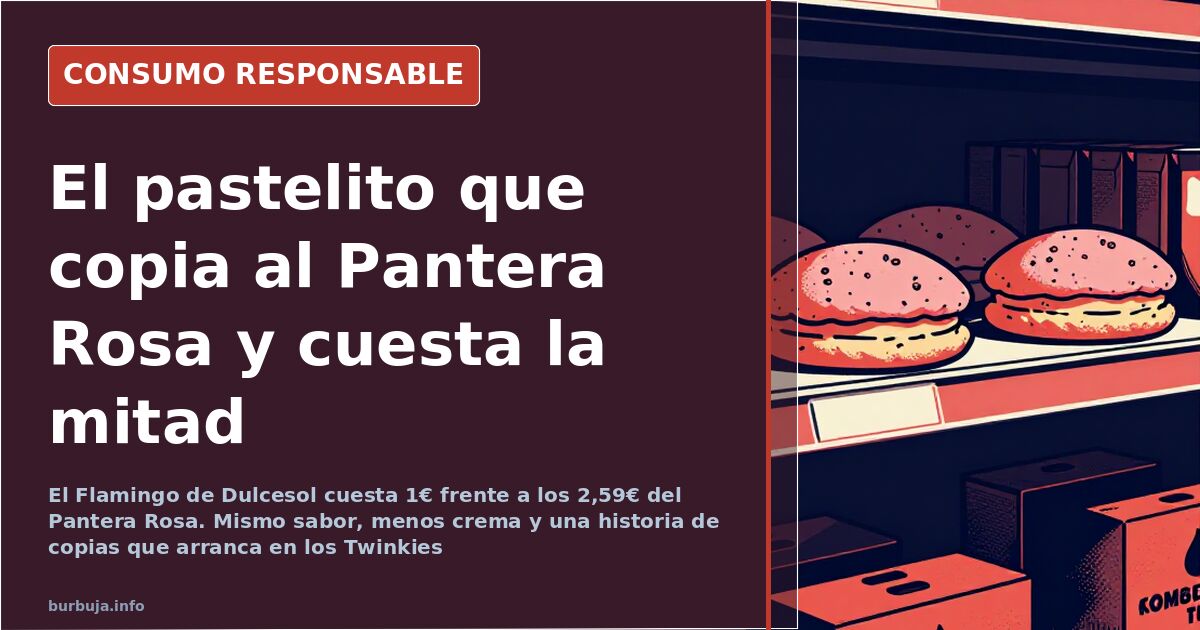
Dulcesol Flamingo: A €1 Copy of Pantera Rosa
The Dulcesol Flamingo is essentially a one-euro version of the Pantera Rosa. This comparison has circulated for some time among consumers who still buy industrial pastries, and the verdict on price is unanimous: €2.59 for the original versus €1 for the imitation. The taste is reportedly virtually identical. The real difference lies in the filling: some Flamingos come out almost empty of cream, while the Pantera Rosa maintains a well-filled interior.
The discussion quickly shifted to the brand's origins. The Pantera Rosa was not born from an original Spanish idea: Bimbo bought the rights to the animated character to wrap an existing pastry, the Bucanero, covering it with a pink layer. What was meant to be a temporary product while the cartoons aired on TV ended up becoming a kiosk classic. The same path was trinc by American Twinkies, the model that inspired both the Pantera Rosa and the Círculo Rojo.
Why does the Pantera Rosa’s pink tonalidad contain cochineal?
The coloring agent that gives the coating its characteristic tone is cochineal, an insect from which carminic acid is extracted. On labels, it appears as carmine, cochineal, or E-120. It is not exclusive to pastries: it is found in strawberry yogurts, sausages, hamburgers, mortadella, candies, and lipsticks. A natural additive, yes, but of animal origin, something many consumers discover with surprise.
Industrial baking lives on these kinds of paradoxes. Sugar, trans fats, and additives that spike metabolism within minutes. A single pastry can be an acceptable snack; three in a row—the triple combo of Pantera Rosa, Bony, and Tigretón—end up sitting badly with anyone. The most repeated warning is the usual one: sporadic consumption and never as a base of the diet.
Dulcesol, the Valencian giant with over €500 million in revenue
Behind the Flamingo is Dulcesol, the commercial brand of Vicky Foods, Spain’s leading manufacturer of sweets and industrial pastries. The company exceeds €500 million in revenue and operates a plant in Africa from which it distributes worldwide. It is not a supermarket private label: it is a group with export ambitions competing head-to-head with the big players.
The comparison with the Pantera Rosa has a trick. The original belongs to Bimbo, which maintains it as a value product while Dulcesol attacks from below with a price around half. The strategy recalls that of Bonys and Tigretones, brands that withstand the passage of time without visible advertising, sustained by the nostalgia of several generations.
Did Pantera Rosas disappear between 1995 and 2005?
Some claim that Pantera Rosas, Bonys, and Tigretones disappeared from the market for a decade, approximately between 1995 and 2005, and reappeared later in private labels and bulk baking formats. Others affirm they never left, simply that people stopped looking for them. What is true is that the perception of absence is repeated across several generations.
Bucaneros, the fourth element of the tetralogy alongside Bony, Tigretón, and Pantera Rosa, did disappear from conventional circuits. Today they are only found in American product stores, where they are sold as imported Twinkies at import prices. Legend has it that Bucaneros were Twinkies manufactured under license in Spain and were renamed because the original name was unpronounceable.
The generation that ate industrial pastries without gaining weight
One of the most repeated observations is the generational paradox: the generation that stuffed themselves with industrial pastries in the eighties and nineties did not experience today’s obesity epidemic. The explanation given is simple: they went out to play or to the friend’s house who had a console. Energy expenditure compensated for the caloric excess. Today the pattern is different.
Historical context matters. These products became popular in the eighties, when Spain was beginning to develop and buying industrial treats for children was not considered wasting money. They were paid-for rolls, a small kiosk luxury viewed today with equal parts nostalgia and suspicion.
Spanish industrial baking survives with a model that needs no advertising: nostalgia does the work. Dulcesol copies the Pantera Rosa and sells it at half price; Bimbo maintains the original as a value product. If the trend continues, it is likely that copies will continue to gain shelf space while the original retreats into the memories of those who grew up with it. Although, seeing how things go, you never know when a pastry might disappear again for a decade.
Also available in: Deutsch
Summary of a discussion on Burbuja.info - Foro de economía, actualidad y política., translated from Spanish and reviewed before publication. Read the full discussion (105 replies).
More summaries
-
Mercadona dominates industrial pastries: unbeatable price and quality
Hacendado pastries cost €5.60/kg vs Dulcesol's €7.50/kg. Is the saving worth it? Data and controversy.
-
Expired Pantera Rosa: Is It Safe to Eat After 15 Days?
A user finds their Pantera Rosa buns are 15 days past the date. The key lies in the difference between expiration and best-before dates.
-
Phoskitos and nostalgia: the irresistible charm of 80s packaged snacks
Phoskitos, Tigretones and Bony shaped the childhood of the 80s. Were they better back then? Nostalgia, thefts driven by hunger, and the recipe change that divides opinions.
-
How many litres of milk can you get from 1 kg of condensed milk?
A forum calculation says a 1 kg can yields 6.6 to 10 litres, but others warn it's not milk but added sugar.
-
Shopper finds worms in blue whiting bought at €2.5/kg in Spain
A shopper in Spain reports worms in blue whiting bought at €2.5/kg, reopening the debate about anisakis in fish sold as fresh.
-
The 3-euro duty making AliExpress shopping more expensive
The EU applies a 3.63-euro charge per imported item, and some estimate prices have risen by 50%. What used to cost 2 euros now costs 5, and the corner shop wins.