
Drone strike on Moscow exposes gaps in Russian air defense
Russian air defenses failed to intercept all drones reaching Moscow, reigniting debate over their actual military effectiveness.
English · Original discussion in Spanish · Published
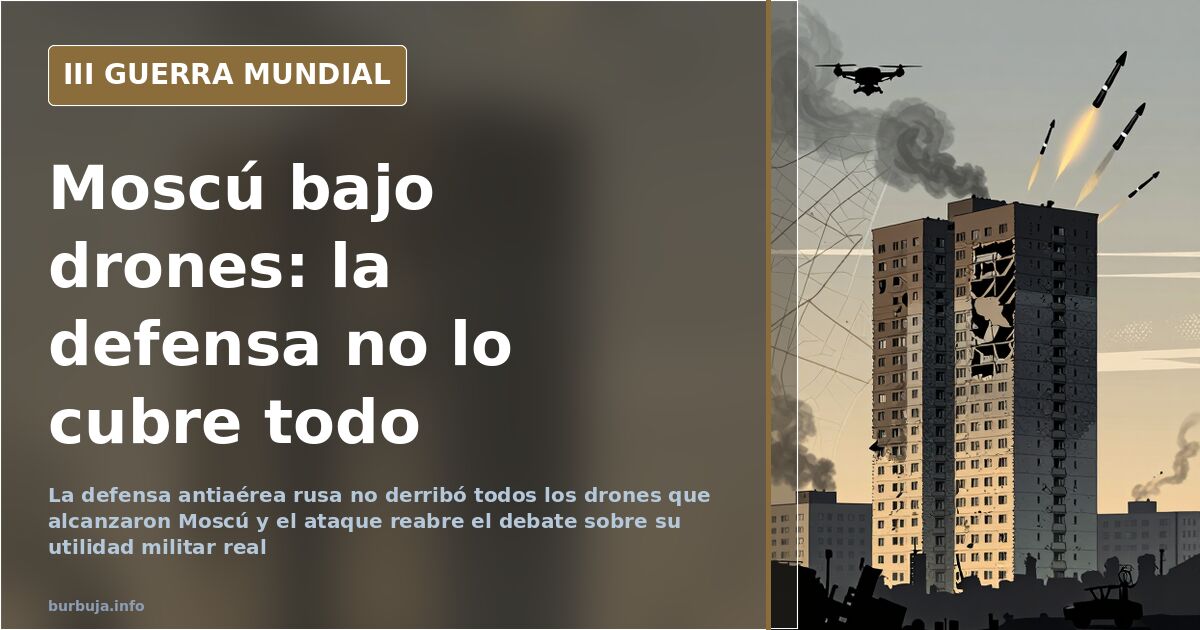
Drones over Moscow: Air defense fails to cover everything
Drones flew over the Russian capital for nearly an hour. The air defense system attempted to shoot them down but did not always succeed: there were impacts. This is the scene left by the attack, with Moscow on alert and the version of an infallible shield cracked. In the trinc hours, the issue ceased to be strictly military and became three discussions at once: why bomb a capital, who has the right to be outraged, and how far one is willing to escalate. And, in the background, an uncomfortable question: has anyone verified anything about what is being seen?
What is sought by attacking Moscow with drones?
The question appeared as soon as the attack was known. The most repeated answer points to the psychological aspect: sowing antiestéticar, demonstrating to the adversary that they are not safe even in their own home. The parallel cited is the Doolittle Raid on Tokyo in World War II, a showy blow with little tactical value and enormous symbolic impact. Some reduce it directly to that: pure theater.
The other reading is that there is no relevant military objective behind it. A cheap drone forces the movement of expensive defenses and alters the perception of a capital that had been seeing the war from afar for months. The damage is not measured in casualties, it is measured in what it disproves. Several participants argue that each incursion of this type has been trinc by more forceful reprisals, and here enters the cold calculation: does the showy blow compensate if the response is worse than the attack?
Sovereignty depends on who you ask
Part of the analysis argues that those who considered the Russian attack on a sovereign country natural now demand explanations for some drones. The discussion shifts to the terrain of consistency. It is argued that the principle is applied as convenient: military alliances with foreign bases in Europe and Asia are not questioned, while Ukraine's approach to NATO is read as an intolerable provocation.
The counterargument is simpler: there is an ongoing invasion and the legitimacy of defending oneself does not depend on the sympathy the victim inspires. In the thread also appears the suspicion, raised by a participant, that the UN Security Council would justify anything claiming the good of humanity. No one expects that debate to be closed.
The TV station that aired Ohio as if it were Moscow
Among the images of the attack circulated a detail that fueled distrust towards major media: according to a message spread in the thread, a US television network allegedly aired images of destruction in Ohio presenting them as Moscow. The episode served to reinforce skepticism about what is seen on screen and about who decides what is truth in a war. It is a classic of information noise: when everyone embellishes their version, verification becomes a luxury.
The dissident who saw a drone fall 20 meters away
One of the most commented accounts was that of a Russian opposition figure who left the country due to disagreement with the political direction and resides in Uzbekistan. According to the testimony collected in the thread, one of the drones impacted very close to the block where he lives: had it gone twenty meters in another direction, he said, it could have killed a relative. The anecdote summarizes the randomness of the attack and of the war narrative itself, where the symbolic and the domestic mix unavoidably.
The response pattern that already repeats
The sequence has become a predictable script: incursion, condemnation, promise of retaliation, and harder blow on Ukrainian infrastructure. Several analyses agree that this type of action does not move the front, but hardens the war. The message reaching the population is ambiguous: on the one hand, the capacity to hit the enemy capital is celebrated, on the other, continuous punishment on one's own territory is admitted. The floating question remains whether the symbol weighs more than the cost.
The underlying nuclear noise
As every time the war steps up a level, atomic rhetoric reappears. Part of the conversation argues that Russia will not give up its territory and that NATO is not prepared for a nuclear scenario. Another responds that any state can develop atomic weapons and that what restrains the rest is the Non-Proliferation Treaty, not technical capability: it is recalled that since the 90s no nuclear tests have been conducted. The threat is used as a deterrence tool, not as a plan. Nevertheless, the noise covers what is relevant: there is no negotiated solution in sight.
The disorienting data: a low-cost drone, described in the thread as improvised, planted antiestéticar in the heart of the Russian capital. And of that, no one has yet given a verifiable figure of impacts.
Also available in: Deutsch
Summary of a discussion on Burbuja.info - Foro de economía, actualidad y política., translated from Spanish and reviewed before publication. Read the full discussion (166 replies).
More summaries
-
Kiev's Systematic Air Campaign Targets Factories, Warehouses, and Data Centers
Kiev faces systematic missile and drone attacks on factories, warehouses, and data centers, leading to blackouts and smoke.
-
Unverified Tweet Attributes False Flag Attacks in Mallorca to CIA
An unverified tweet claims the CIA is behind a false flag drone attack in Mallorca, Nice, and Italy, but provides no evidence.
-
Russian offensive stalls: 2,250 casualties in one day and refineries ablaze
Russia loses 2,250 soldiers in a single day, its oil output falls to 17-year lows and refineries burn. The war of attrition is taking its toll.
-
Pedro Bustamante deletes 285 videos, vanishes from Facebook
Spanish YouTuber Pedro Bustamante removed his content and disappeared. Rumors place him in Munich, reading German press.
-
Ukraine war resembles 1914, but with drones
Artillery, trenches and drones: the Ukraine front mirrors the attrition of 1914, with a flying eye that kills. A parallel that divides analysts.
-
Russia's alleged contempt for Spain: the myth dividing pro-Russian voices
One claim holds that Russians look down on Spaniards, but it rests on anecdotes and internet comments. The debate reveals more about the Spanish inferiority complex than about Russia.