
Dragons: A Myth Recurring Across the Globe
The dragon myth appears worldwide, linked to misinterpreted fossils, Neolithic sacred serpents, and stories spread by human migrations.
English · Original discussion in Spanish · Published
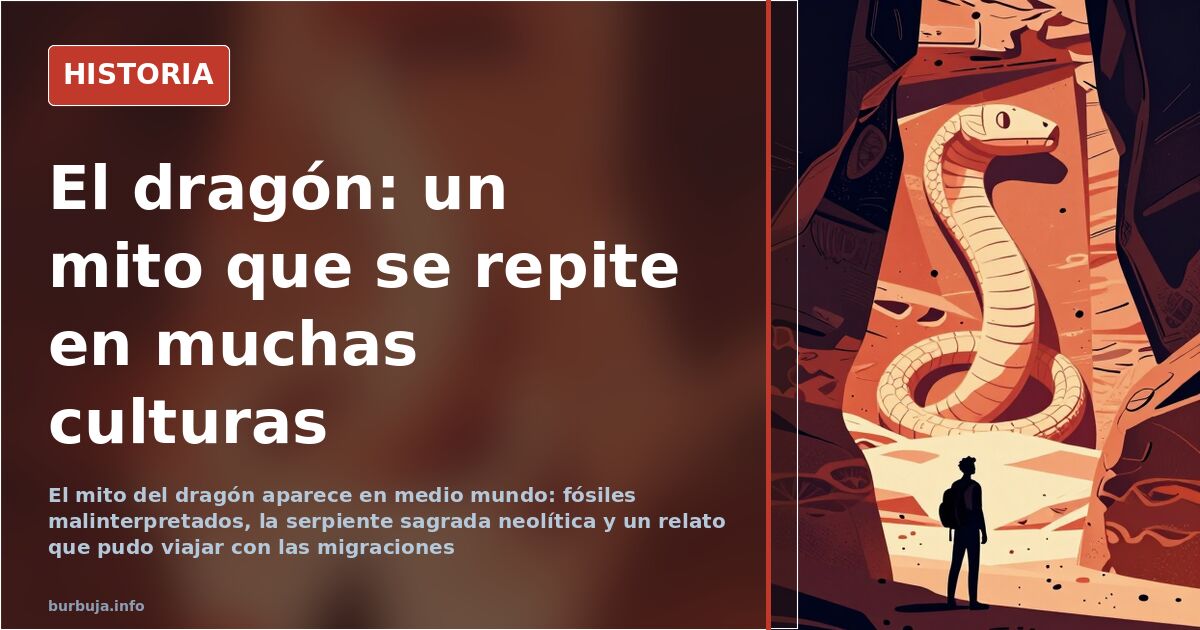
From Klagenfurt to China: Why Dragons Are Everywhere
Vikings, Chinese, Hittites, Basques. As the debate suggests, none communicated with each other, yet all depicted a colossal winged reptile breathing fire. This rare coincidence has sparked explanations for centuries, from misidentified fossils to extraterrestrial visitors. The question isn't if the creature existed, but why so many isolated cultures imagined something so similar.
Why Medieval Farmers Saw Dragons in Skulls
Fossils explain part of the enigma. When someone in the 14th century found a massive skull, they didn't think of an extinct species; they thought of a monster. In 1335, residents of Klagenfurt discovered a woolly rhinoceros (Coelodonta antiquitatis) skull and built a dragon legend around it. The skull remains today at the Landesmuseum für Kärnten.
This is not an isolated or modern case. Suetonius, in the 1st century AD, noted in *Life of the Divine Augustus* that large bones were buried everywhere on Capri. He attributed them to ancient beasts; islanders blamed giants fallen during the war of the gods. The pattern repeats with the Mosasaurus, found in 1764 in a limestone quarry in Maastricht: a 15-meter marine reptile with a 1.5-meter skull and dagger-like teeth. The mental leap of those who found it must have been significant.
There are more examples. In Sicily, a pygmy subspecies of African elephant existed whose skulls, according to the thread, natives used as masks. Ulysses' adventure with the Cyclopes is set, coincidentally, in Sicily.
The Serpent, the First Sacred Animal
Before dragons existed, serpents did. In the Neolithic era, humans lived close to the earth, where grains sprouted and minerals hid. What animal lives in permanent contact with the ground? The snake. It became the first sacred animal. Based on this, the dragon is constructed by combining two worlds: what crawls and what flies. A being unifying sky and earth necessarily has traits of both.
It's not the only root. Another line points to water: the serpent blocking rivers or retaining rain is a basic survival myth, because without water there is no harvest. From there to the giant serpent threatening to dry up the world is a short step.
Do Dragons Share a Common Ancestor?
A discipline treats myths like species, creating phylogenetic trees to trace their origins. Paleoanthropologist Julien d'Huy argues the dragon was born in Africa as a giant horned serpent that held back water in primordial times, flew, and was immortal. From there, it spread with human migrations, adapting its form in each culture. The battle between eagle and dragon, thunder god versus serpent, or Saint George versus the monster would be variants of the same original story.
This idea fits another observation from the thread: myths change much slower than languages and preserve overlapping layers, like geological strata. There are Neolithic and Paleolithic layers within the same story. Creation by clay would be Neolithic; creation by water, much older.
From Hittites to Vikings: The Same Script
Another school argues that the hero-slaying-dragon narrative is not universal but belongs to Indo-European expansions, repeated wherever those peoples settled. The Hittite god Tarhunt, with his son Sarruma, kills the dragon Illuyanka. Norse Thor faces the serpent Jörmungandr. Sigurd kills Fafnir in the Volsunga saga. The pattern repeats with suspicious fidelity.
Basque mythology also leaves traces: Sugaar, the serpent-dragon, holds importance, and in the Aralar range, a legend persists of a cave connecting to its lair. Documented reality shows that range hosts a huge complex of megalithic monuments from 5,000 years ago: it was a sacred place long before anyone drew a dragon.
The Chinese Dragon Is Not the European Dragon
We should pause here. In China, the dragon is related to the serpent, to the point that snakes are called little dragons. Nüwa, creator of humanity in one of the oldest Chinese myths, is serpentine. In the West, however, the dragon is a winged lizard with a spiked tail and destructive vocation, a symbol of evil destroying entire villages. They are not the same creature, though they share a name. Part of later confusion may come from heraldic griffins and late mixtures.
Winged serpents also existed before the medieval dragon: in the Roman world, there were draconibus, snakes with small wings near the head associated with Diana's cult.
Reptilians with Ships and Fossiles Some Refuse to See
The most exotic explanation circulating in forums and documentaries is that of Reptilians: supposed beings flying in ships, hence represented spitting fire. It comes from conspiracy-theory TV programs and has no backing outside that circuit.
More striking is the opposite: denying fossils. Some claim dinosaurs never existed and museum skeletons are artificial. It has no basis. Remains surface every year due to erosion, like the Baryonyx walkeri, found by a simple walker with open eyes.
In the end, the dragon works like few symbols: appearing in a Basque cave, Babylon, a Chinese temple, or a medieval shield. How much is misinterpreted fossil, how much sacred serpent, and how much old human need to give antiestéticar a face?
Vikings, Chinese, Hittites, Basques. As the debate suggests, none communicated with each other, yet all depicted a colossal winged reptile breathing fire. This rare coincidence has sparked explanations for centuries, from misidentified fossils to extraterrestrial visitors. The question isn't if the creature existed, but why so many isolated cultures imagined something so similar.
Why Medieval Farmers Saw Dragons in Skulls
Fossils explain part of the enigma. When someone in the 14th century found a massive skull, they didn't think of an extinct species; they thought of a monster. In 1335, residents of Klagenfurt discovered a woolly rhinoceros (Coelodonta antiquitatis) skull and built a dragon legend around it. The skull remains today at the Landesmuseum für Kärnten.
This is not an isolated or modern case. Suetonius, in the 1st century AD, noted in *Life of the Divine Augustus* that large bones were buried everywhere on Capri. He attributed them to ancient beasts; islanders blamed giants fallen during the war of the gods. The pattern repeats with the Mosasaurus, found in 1764 in a limestone quarry in Maastricht: a 15-meter marine reptile with a 1.5-meter skull and dagger-like teeth. The mental leap of those who found it must have been significant.
There are more examples. In Sicily, a pygmy subspecies of African elephant existed whose skulls, according to the thread, natives used as masks. Ulysses' adventure with the Cyclopes is set, coincidentally, in Sicily.
The Serpent, the First Sacred Animal
Before dragons existed, serpents did. In the Neolithic era, humans lived close to the earth, where grains sprouted and minerals hid. What animal lives in permanent contact with the ground? The snake. It became the first sacred animal. Based on this, the dragon is constructed by combining two worlds: what crawls and what flies. A being unifying sky and earth necessarily has traits of both.
It's not the only root. Another line points to water: the serpent blocking rivers or retaining rain is a basic survival myth, because without water there is no harvest. From there to the giant serpent threatening to dry up the world is a short step.
Do Dragons Share a Common Ancestor?
A discipline treats myths like species, creating phylogenetic trees to trace their origins. Paleoanthropologist Julien d'Huy argues the dragon was born in Africa as a giant horned serpent that held back water in primordial times, flew, and was immortal. From there, it spread with human migrations, adapting its form in each culture. The battle between eagle and dragon, thunder god versus serpent, or Saint George versus the monster would be variants of the same original story.
This idea fits another observation from the thread: myths change much slower than languages and preserve overlapping layers, like geological strata. There are Neolithic and Paleolithic layers within the same story. Creation by clay would be Neolithic; creation by water, much older.
From Hittites to Vikings: The Same Script
Another school argues that the hero-slaying-dragon narrative is not universal but belongs to Indo-European expansions, repeated wherever those peoples settled. The Hittite god Tarhunt, with his son Sarruma, kills the dragon Illuyanka. Norse Thor faces the serpent Jörmungandr. Sigurd kills Fafnir in the Volsunga saga. The pattern repeats with suspicious fidelity.
Basque mythology also leaves traces: Sugaar, the serpent-dragon, holds importance, and in the Aralar range, a legend persists of a cave connecting to its lair. Documented reality shows that range hosts a huge complex of megalithic monuments from 5,000 years ago: it was a sacred place long before anyone drew a dragon.
The Chinese Dragon Is Not the European Dragon
We should pause here. In China, the dragon is related to the serpent, to the point that snakes are called little dragons. Nüwa, creator of humanity in one of the oldest Chinese myths, is serpentine. In the West, however, the dragon is a winged lizard with a spiked tail and destructive vocation, a symbol of evil destroying entire villages. They are not the same creature, though they share a name. Part of later confusion may come from heraldic griffins and late mixtures.
Winged serpents also existed before the medieval dragon: in the Roman world, there were draconibus, snakes with small wings near the head associated with Diana's cult.
Reptilians with Ships and Fossiles Some Refuse to See
The most exotic explanation circulating in forums and documentaries is that of Reptilians: supposed beings flying in ships, hence represented spitting fire. It comes from conspiracy-theory TV programs and has no backing outside that circuit.
More striking is the opposite: denying fossils. Some claim dinosaurs never existed and museum skeletons are artificial. It has no basis. Remains surface every year due to erosion, like the Baryonyx walkeri, found by a simple walker with open eyes.
In the end, the dragon works like few symbols: appearing in a Basque cave, Babylon, a Chinese temple, or a medieval shield. How much is misinterpreted fossil, how much sacred serpent, and how much old human need to give antiestéticar a face?
Also available in: Deutsch
Summary of a discussion on Burbuja.info - Foro de economía, actualidad y política., translated from Spanish and reviewed before publication. Read the full discussion (122 replies).
More summaries
-
ETA and GAL: two arms of the same Gladio network in Spain
Investigation linking ETA and GAL as arms of the same NATO Gladio network, with drug trafficking funding and CIA control.
-
Was British Empire Success Luck or Strategy?
In 1793 Spain had 80 ships of the line; at Trafalgar, only 35. Analysis suggests 18th-century British hegemony relied more on chance than merit.
-
Paris: World's Most Beautiful City? The Myth Divides Opinion
Napoleon III and Haussmann made Paris the top tourist destination, but at the cost of demolishing its historic core. This myth is now under debate.
-
Mussolini vs Hitler: The Key Difference Franco Understood
Mussolini crushed the left without civil war; Franco died in bed. Hitler dragged Italy to ruin. The key wasn't ideology, but...
-
Muhammad's Life: Oral Tradition and Historical Doubts
Hadiths about Muhammad were written centuries after his death. Islamic historical criticism is still emerging, unlike Christian studies.
-
Valley of the Fallen: Spanish monument divides critics and admirers
Spain's Valley of the Fallen, with its 150-meter cross, sparks debate over aesthetics versus ideology. Analysis of its history and future.