
Dogs Out, Kids In: 2020 Spain's Alarming Exception
Spain's 2020 state of alarm allowed dog walks but kept children indoors, a confusing rule sparking debate over public health and animal contagion fears.
English · Original discussion in Spanish · Published
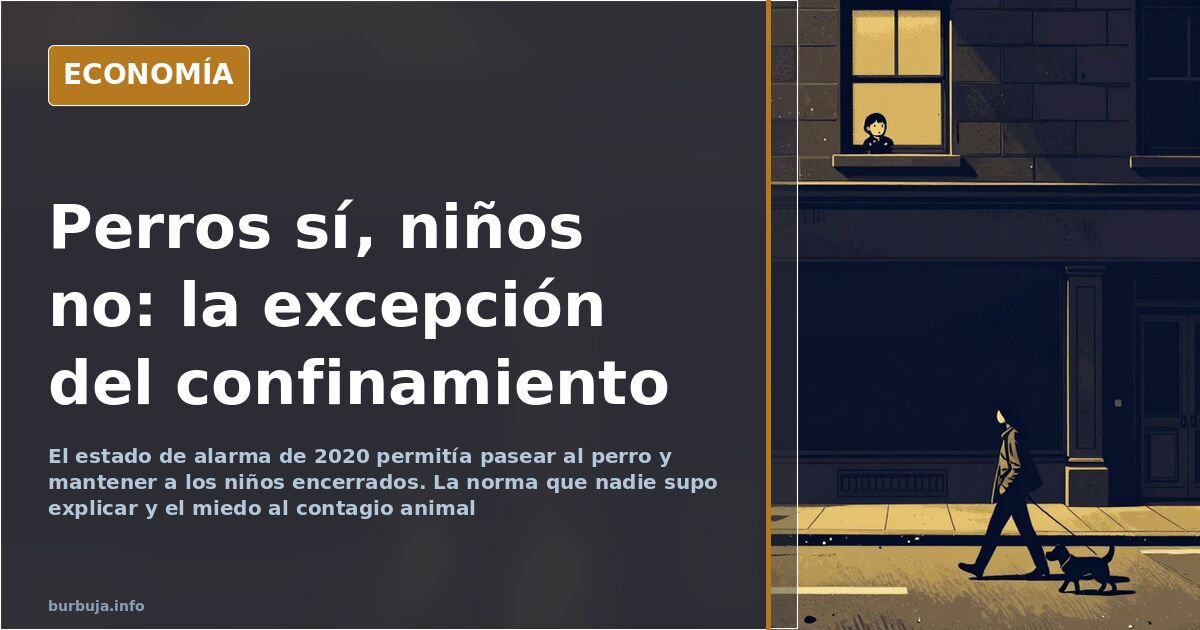
Why dogs could walk while children stayed home
Why could dogs go out while children remained confined? This question dominated the 2020 lockdown debate and remains largely unexplained. The state of alarm permitted dog walks, yet minors were kept indoors without stepping outside. The rule contradicted public health messaging, causing immediate confusion for families.
What the state of alarm allowed and prohibited
The decree authorized pet walks because animals need to relieve themselves and do not understand quarantines. No such exception existed for children: balconies were fine, streets were not. This contrast became a frequent point of criticism. Some argued simply that dogs need to move.
Some municipalities enforced stricter rules: in Badajoz, walking a dog more than 20 minutes and beyond 150 meters from home was considered a serious offense. This limit was difficult to justify for an animal needing exercise and a owner risking a fine for exceeding the radius.
Can dogs transmit cobi19?
Debate suggested available evidence indicated no transmission. The WHO and Hong Kong authorities, cited in the thread, agreed: there is no proof that dogs and cats infect humans. A notable case involved a dog testing positive, but it was noted its mouth and nose might be contaminated by the home environment, not truly infected. The test was repeated after the animal's quarantine. Antiestéticar, meanwhile, had already done its work.
The thread also cited a press report dated 15/04/2020 regarding a study by the University of Ottawa suggesting stray dogs might have been possible bicho transmitters to humans. This unconfirmed hypothesis reignited debate: despite WHO insistence on no animal transmission, public opinion remained suspicious of dogs.
The cost of keeping children confined
This was not just about physical health. Analysis focused on child confinement. In a province with zero deaths, a forum user noted a seven-year-old had not stepped outside for days: he had not even served 5% of his sentence. Meanwhile, dogs could go out under the exception. This asymmetry was the main argument of critics.
Others argued the opposite, logically: dogs cannot relieve themselves indoors, but children can. The dog's walk was physiological; the child's was a parental decision. Defenders of dog walks noted many dogs cannot do this indoors and it is hard to explain to an animal previously punished for doing so inside.
Double standards in rule application
Another criticism focused less on the decree and more on its application. Sanctions were perceived to fall differently depending on who abusa them: groups in parks faced no punishment, while fathers with children outdoors risked fines. This perception of grievance fueled discontent as much as the rule itself. A user cited a video from the third day of quarantine showing people ignoring lockdown without apparent consequences.
Pets as vectors for neighborhood complaints
Dog walks exacerbated old urban conflicts: urine, feces, and playgrounds turned into canine territory. Some called for treating companion animals as a public health issue, while others warned of abandonment antiestéticars. This antiestéticar—that the alarm might end with dogs and cats off the streets or worse—also had its place.
In the end, dogs went out, children did not, and no one explained the criterion for this line. If the issue was contagion, dog walks were unnecessary; if it was mental health, children's walks were missing. The only certainty is that some walked peacefully while others counted days from their balconies.
Why could dogs go out while children remained confined? This question dominated the 2020 lockdown debate and remains largely unexplained. The state of alarm permitted dog walks, yet minors were kept indoors without stepping outside. The rule contradicted public health messaging, causing immediate confusion for families.
What the state of alarm allowed and prohibited
The decree authorized pet walks because animals need to relieve themselves and do not understand quarantines. No such exception existed for children: balconies were fine, streets were not. This contrast became a frequent point of criticism. Some argued simply that dogs need to move.
Some municipalities enforced stricter rules: in Badajoz, walking a dog more than 20 minutes and beyond 150 meters from home was considered a serious offense. This limit was difficult to justify for an animal needing exercise and a owner risking a fine for exceeding the radius.
Can dogs transmit cobi19?
Debate suggested available evidence indicated no transmission. The WHO and Hong Kong authorities, cited in the thread, agreed: there is no proof that dogs and cats infect humans. A notable case involved a dog testing positive, but it was noted its mouth and nose might be contaminated by the home environment, not truly infected. The test was repeated after the animal's quarantine. Antiestéticar, meanwhile, had already done its work.
The thread also cited a press report dated 15/04/2020 regarding a study by the University of Ottawa suggesting stray dogs might have been possible bicho transmitters to humans. This unconfirmed hypothesis reignited debate: despite WHO insistence on no animal transmission, public opinion remained suspicious of dogs.
The cost of keeping children confined
This was not just about physical health. Analysis focused on child confinement. In a province with zero deaths, a forum user noted a seven-year-old had not stepped outside for days: he had not even served 5% of his sentence. Meanwhile, dogs could go out under the exception. This asymmetry was the main argument of critics.
Others argued the opposite, logically: dogs cannot relieve themselves indoors, but children can. The dog's walk was physiological; the child's was a parental decision. Defenders of dog walks noted many dogs cannot do this indoors and it is hard to explain to an animal previously punished for doing so inside.
Double standards in rule application
Another criticism focused less on the decree and more on its application. Sanctions were perceived to fall differently depending on who abusa them: groups in parks faced no punishment, while fathers with children outdoors risked fines. This perception of grievance fueled discontent as much as the rule itself. A user cited a video from the third day of quarantine showing people ignoring lockdown without apparent consequences.
Pets as vectors for neighborhood complaints
Dog walks exacerbated old urban conflicts: urine, feces, and playgrounds turned into canine territory. Some called for treating companion animals as a public health issue, while others warned of abandonment antiestéticars. This antiestéticar—that the alarm might end with dogs and cats off the streets or worse—also had its place.
In the end, dogs went out, children did not, and no one explained the criterion for this line. If the issue was contagion, dog walks were unnecessary; if it was mental health, children's walks were missing. The only certainty is that some walked peacefully while others counted days from their balconies.
Summary of a discussion on Burbuja.info - Foro de economía, actualidad y política., translated from Spanish and reviewed before publication. Read the full discussion (279 replies).
More summaries
-
State of Alarm across Spain? The Law That Makes It Impossible
The hypothesis of a state of alarm in Spain clashes with the Constitution: the Constitutional Court clarified this back in 2021. What can and cannot be done?
-
Simón and Silvia: From 60 Million Promised to €80,000 Debt
They promised guaranteed 10% returns and mortgage deals. Now they face alleged scams and €80,000 tax debts with the Tax Agency.
-
Twentysomethings: 0 Contributed Years vs. 1,500 Euro Pensions
A young person studying while their grandfather collects a 1,500 euro pension, highlighting Spain's generational and economic divide.
-
Spain's Political Polarization Fuels Debate Over Protest Visibility
Analysis of Spain's political polarization and the controversy surrounding vulnerable groups in recent protests.
-
Why Farmers Don't Sell Produce Directly: The Real Tomato Cost
A forum debate highlights a 15.4% supplier margin while farmers argue tomato prices remain high due to distribution costs, not just retail markups.
-
Inside Spain's Wealthiest Neighborhood: The La Moraleja Report
A report on La Moraleja, Spain's richest district, reveals 13 euro menus and 1,700 sqm plots, sparking debate over Madrid's bourgeois lifestyle.