
Dogs at Decathlon: From Sniffing to Complaint Forms
A dog sniffs a customer at Decathlon, leading to a returned purchase. The conflict between pet-friendly policies, allergies, and store regulations.
English · Original discussion in Spanish · Published
The Day a Dog Sniffed Your Feet at Decathlon and You Were the Bad Guy
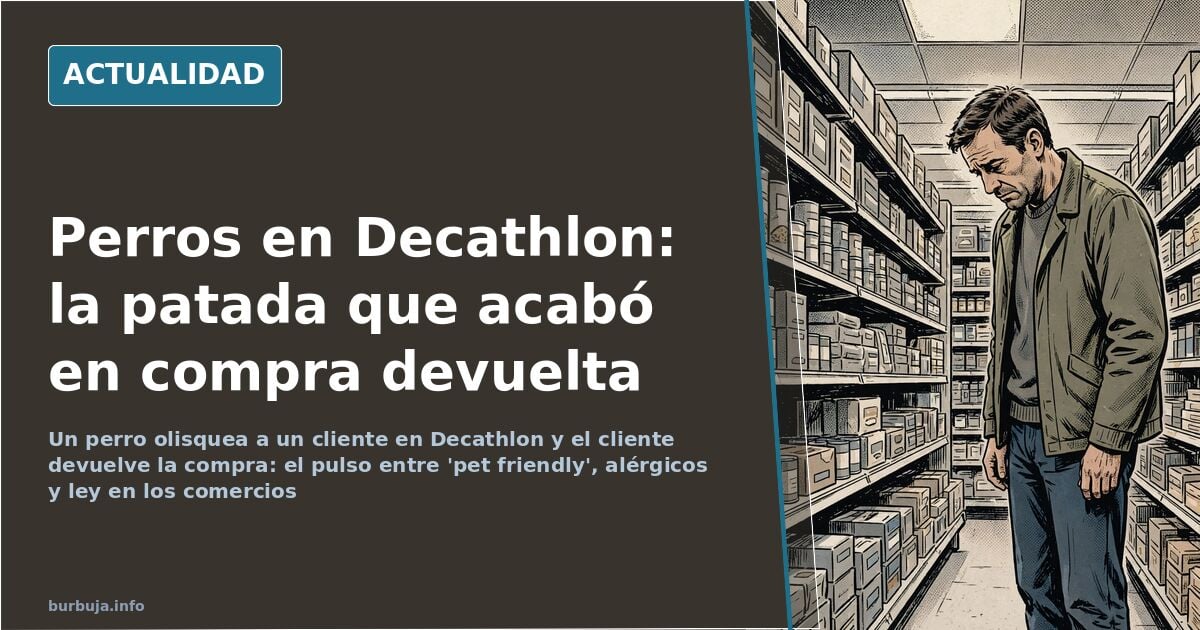
A customer was waiting in the checkout line when a large dog approached and sniffed his feet. He shooed it away with a deterrent kick—not a spinning one, he clarifies, but a "get out of here, mutt" kind—and the owner snapped back with the classic "don't worry, he won't do anything." The store assistant, according to the same account, implied the customer was the one in the wrong. The result: he returned everything in his basket, wrote a letter to the store manager with acknowledgment of receipt, and decided not to return.
That scene, repeated and dissected over nearly seven years in a discussion with 756 replies, is a snapshot of a conflict that isn't about dogs. It's about what can be demanded of a stranger in a space that belongs to no one and everyone.
Can a Store Allow Dogs Inside?
In Spain, there's no state-level regulation prohibiting animals in a sports store. There is a Companion Animal Code published in the BOE (Official State Gazette), cited in the discussion, which governs pet ownership and leaves the ultimate decision on access to the establishment's owners. The "pet friendly" sign, therefore, is not meaningless; it's the exercise of that authority. Those who argue that the BOE supersedes the sign are debating the scope of the rule, not its existence.
The nuance is important. Dogs entering a store doesn't abusa a general prohibition; what it clashes with are the rights of those who work there and those who shop there. And the most common response is the same one applied to any consumer conflict: if you don't like how you're treated, take your things and leave. Which is exactly what the shopper with the cart did.
Allergies, Fur, and Carpets: Who Pays the Price
The health argument arises quickly and isn't easily dismissed with sympathy for animals. Some point out that there are people with allergies, people with phobias, and people who don't want a snout rubbing against their clothes, and that a third party's discomfort isn't resolved by telling them the dog is harmless. An uncomfortable detail is added: not all dogs are vaccinated or dewormed, and no one checks anything at the door.
The question that no one fully answers is about hygiene. If an animal urinates or defecates on a carpet, who cleans it? The shift assistant with their mop, or the minimum-wage cleaner? No one has put a protocol in writing, and that absence is proof that most of these stores welcomed dogs without considering the cost.
From Decathlon to El Corte Inglés: The Spreading Trend
This case isn't isolated. The same discussion mentions large department stores and bookstores that already admit animals: El Corte Inglés, Casa del Libro. The most cited comparison is amusing: Carrefour sells tires, and no one thinks of pushing a car down the perfume aisle.
The pattern is the same everywhere: a commercial decision—to attract customers with pets—made without consulting customers without pets, who are the majority. And with an overlooked consequence: the dog gains nothing inside a noisy store with slippery floors. Those who bring their dog because they can't leave it alone are solving their problem at the expense of others, and those who bring it for pleasure are punishing the animal.
"My Dog is Better Than Many People"
This phrase circulates frequently and categorizes the person who says it. Behind it lies a bigger idea: that the pet occupies the place of a child, and the rest of humanity is an obstacle to be navigated. This leap—from responsible ownership to the right to impose one's choices anywhere—is the core of the problem.
It's worth separating things. There are dog owners with perfectly trained dogs who request designated spaces and short leashes; and there are those who use the animal as an extension of their own will. The former have a point on something basic: a culture of coexistence is built with rules, not with friendly signs.
Where the Issue Gets Stuck
No one is going to establish a common criterion. There is no authority to do so, nor the will: the store decides, the customer responds with their wallet, and the conflict remains unresolved. The only thing that has changed over time is the background context, and it doesn't help. Many of these chains are closing stores and reducing stock, with increasingly empty shelves and sales assistants who refer customers to the website. That the first battle for common space in a store like this is over a dog says a lot about the level of the debate.
A customer was waiting in the checkout line when a large dog approached and sniffed his feet. He shooed it away with a deterrent kick—not a spinning one, he clarifies, but a "get out of here, mutt" kind—and the owner snapped back with the classic "don't worry, he won't do anything." The store assistant, according to the same account, implied the customer was the one in the wrong. The result: he returned everything in his basket, wrote a letter to the store manager with acknowledgment of receipt, and decided not to return.
That scene, repeated and dissected over nearly seven years in a discussion with 756 replies, is a snapshot of a conflict that isn't about dogs. It's about what can be demanded of a stranger in a space that belongs to no one and everyone.
Can a Store Allow Dogs Inside?
In Spain, there's no state-level regulation prohibiting animals in a sports store. There is a Companion Animal Code published in the BOE (Official State Gazette), cited in the discussion, which governs pet ownership and leaves the ultimate decision on access to the establishment's owners. The "pet friendly" sign, therefore, is not meaningless; it's the exercise of that authority. Those who argue that the BOE supersedes the sign are debating the scope of the rule, not its existence.
The nuance is important. Dogs entering a store doesn't abusa a general prohibition; what it clashes with are the rights of those who work there and those who shop there. And the most common response is the same one applied to any consumer conflict: if you don't like how you're treated, take your things and leave. Which is exactly what the shopper with the cart did.
Allergies, Fur, and Carpets: Who Pays the Price
The health argument arises quickly and isn't easily dismissed with sympathy for animals. Some point out that there are people with allergies, people with phobias, and people who don't want a snout rubbing against their clothes, and that a third party's discomfort isn't resolved by telling them the dog is harmless. An uncomfortable detail is added: not all dogs are vaccinated or dewormed, and no one checks anything at the door.
The question that no one fully answers is about hygiene. If an animal urinates or defecates on a carpet, who cleans it? The shift assistant with their mop, or the minimum-wage cleaner? No one has put a protocol in writing, and that absence is proof that most of these stores welcomed dogs without considering the cost.
From Decathlon to El Corte Inglés: The Spreading Trend
This case isn't isolated. The same discussion mentions large department stores and bookstores that already admit animals: El Corte Inglés, Casa del Libro. The most cited comparison is amusing: Carrefour sells tires, and no one thinks of pushing a car down the perfume aisle.
The pattern is the same everywhere: a commercial decision—to attract customers with pets—made without consulting customers without pets, who are the majority. And with an overlooked consequence: the dog gains nothing inside a noisy store with slippery floors. Those who bring their dog because they can't leave it alone are solving their problem at the expense of others, and those who bring it for pleasure are punishing the animal.
"My Dog is Better Than Many People"
This phrase circulates frequently and categorizes the person who says it. Behind it lies a bigger idea: that the pet occupies the place of a child, and the rest of humanity is an obstacle to be navigated. This leap—from responsible ownership to the right to impose one's choices anywhere—is the core of the problem.
It's worth separating things. There are dog owners with perfectly trained dogs who request designated spaces and short leashes; and there are those who use the animal as an extension of their own will. The former have a point on something basic: a culture of coexistence is built with rules, not with friendly signs.
Where the Issue Gets Stuck
No one is going to establish a common criterion. There is no authority to do so, nor the will: the store decides, the customer responds with their wallet, and the conflict remains unresolved. The only thing that has changed over time is the background context, and it doesn't help. Many of these chains are closing stores and reducing stock, with increasingly empty shelves and sales assistants who refer customers to the website. That the first battle for common space in a store like this is over a dog says a lot about the level of the debate.
Summary of a discussion on Burbuja.info - Foro de economía, actualidad y política., translated from Spanish and reviewed before publication. Read the full discussion (756 replies).
More summaries
-
Dogs in Public Venues: The Battle for Coexistence
The presence of dogs in public establishments has become a conflict point: allergies, phobias, and hygiene versus the owners' rights. Is there no solution?
-
Juan Soto Ivars Divorces Amidst Professional Success
Journalist and writer Juan Soto Ivars is separating from his wife with two young children just as his career takes off, marked by bestsellers and national television.
-
Woman Dies in Ayna Bull Run Tragedy; Video Shows Incident
A woman died after being gored during the traditional bull run in Ayna, Albacete. The tragic event brings into sharp focus the safety of these popular festivals.
-
Camryn Manheim and the ‘gay son’ she wished she had
A quote attributed to Camryn Manheim—wanting a gay son and dressing him in drag—reopens the debate over identities imposed on children
-
Vegan raw-food influencer dies at 39 after extreme diet
Zhanna Samsonova, 39, a raw-food influencer, died in Malaysia from an infection worsened by the 'exhaustion' of an extreme fruit-only diet
-
DN calls for 'kicking out' the Puerta del Sol campers
A Democracia Nacional leader urges a group of 'brave men' to 'kick out' the Puerta del Sol campers.