
Dog tax: 30 euros for a problem still unsolved
Between 20 and 30 euros a year per owner and a real cost of 1,400 per dog: Spain is split over a dog tax that fails to solve the dog mess problem.
English · Original discussion in Spanish · Published
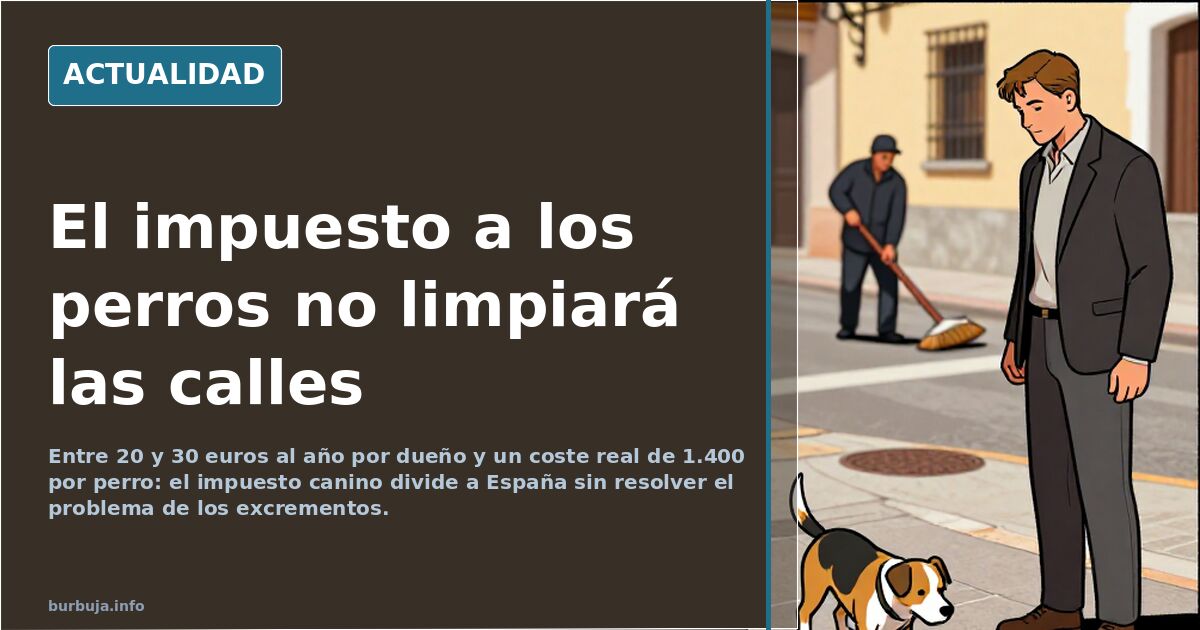
A 30-euro dog tax won't clean the streets
A municipal tax on dog owners is back on the table. The figure at the start of the debate is modest: between 20 and 30 euros a year for insurance covering damage caused by the uncivil irresponsibility of those who don't pick up what their animal leaves behind. Seen in isolation, the number is almost laughable. The pet sector turns over 3 billion euros a year in Spain alone. With that backdrop, the issue quickly shifts from tax policy to neighbourly coexistence.
Can a tax stop the streets from smelling?
The doubt runs through the whole conversation. A tax doesn't put anyone behind every dog to clean up after it. Municipal bylaws already requiring owners to pick up waste have existed for years: there's no shortage of rules, there's a shortage of enforcement. Some argue a new payment would only fatten the coffers without changing a single curb. Against that is the argument that fines, when they come, are so rare and so small that no one antiestéticars them.
The model held up as a contrast is the Swiss one. There, people pay, but the council provides dog waste bins and free bags. The difference isn't the amount, it's what you get in return. A tax with no service reads as just another surcharge, and that explains much of the resistance.
What it really costs to have a dog each year
The headline that sparked the controversy mixes two figures that aren't in the same league. On one hand, insurance at 20 to 30 euros. On the other, the estimated cost of keeping an animal, around 1,400 euros a year. The proposed fee is less than 3% of what the dog already costs. Anyone paying for food, vet visits and the rest barely notices that thirty euros; neither does the person who leaves poop on the pavement.
On that basis, more than a few suspect the problem was never money, but the message. A bill doesn't change habits; a penalty does, or so it's supposed. And there the recurring complaint emerges: responsible owners are targeted while the uncivil ones carry on as before.
From scooters to children: where the comparison overflows
The debate stretches to the usual place. There are proposals to register bicycles and scooters too, with their own insurance, and to take away the licence of reckless riders. One step further and the uncomfortable comparison appears: if you charge for having a dog, why not a fee for having children, liability insurance for the damage they cause, or a levy on parents who block the school exit? The snowball rolls on its own, and almost no one wants to look at it head-on.
A dog in A&E and the shop that had to close
Outside strictly fiscal territory, concrete scenes appear. A dog in an emergency box at a hospital. A shop in the United States where the upper floor had to close because of the smell after a poo, with an employee tasked with the disaster. The real unease isn't so much the annual bill as the feeling that shared space has been ceded without brakes, and that anyone who complains is cast as the killjoy.
Punish, don't collect: the alternative gaining ground
The route with the most support isn't the tax, but useful punishment. Fines converted into hours cleaning public streets, with broom, dustpan and bags of their own, so the offender can't just pay it off. A points-based licence like driving, with 1,000 euros per uncollected dropping. The underlying idea is simple: the cost should fall on whoever makes the mess, not on whoever already cleans it.
In the end, the levy is the easy part: it's charged on the register and doesn't require inspectors. The hard part is the same as always: getting those who don't clean up to pay for not cleaning up. There the analysis gets stuck, between the owner who feels singled out and the pavement that is just as dirty as before.
A municipal tax on dog owners is back on the table. The figure at the start of the debate is modest: between 20 and 30 euros a year for insurance covering damage caused by the uncivil irresponsibility of those who don't pick up what their animal leaves behind. Seen in isolation, the number is almost laughable. The pet sector turns over 3 billion euros a year in Spain alone. With that backdrop, the issue quickly shifts from tax policy to neighbourly coexistence.
Can a tax stop the streets from smelling?
The doubt runs through the whole conversation. A tax doesn't put anyone behind every dog to clean up after it. Municipal bylaws already requiring owners to pick up waste have existed for years: there's no shortage of rules, there's a shortage of enforcement. Some argue a new payment would only fatten the coffers without changing a single curb. Against that is the argument that fines, when they come, are so rare and so small that no one antiestéticars them.
The model held up as a contrast is the Swiss one. There, people pay, but the council provides dog waste bins and free bags. The difference isn't the amount, it's what you get in return. A tax with no service reads as just another surcharge, and that explains much of the resistance.
What it really costs to have a dog each year
The headline that sparked the controversy mixes two figures that aren't in the same league. On one hand, insurance at 20 to 30 euros. On the other, the estimated cost of keeping an animal, around 1,400 euros a year. The proposed fee is less than 3% of what the dog already costs. Anyone paying for food, vet visits and the rest barely notices that thirty euros; neither does the person who leaves poop on the pavement.
On that basis, more than a few suspect the problem was never money, but the message. A bill doesn't change habits; a penalty does, or so it's supposed. And there the recurring complaint emerges: responsible owners are targeted while the uncivil ones carry on as before.
From scooters to children: where the comparison overflows
The debate stretches to the usual place. There are proposals to register bicycles and scooters too, with their own insurance, and to take away the licence of reckless riders. One step further and the uncomfortable comparison appears: if you charge for having a dog, why not a fee for having children, liability insurance for the damage they cause, or a levy on parents who block the school exit? The snowball rolls on its own, and almost no one wants to look at it head-on.
A dog in A&E and the shop that had to close
Outside strictly fiscal territory, concrete scenes appear. A dog in an emergency box at a hospital. A shop in the United States where the upper floor had to close because of the smell after a poo, with an employee tasked with the disaster. The real unease isn't so much the annual bill as the feeling that shared space has been ceded without brakes, and that anyone who complains is cast as the killjoy.
Punish, don't collect: the alternative gaining ground
The route with the most support isn't the tax, but useful punishment. Fines converted into hours cleaning public streets, with broom, dustpan and bags of their own, so the offender can't just pay it off. A points-based licence like driving, with 1,000 euros per uncollected dropping. The underlying idea is simple: the cost should fall on whoever makes the mess, not on whoever already cleans it.
In the end, the levy is the easy part: it's charged on the register and doesn't require inspectors. The hard part is the same as always: getting those who don't clean up to pay for not cleaning up. There the analysis gets stuck, between the owner who feels singled out and the pavement that is just as dirty as before.
Summary of a discussion on Burbuja.info - Foro de economía, actualidad y política., translated from Spanish and reviewed before publication. Read the full discussion (429 replies).
More summaries
-
Woman Dies in Ayna Bull Run Tragedy; Video Shows Incident
A woman died after being gored during the traditional bull run in Ayna, Albacete. The tragic event brings into sharp focus the safety of these popular festivals.
-
Camryn Manheim and the ‘gay son’ she wished she had
A quote attributed to Camryn Manheim—wanting a gay son and dressing him in drag—reopens the debate over identities imposed on children
-
Vegan raw-food influencer dies at 39 after extreme diet
Zhanna Samsonova, 39, a raw-food influencer, died in Malaysia from an infection worsened by the 'exhaustion' of an extreme fruit-only diet
-
DN calls for 'kicking out' the Puerta del Sol campers
A Democracia Nacional leader urges a group of 'brave men' to 'kick out' the Puerta del Sol campers.
-
Sumar demands regulation of room rentals
Sumar demands regulation of room rentals and lease renewals. An investor warns that property maths no longer add up.
-
Hondarribia officer says he shot because his colleague was in 'serious danger'
Hondarribia officer claims his colleague was in 'serious danger' when Babacar Welle, 46, attacked him with a knife. The Ertzaintza is investigating.