
Doctor proposes fee for emergency room visits to curb overcrowding
A doctor suggests a small fee for emergency room visits to reduce abuse of Spain's public health service and clarify who truly pays for care.
English · Original discussion in Spanish · Published
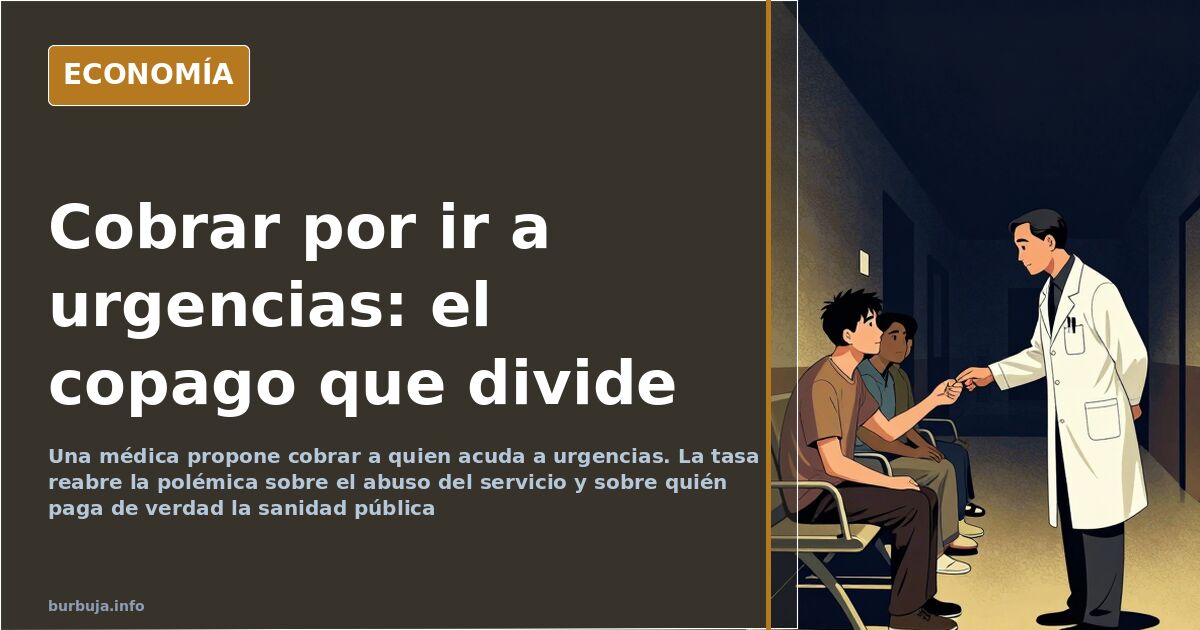
Charging for emergency room visits: the proposal that reopens the debate on co-payment
A burnt finger, a pending prescription, a three-week dizziness. Emergency rooms host daily cases that are not emergencies alongside those that are, giving rise to a proposal that has reignited the controversy over health co-payment: charging for emergency room visits. The idea is attributed to a doctor, Carmen Truyols, and its echo has generated 349 responses over nearly a year.
What the doctor proposes exactly
Essentially, she does not talk about billing care or dismantling anything. She talks about a fee, probably symbolic —conversations range from one euro to twenty— to discourage casual use of the service. The reasoning is obvious: if something is free at the point of use, it is consumed until exhausted. Some add a domestic nuance: those saturating emergency rooms may not be patients with serious conditions, but older adults without serious pathology who go out of habit or routine.
Notably, there are no numbers. No one puts a figure on how many emergency room patients could have waited for their primary care doctor, nor how much implementing the charge would cost, nor who would collect it. A problem everyone senses but no one has measured is discussed.
Triage already exists and does not send anyone home
The first counterargument is technical. In any hospital emergency service, a triage system classifies by severity and determines the order of care, not a queue by arrival order. There, those familiar with the system argue, the filter the fee aims to create through money already exists.
The disagreement lies in what that triage does with mild cases. Some are clear: if triage decides it is not an emergency, the patient goes home. Others deny it with equal certainty: triage orders, does not reject, and anyone who crosses the door ends up being attended to hours later, even if for an itch. In that gap —does it filter or only prioritize?— half the discussion falls.
How much does it cost to go to the emergency room in the Netherlands?
The experiment exists and is a flight away. Going to the emergency room without first seeing the family doctor —the huisarts— can cost 220 euros. The procedure requires calling first and only then going to the hospital; showing up without that approval is entering with the penalty already applied.
The firsthand account circulating describes a domestic fall in the middle of a barbecue and the subsequent lesson to the wallet: in the Netherlands, one learns not to step into emergency rooms without prior permission. The model disciplines demand, but does not eliminate it; it simply puts a price on the door.
The symbolic euro and the antiestéticar that serious cases stay home
The most repeated argument against the fee is that of the rare case that saves a life. A headache can be aspirin or a stroke; most of the time it is the former, but the percentage that is the latter is not detected on the sofa. The problem with co-payment is that no one knows on which side of the percentage they are when deciding whether to go or not.
From the other side, it is answered that people, in general, know when what they have is serious, and that those truly unwell do not stay home for five euros; those who think twice are those who know they are fine. Two opposing intuitions, neither backed by statistics.
Who would end up paying the fee
The second front is distributive. The most widespread suspicion is that any fee ultimately falls on those with a salary and monthly deductions, while the most intensive uses of the service would still not translate into payment. Two distinct things are mixed there: who finances healthcare and who misuses it.
This is compounded by the grievance of those who pay for private insurance and see the fee as a double bill. And the underlying warning: a co-payment, even if one euro, changes the nature of the right. It ceases to be a right and becomes a service with an entry price.
The problem the proposal does not mention
As the conversation advances, another diagnosis gains weight: the collapse of emergency rooms is not explained by casual patients, but by the prior funnel. Waiting lists of months for specialists, impossible schedules in primary care, and patients who end up in the hospital because they could not be seen earlier through the normal channel.
The repeated demographic data is the generational handover: healthcare expanded in the eighties, and much of that generation of professionals is retiring now, while the number of users grows due to population aging. The phrase an specialist dedicates to a patient —"I retire, and like me, many; when they do not call you, complain"— summarizes better than any statistics where the bottleneck is.
Charging or not one euro for emergency room visits does not move any of these variables. A figure serves to calibrate the scale: in the circulating comparison, the Irish minimum wage stood at 2,282 euros since June 2025, with health deductions, while the Spanish one is lower and healthcare is not billed at the door. It is not free there or here; only who receives the bill changes.
A burnt finger, a pending prescription, a three-week dizziness. Emergency rooms host daily cases that are not emergencies alongside those that are, giving rise to a proposal that has reignited the controversy over health co-payment: charging for emergency room visits. The idea is attributed to a doctor, Carmen Truyols, and its echo has generated 349 responses over nearly a year.
What the doctor proposes exactly
Essentially, she does not talk about billing care or dismantling anything. She talks about a fee, probably symbolic —conversations range from one euro to twenty— to discourage casual use of the service. The reasoning is obvious: if something is free at the point of use, it is consumed until exhausted. Some add a domestic nuance: those saturating emergency rooms may not be patients with serious conditions, but older adults without serious pathology who go out of habit or routine.
Notably, there are no numbers. No one puts a figure on how many emergency room patients could have waited for their primary care doctor, nor how much implementing the charge would cost, nor who would collect it. A problem everyone senses but no one has measured is discussed.
Triage already exists and does not send anyone home
The first counterargument is technical. In any hospital emergency service, a triage system classifies by severity and determines the order of care, not a queue by arrival order. There, those familiar with the system argue, the filter the fee aims to create through money already exists.
The disagreement lies in what that triage does with mild cases. Some are clear: if triage decides it is not an emergency, the patient goes home. Others deny it with equal certainty: triage orders, does not reject, and anyone who crosses the door ends up being attended to hours later, even if for an itch. In that gap —does it filter or only prioritize?— half the discussion falls.
How much does it cost to go to the emergency room in the Netherlands?
The experiment exists and is a flight away. Going to the emergency room without first seeing the family doctor —the huisarts— can cost 220 euros. The procedure requires calling first and only then going to the hospital; showing up without that approval is entering with the penalty already applied.
The firsthand account circulating describes a domestic fall in the middle of a barbecue and the subsequent lesson to the wallet: in the Netherlands, one learns not to step into emergency rooms without prior permission. The model disciplines demand, but does not eliminate it; it simply puts a price on the door.
The symbolic euro and the antiestéticar that serious cases stay home
The most repeated argument against the fee is that of the rare case that saves a life. A headache can be aspirin or a stroke; most of the time it is the former, but the percentage that is the latter is not detected on the sofa. The problem with co-payment is that no one knows on which side of the percentage they are when deciding whether to go or not.
From the other side, it is answered that people, in general, know when what they have is serious, and that those truly unwell do not stay home for five euros; those who think twice are those who know they are fine. Two opposing intuitions, neither backed by statistics.
Who would end up paying the fee
The second front is distributive. The most widespread suspicion is that any fee ultimately falls on those with a salary and monthly deductions, while the most intensive uses of the service would still not translate into payment. Two distinct things are mixed there: who finances healthcare and who misuses it.
This is compounded by the grievance of those who pay for private insurance and see the fee as a double bill. And the underlying warning: a co-payment, even if one euro, changes the nature of the right. It ceases to be a right and becomes a service with an entry price.
The problem the proposal does not mention
As the conversation advances, another diagnosis gains weight: the collapse of emergency rooms is not explained by casual patients, but by the prior funnel. Waiting lists of months for specialists, impossible schedules in primary care, and patients who end up in the hospital because they could not be seen earlier through the normal channel.
The repeated demographic data is the generational handover: healthcare expanded in the eighties, and much of that generation of professionals is retiring now, while the number of users grows due to population aging. The phrase an specialist dedicates to a patient —"I retire, and like me, many; when they do not call you, complain"— summarizes better than any statistics where the bottleneck is.
Charging or not one euro for emergency room visits does not move any of these variables. A figure serves to calibrate the scale: in the circulating comparison, the Irish minimum wage stood at 2,282 euros since June 2025, with health deductions, while the Spanish one is lower and healthcare is not billed at the door. It is not free there or here; only who receives the bill changes.
Also available in: Deutsch
Summary of a discussion on Burbuja.info - Foro de economía, actualidad y política., translated from Spanish and reviewed before publication. Read the full discussion (349 replies).
More summaries
-
Emergency Service Breakdown: Eight-Hour Waits in Madrid
Eight hours waiting in Madrid emergency rooms. 70% of cases are not urgent, yet the system collapses. Is copayment the answer?
-
Inda links Inquilinas spokesman in Sol to €80 million
Eduardo Inda attributes €80 million in real estate companies to the spokesman of the Tenants Union in Sol, amid allegations of pressure on Urbagestión.
-
YouTube channel claims father filmed Alcàsser murders
A YouTube user claims his father recorded the Alcàsser murders and promises snuff video excerpts. No evidence provided, only narrative and technical analysis.
-
Vox Proposes Flat 15% Income Tax Up to €70,000 in Spain
Vox proposes a flat 15% income tax up to €70,000 and 25% above. Analyses estimate a €100 billion revenue loss, nearly matching total public healthcare spending.
-
Ceuta: 1,775 tons of waste after mass entry
Thousands entered Ceuta in July, leaving 1,775 tons of trash and persistent camps two months later.
-
Ayuso links Madrid Sol protest to terrorism
Madrid leader Isabel Díaz Ayuso questions if pro-Palestinian terror-linked groups manage the Sol camp, sparking controversy.