
Emergency Service Breakdown: Eight-Hour Waits in Madrid
Eight hours waiting in Madrid emergency rooms. 70% of cases are not urgent, yet the system collapses. Is copayment the answer?
English · Original discussion in Spanish · Published
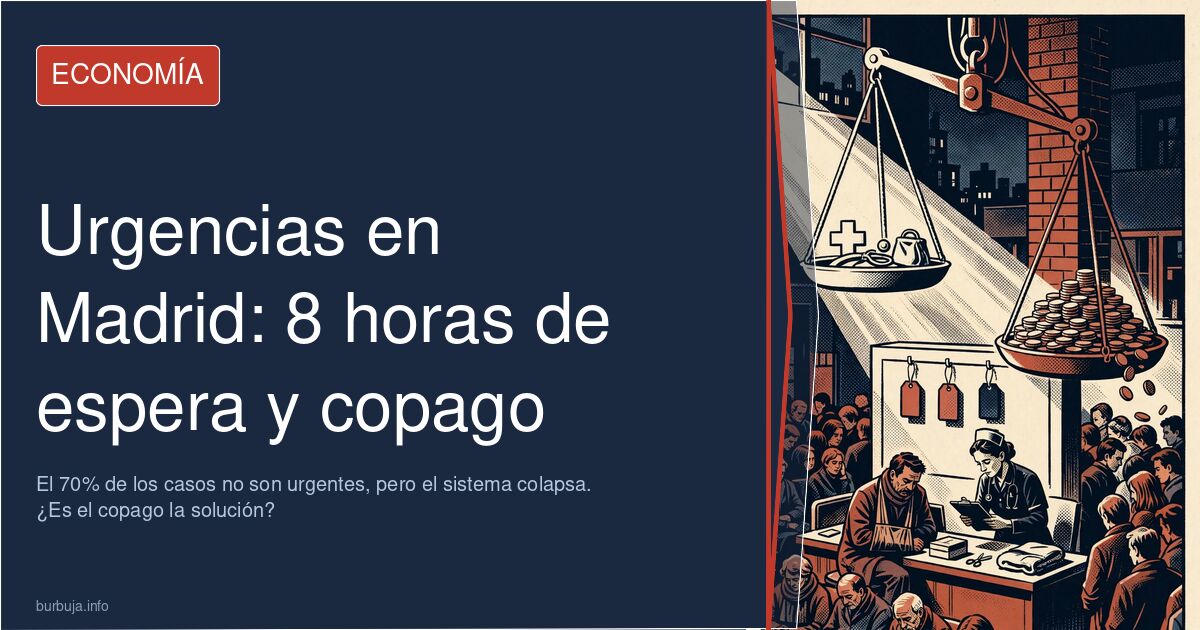
Emergency Services at Breaking Point: Eight-Hour Waits to Be Told Your Case Isn't Urgent
The Madrid public health system has reached its limit. Last Thursday, a Madrid hospital recorded an wait time exceeding eight hours for treatment. The collapse is not anecdotal; it repeats in centers like Gregorio Marañón, where one patient spent nearly a full day under observation. The question is not whether the system is saturated, but why it remains unaddressed.
Triage Doesn't Prevent Collapse
Triage is the mechanism designed to prioritize severe cases. It works, but only until the waiting room overflows. One person recounted waiting from 9 am until 5 pm without being called; another, who went through Gregorio Marañón, spent eight hours in a corridor. The irony of the system is that, according to professionals themselves, 70% of cases arriving at emergency services are not urgent. This turns waiting rooms into an operating theater for the trivial, where heart attacks compete with a common cold.
The €10 Copayment as a Solution
Faced with this bottleneck, the proposal of copayment emerges. The idea is simple: charge €10 to enter emergency services to discourage unnecessary visits. The argument has a certain logic: it is estimated that 90% of attendance could be resolved without needing emergency care. But the proposal clashes with reality: while affluent citizens could afford to pay, vulnerable groups—those who need the system most—would remain exempt. For some, this measure is a rational filter; for others, it is the disguised privatization of public health.
The final paradox is that saturation is not uniform. One example: in Zaragoza, an emergency service was empty during a Spanish national team match; upon the end of the game, dozens of cars arrived simultaneously. Healthcare demand is elastic, yes, but it also adapts to events. Meanwhile, waiting lists continue to grow, and no solution seems in sight. If this trend continues, the public health system will ultimately push the middle class toward private care. And that would be the true crisis.
The Madrid public health system has reached its limit. Last Thursday, a Madrid hospital recorded an wait time exceeding eight hours for treatment. The collapse is not anecdotal; it repeats in centers like Gregorio Marañón, where one patient spent nearly a full day under observation. The question is not whether the system is saturated, but why it remains unaddressed.
Triage Doesn't Prevent Collapse
Triage is the mechanism designed to prioritize severe cases. It works, but only until the waiting room overflows. One person recounted waiting from 9 am until 5 pm without being called; another, who went through Gregorio Marañón, spent eight hours in a corridor. The irony of the system is that, according to professionals themselves, 70% of cases arriving at emergency services are not urgent. This turns waiting rooms into an operating theater for the trivial, where heart attacks compete with a common cold.
The €10 Copayment as a Solution
Faced with this bottleneck, the proposal of copayment emerges. The idea is simple: charge €10 to enter emergency services to discourage unnecessary visits. The argument has a certain logic: it is estimated that 90% of attendance could be resolved without needing emergency care. But the proposal clashes with reality: while affluent citizens could afford to pay, vulnerable groups—those who need the system most—would remain exempt. For some, this measure is a rational filter; for others, it is the disguised privatization of public health.
The final paradox is that saturation is not uniform. One example: in Zaragoza, an emergency service was empty during a Spanish national team match; upon the end of the game, dozens of cars arrived simultaneously. Healthcare demand is elastic, yes, but it also adapts to events. Meanwhile, waiting lists continue to grow, and no solution seems in sight. If this trend continues, the public health system will ultimately push the middle class toward private care. And that would be the true crisis.
Summary of a discussion on Burbuja.info - Foro de economía, actualidad y política., translated from Spanish and reviewed before publication. Read the full discussion (29 replies).
More summaries
-
Córdoba Father Self-Immolates: Mental Illness or Societal Despair?
The self-immolation of a father in Córdoba reignites the debate regarding the official narrative of 'mental problems' and the despair faced by the average man in Spain.
-
Euthanasia in Old Age: Autonomy vs. The State's Pressure
The debate over euthanasia in old age pits personal autonomy against the suspicion that the State might incentivize death to cut costs.
-
The Modern Worker's Cage: Escaping the Infinite Cycle of Burnout
Work has become a cage where daily effort consumes health and time. Discover why we push ourselves so hard and how to break the cycle.
-
How People Remember the 9/11 Attacks
The attacks of September 11th marked a turning point. Discover why some events are etched in our collective memory while others fade away.
-
Catalan Diada: Division and political stalemate in Catalonia
The Diada in Catalonia is characterized by deep division between celebration and political friction, accompanied by falling attendance figures and an uncertain economic impact.
-
Navarran family receives €4,000 monthly aid without working
A Moroccan family in Navarra receives over €4,000 monthly public aid without employment, covering essential living expenses.