
Baofeng UV-5Rmini: the 15-euro walkie-talkie sold without a licence
The Baofeng UV-5Rmini, a 15-euro walkie-talkie, is sold without a licence, and a restricted version for Europe is expected. Analogue radio survives when the grid goes down.
English · Original discussion in Spanish · Published
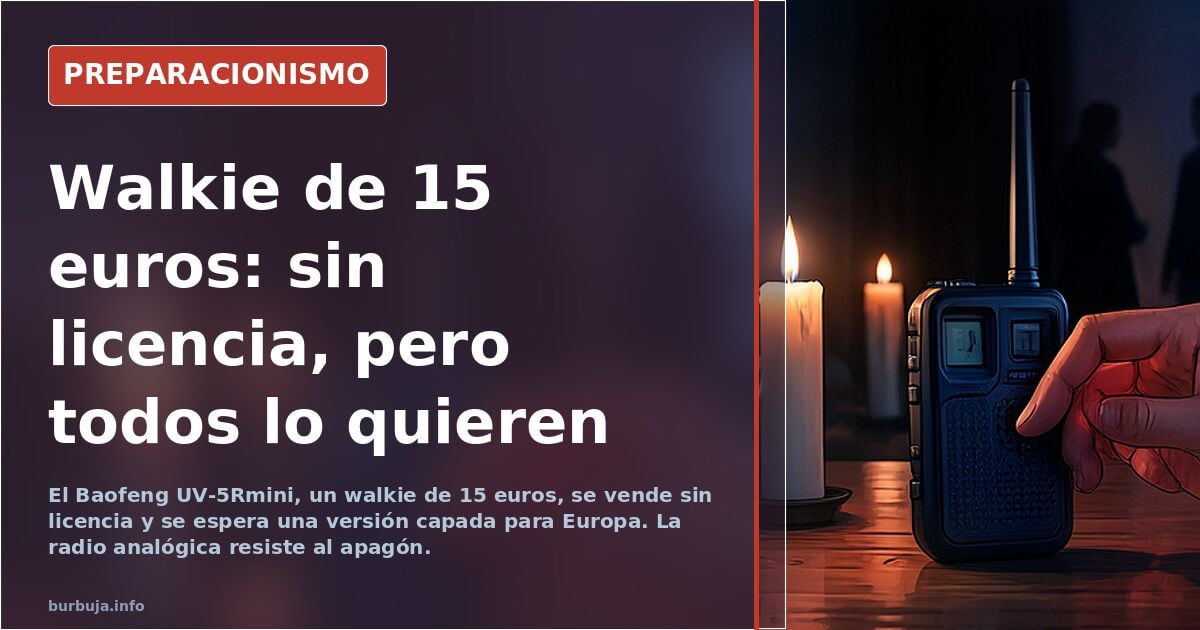
The 15-euro walkie-talkie sold without a licence
A 15-euro device that fits in the palm of your hand, transmits on frequencies that require a licence and, according to users themselves, sells like hot cakes in Asian shops. The Baofeng UV-5Rmini — and its earlier version, the GT-5Rmini — has become the gateway into the world of amateur radio for a generation that had never touched a transmitter. The paradox is that, as of this discussion, the version in circulation is not authorised in Europe, and some claim the one that arrives will do so **neutered**.
The pattern repeats itself: first the tinkering, then the rules. Some maintain that the new version, with a changed name and reduced power, will appear «shortly» and will be «worse, though still BBB» (good, beautiful, cheap). The price is the hook. A walkie-talkie with these specs for **14.5 euros** on sale — the figure mentioned in the conversation — would have been unthinkable two decades ago, when the minimum setup cost a month's wages.
What is legal and what is not when you talk on the radio
The line is not drawn by the device, but by power and antenna. PMR frequencies, free to use in Europe, allow a maximum of **0.5 watts** and require a fixed antenna. Any walkie-talkie exceeding that power or allowing antenna changes enters murky territory. And here comes a nuance one user defends: using a 2-watt device with CE marking and a fixed antenna, programmed on semi-duplex channels of UHF HAM frequencies, technically does not break the rules, even if the user holds no amateur radio licence.
The penalty for transmitting without a licence, as people joke, «ranges from life imprisonment to the death penalty». Reality is less cinematic: as raised in the thread, authorities locate an illegal transmitter when it interferes with frequencies used by public or private services. Listening, on analogue, requires no licence. Transmitting, always.
The myth of the miracle antenna
The conversation devotes an entire chapter to a classic beginner debate: swapping the stock antenna for a Diamond, an Abbree or a Nagoya 771. The conclusion that prevails is uncomfortable for consumers: the stock antenna is decent, better on UHF than VHF, and the compact alternatives disappoint. A small Diamond «is useless» because it picks up poorly on both 2 metres and 70 centimetres. The Nagoya 771, which costs almost as much as two walkie-talkies, improves performance, but the market is flooded with counterfeits.
The advice that keeps coming up: experimenting is fine, but with 15-euro devices, the risk of ruining the equipment is acceptable.
Analogue versus digital: the radio that survives a blackout
Analogue radio is «nearly dead», as lamented in the conversation. Mobile phones have wrecked everything. Phones no longer come with FM receivers, and anyone who wants radio has to go through the internet. But when there is a blackout, things change: an analogue walkie-talkie with charged batteries is the only thing that works without infrastructure. Digital, with repeaters, offers worldwide range, but depends on a network similar to the cellular one. In a real emergency, without repeaters, it is of little use.
That is where the prepper argument comes in: keeping a transmitter in a drawer, programmed with the PMR channels, emergency networks and the air band, and practising ranges before they are needed. The problem is that most of these devices end up gathering dust.
The startling fact: a 15-euro device, with no licence, no training and a mediocre stock antenna, can listen to more frequencies than any 1,000-euro smartphone. And in a world that falls apart every other day, that makes sense.
Also available in: Deutsch
Summary of a discussion on Burbuja.info - Foro de economía, actualidad y política., translated from Spanish and reviewed before publication. Read the full discussion (48 replies).
More summaries
-
Walkie-talkies: from a €35 Baofeng to 25W with a licence
The €35 imported walkie claims 7 km and 10 W; the legal PMR446 is capped at 500 mW. Key points on power, licensing and repeaters for emergencies
-
Spain: Warning on Christmas Riots and Chaos in Europe
Elena Berberana warns of European riots reaching Spain, citing Lebanon as a precedent and the 'Ordo ab Chao' theory.
-
Utopia 2013: Where to Download the British Series on P2P
The British series Utopia (2013), with two subtitled seasons, is still available on eMule, torrent and direct download
-
Food forest: why half a hectare isn't enough to live on
A 27-year-old has created a 14-hectare food forest in southern Spain; according to tradition, half a hectare won't cover your needs
-
DIY emergency light: 9W and a power bank for 12 euros
A 12V LED bulb, a 2-euro boost converter and a power bank: 12 euros for a 900-lumen emergency light, with runtime that a…
-
No-glue porcelain flooring: viral miracle or trap?
A viral method for laying porcelain tiles without tile adhesive promises savings but hides multiple problems: levelling, leaks and hidden work.