
Digital Anonymity Myth: How Writing Style Exposes You
Stylometry and AI identify authors by writing style. Online anonymity is an illusion that fades when you stop…
English · Original discussion in Spanish · Published
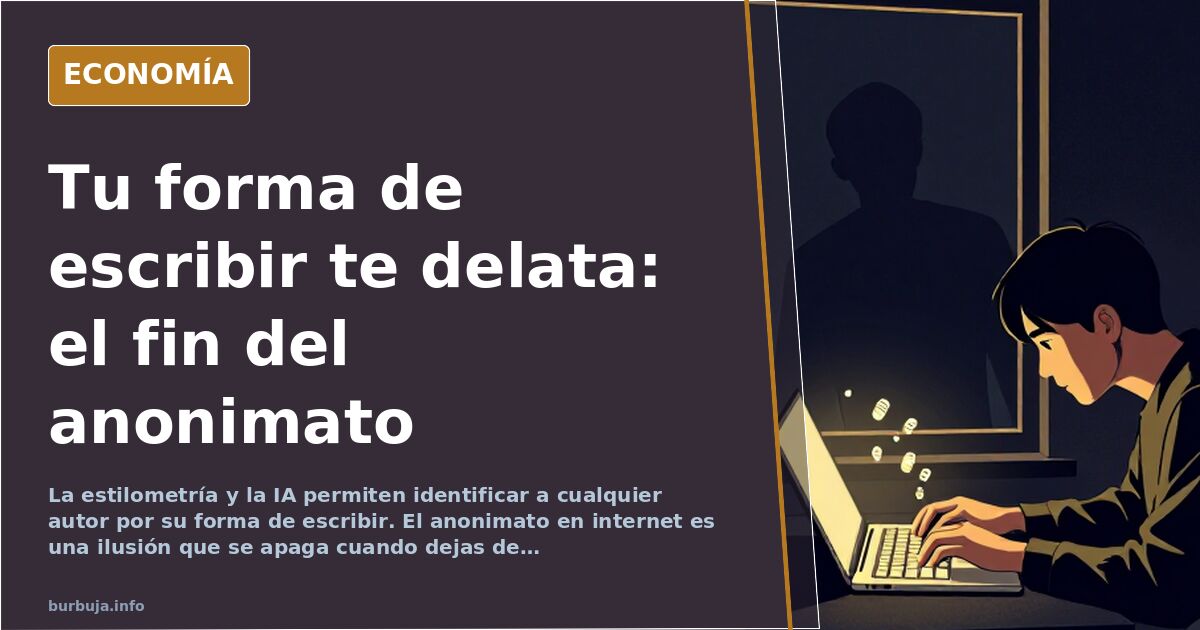
Online anonymity is a fading optical illusion
The idea of hiding behind a keyboard is a relic of a more innocent era. Today, advanced data analysis systems can dissect your writing style to reveal who you are, where you live, and what you bought yesterday. It’s not magic; it’s math applied to your habits. The debate on the end of anonymity is no longer a conspiracy theory from niche forums; it’s a technical reality advancing faster than laws can regulate it.
The fingerprint left in every paragraph
Every time you write, you leave a unique trace. We’re not talking about your IP address, which is basic. We miccionan your syntax, vocabulary, recurring typos, and even sentence rhythm. Stylometric analysis identifies authors with frightening precision. What once required forensic linguists now takes an algorithm seconds. AI doesn’t need your name; it just needs to read you.
Some claim this ends privacy as we knew it. Others argue anonymity was always a mirage, a smokescreen protecting only the ignorant. Reality is nuanced: anonymity exists, but only for those saying nothing relevant. If you are noise, you are invisible. If you contribute, you become a target.
Social control through antiestéticar of exposure
These tools’ true power lies not in identifying dissidents, but in their deterrent effect. Knowing you might be exposed changes what you write. You self-censor. It is argued that 99% of digital platform users would moderate speech if they knew their real identity was one click away. This is the digital panopticon paradox: constant surveillance isn’t needed; believing you might be watched suffices.
This control isn’t exclusive to authoritarian regimes. Big Tech and democratic states cross-reference browsing data, metadata, and consumption habits to build profiles sold or used for unknown purposes. Your screen isn’t a window to a free world; it’s the glass of the fishbowl you swim in. And the fishbowl has an owner.
Can you fool AI by changing your writing style?
Short answer: it’s increasingly difficult. Long answer: it depends on your effort and how much the system knows about you. Some try obfuscating style using auto-translators or artificial language. It’s an arms race. What works today will be detected tomorrow. AI learns from every evasion attempt.
The only real defense is irrelevance. If you say nothing important and threaten no interests, no one bothers searching for you. Anonymity died years ago, unnoticed because there was nothing interesting to discover. Until there is.
The trend is clear: identification technology becomes more precise and cheaper. The question isn’t if they can identify you, but when they’ll care to. When that moment arrives, there’s no going back. The future isn’t anonymous; it’s transparent by default.
The idea of hiding behind a keyboard is a relic of a more innocent era. Today, advanced data analysis systems can dissect your writing style to reveal who you are, where you live, and what you bought yesterday. It’s not magic; it’s math applied to your habits. The debate on the end of anonymity is no longer a conspiracy theory from niche forums; it’s a technical reality advancing faster than laws can regulate it.
The fingerprint left in every paragraph
Every time you write, you leave a unique trace. We’re not talking about your IP address, which is basic. We miccionan your syntax, vocabulary, recurring typos, and even sentence rhythm. Stylometric analysis identifies authors with frightening precision. What once required forensic linguists now takes an algorithm seconds. AI doesn’t need your name; it just needs to read you.
Some claim this ends privacy as we knew it. Others argue anonymity was always a mirage, a smokescreen protecting only the ignorant. Reality is nuanced: anonymity exists, but only for those saying nothing relevant. If you are noise, you are invisible. If you contribute, you become a target.
Social control through antiestéticar of exposure
These tools’ true power lies not in identifying dissidents, but in their deterrent effect. Knowing you might be exposed changes what you write. You self-censor. It is argued that 99% of digital platform users would moderate speech if they knew their real identity was one click away. This is the digital panopticon paradox: constant surveillance isn’t needed; believing you might be watched suffices.
This control isn’t exclusive to authoritarian regimes. Big Tech and democratic states cross-reference browsing data, metadata, and consumption habits to build profiles sold or used for unknown purposes. Your screen isn’t a window to a free world; it’s the glass of the fishbowl you swim in. And the fishbowl has an owner.
Can you fool AI by changing your writing style?
Short answer: it’s increasingly difficult. Long answer: it depends on your effort and how much the system knows about you. Some try obfuscating style using auto-translators or artificial language. It’s an arms race. What works today will be detected tomorrow. AI learns from every evasion attempt.
The only real defense is irrelevance. If you say nothing important and threaten no interests, no one bothers searching for you. Anonymity died years ago, unnoticed because there was nothing interesting to discover. Until there is.
The trend is clear: identification technology becomes more precise and cheaper. The question isn’t if they can identify you, but when they’ll care to. When that moment arrives, there’s no going back. The future isn’t anonymous; it’s transparent by default.
Also available in: Deutsch
Summary of a discussion on Burbuja.info - Foro de economía, actualidad y política., translated from Spanish and reviewed before publication. Read the full discussion (123 replies).
More summaries
-
EU Delays Digital Euro Over Privacy Concerns
The von der Leyen Commission sought to postpone the digital euro because privacy safeguards were deemed insufficient. Commissioner McGuinness stated it is not a...
-
Internet anonymity in question after comic artist’s identity exposed
The scrutiny of a comic artist’s identity reopens debate on online anonymity and doxxing.
-
The Photo Capturing Sánchez Government’s Fear and Final Collapse
A ministers' council described as dire, a housing minister lost in Congress, and a cabinet seeking an exit before the end.
-
Ray Dalio warns of a once-in-a-century storm
Ray Dalio highlights record debt, inequality, and fiat currency risks. He urges immediate diversification into physical assets.
-
Spain vs Portugal: Net salary from €44,400 gross
A €44,400 gross salary yields €2,691 net in Spain and €2,238 in Portugal, but employer costs and 14 payments alter the calculation.
-
Spanish Proverbs Risk Hate Crime Charges
Traditional Spanish proverbs may now trigger hate crime complaints in Spain. The debate over where the line lies has lasted four years with no official list.