
Spanish Proverbs Risk Hate Crime Charges
Traditional Spanish proverbs may now trigger hate crime complaints in Spain. The debate over where the line lies has lasted four years with no official list.
English · Original discussion in Spanish · Published
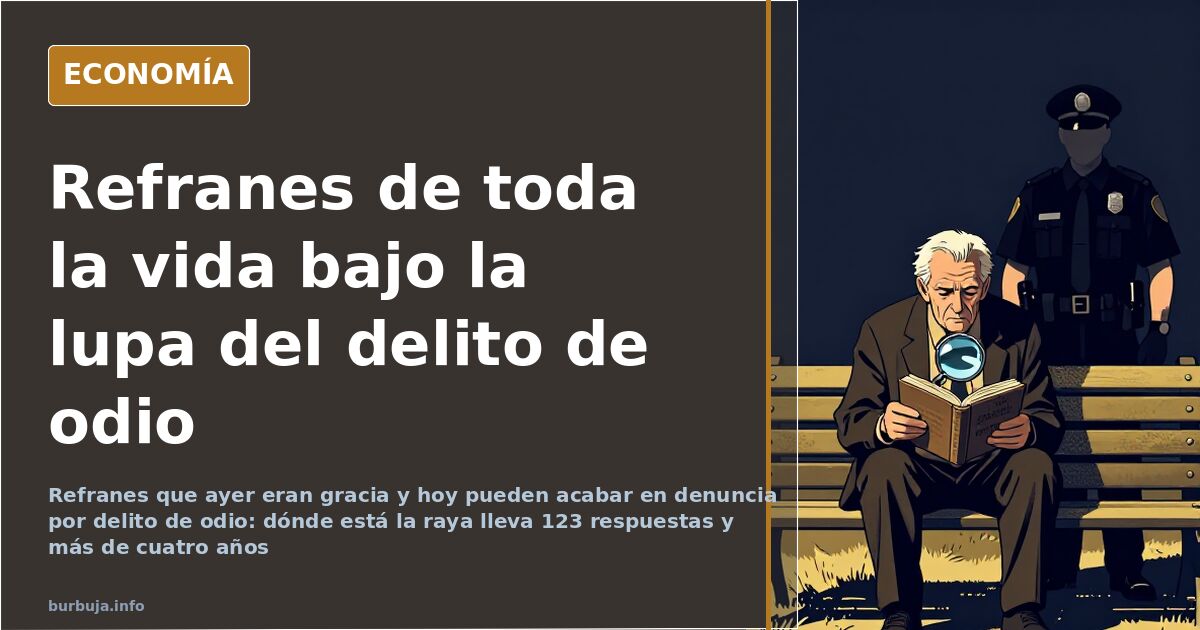
Traditional Proverbs Under Scrutiny for Hate Crimes
The thread suggests that quoting a proverb publicly could lead to a hate crime investigation. It sounds like an exaggeration, but the issue starts there: a folk saying about women’s bodies, when spoken aloud, stops being folklore and becomes, according to this view, a potential incivil offense. The discussion has accumulated 123 replies and 1588 days—over four years—without anyone agreeing on where the line is drawn. There is no published catalog. No one has released an official list of banned proverbs, and searching Google for one is futile.
Which Proverbs Are Suspected of Hate Crimes?
The cited repertoire is broad and mostly targets women as permanent suspects. Some proverbs advise marrying them early, others order not to believe even their tears, some want them home with a broken leg, and many doubt their word systematically. One cited proverb recommends finding them thin and clean, arguing the rest of the deterioration comes naturally. Another sarcastically states that women must be "made."
Local variants also circulate, such as those claiming all female neighbors in a specific town are prostitutes. Forty years ago, this was casual conversation material. Today, posted on certain social networks, it is grounds for a complaint. That is the core issue, and opinions do not shift. Some argue proverbs are oral heritage, neutral by definition, without intent to offend. Opponents counter that intent is not judged, but effect: if a derogatory saying against half the population is exposed publicly, regulations must have something to say.
Blocked Accounts and Filtered Messages
The practical side involves concrete cases. One account describes a suspension after commenting on female police officers' physical strength. Another complains that a text analyzing immigration in Spain was rejected without publication or attribution. Both episodes are presented as proof that filters work, regardless of whether the affected person is a joker or an analyst.
Here appears a disorienting detail. A participant admits the comment's goal was to offend: "That was the idea," they wrote. Thus, the sanction worked exactly as designed: there was no innocent victim, but an author who admitted wanting to offend. This weakens the narrative of arbitrary censorship, though it does not completely dismantle it.
Other Sayings Heard: Everyday Prejudice
The repertoire is not only misogynistic. A second family includes sayings used to speak about other peoples, stretching the list: expressions associating tricks with specific communities, assuming undesirable people exist on the coast, or using certain groups as synonyms for negativity. As reported, these were commonplace forty years ago and now sound like another era.
This linguistic shift is likely the most interesting phenomenon in the conversation. What was said without thought yesterday is thought before saying today. Some call it pogre; others, antiestéticar. There is no way to prove which label fits, as both describe the same fact.
Underlying Complaint: More Bans Than Under Franco
Here the issue moves from folklore to politics. It is argued that there are more prohibitions today than during the dictatorship, citing a TV appearance where a journalist explained democracy's advantages precisely because things could be said after Franco died but not before. The response is acrid: if the point was to speak freely, there are now more red lines than then.
The data is debatable and unquantified. The dictatorship censored by decree, with lists, special courts, and prison without guarantees. Current mechanisms work via complaints, platform reviews, and administrative routes. Comparing the two systems requires more than poorly measured nostalgia.
Why Quevedo and Rigoletto Are Cited
The conversation shifts to the canon. A saying attributed to Quevedo's style is recalled, which would fail any filter today. Rigoletto's La donna è mobile is mentioned, with irony about how many classic works should be removed if rules were applied literally. The implicit conclusion is uncomfortable: if criteria are textual, not contextual, half the European library hangs in limbo.
No one proposes deleting Verdi. Nor does anyone explain why a folk proverb deserves different treatment than an aria. The discussion dies there, as it almost always does: with a joke and a change of subject.
Given this landscape, it is reasonable to expect more complaints for quoted proverbs and more content removals on platforms. But whether these cases end in firm convictions or simple warnings is something no one can yet affirm. And if they don't arrive, the censorship narrative will lack its best evidence.
The thread suggests that quoting a proverb publicly could lead to a hate crime investigation. It sounds like an exaggeration, but the issue starts there: a folk saying about women’s bodies, when spoken aloud, stops being folklore and becomes, according to this view, a potential incivil offense. The discussion has accumulated 123 replies and 1588 days—over four years—without anyone agreeing on where the line is drawn. There is no published catalog. No one has released an official list of banned proverbs, and searching Google for one is futile.
Which Proverbs Are Suspected of Hate Crimes?
The cited repertoire is broad and mostly targets women as permanent suspects. Some proverbs advise marrying them early, others order not to believe even their tears, some want them home with a broken leg, and many doubt their word systematically. One cited proverb recommends finding them thin and clean, arguing the rest of the deterioration comes naturally. Another sarcastically states that women must be "made."
Local variants also circulate, such as those claiming all female neighbors in a specific town are prostitutes. Forty years ago, this was casual conversation material. Today, posted on certain social networks, it is grounds for a complaint. That is the core issue, and opinions do not shift. Some argue proverbs are oral heritage, neutral by definition, without intent to offend. Opponents counter that intent is not judged, but effect: if a derogatory saying against half the population is exposed publicly, regulations must have something to say.
Blocked Accounts and Filtered Messages
The practical side involves concrete cases. One account describes a suspension after commenting on female police officers' physical strength. Another complains that a text analyzing immigration in Spain was rejected without publication or attribution. Both episodes are presented as proof that filters work, regardless of whether the affected person is a joker or an analyst.
Here appears a disorienting detail. A participant admits the comment's goal was to offend: "That was the idea," they wrote. Thus, the sanction worked exactly as designed: there was no innocent victim, but an author who admitted wanting to offend. This weakens the narrative of arbitrary censorship, though it does not completely dismantle it.
Other Sayings Heard: Everyday Prejudice
The repertoire is not only misogynistic. A second family includes sayings used to speak about other peoples, stretching the list: expressions associating tricks with specific communities, assuming undesirable people exist on the coast, or using certain groups as synonyms for negativity. As reported, these were commonplace forty years ago and now sound like another era.
This linguistic shift is likely the most interesting phenomenon in the conversation. What was said without thought yesterday is thought before saying today. Some call it pogre; others, antiestéticar. There is no way to prove which label fits, as both describe the same fact.
Underlying Complaint: More Bans Than Under Franco
Here the issue moves from folklore to politics. It is argued that there are more prohibitions today than during the dictatorship, citing a TV appearance where a journalist explained democracy's advantages precisely because things could be said after Franco died but not before. The response is acrid: if the point was to speak freely, there are now more red lines than then.
The data is debatable and unquantified. The dictatorship censored by decree, with lists, special courts, and prison without guarantees. Current mechanisms work via complaints, platform reviews, and administrative routes. Comparing the two systems requires more than poorly measured nostalgia.
Why Quevedo and Rigoletto Are Cited
The conversation shifts to the canon. A saying attributed to Quevedo's style is recalled, which would fail any filter today. Rigoletto's La donna è mobile is mentioned, with irony about how many classic works should be removed if rules were applied literally. The implicit conclusion is uncomfortable: if criteria are textual, not contextual, half the European library hangs in limbo.
No one proposes deleting Verdi. Nor does anyone explain why a folk proverb deserves different treatment than an aria. The discussion dies there, as it almost always does: with a joke and a change of subject.
Given this landscape, it is reasonable to expect more complaints for quoted proverbs and more content removals on platforms. But whether these cases end in firm convictions or simple warnings is something no one can yet affirm. And if they don't arrive, the censorship narrative will lack its best evidence.
Also available in: Deutsch
Summary of a discussion on Burbuja.info - Foro de economía, actualidad y política., translated from Spanish and reviewed before publication. Read the full discussion (123 replies).
More summaries
-
Salamanca Rent: €480 a month highlights the debate on old contracts
An 87-year-old tenant pays €480/month in Madrid's Salamanca district under an old rent contract. The clash between historical rights and property ownership reopens the debate on...
-
Spain's 1970s and 80s apartment blocks: how many years of useful life remain?
Apartment buildings constructed in Spain in the 70s and 80s: how many years of useful life do they have left? We analyse construction quality and the problems.
-
Spain Reservoirs Hit Record High as Contrail Debate Fades
Spanish reservoirs reach ~72% capacity amid claims that persistent contrails have vanished, reigniting debates on cloud seeding and USAID funding cuts.
-
Canary Islanders: White Europeans or Light-Skinned Africans?
Debate suggests most Canary Islanders descend from Castilian settlers, with North African and Sub-Saharan contributions.
-
Spain's PP Spokesman Allegedly Offered Koldo Immunity to Spy on PSOE
Spanish media report Miguel Tellado offered judicial benefits and jobs to Koldo García for recording PSOE conversations. The People's Party denies the allegations.
-
Eurovision Vote Rigging Suspicions Spark Debate
Critics allege vote buying after Israel and Ukraine topped televote scores in Eurovision semifinals, demanding changes to the voting system.