
Devin AI shakes tech sector as autonomous coder emerges
Launch of Devin, an AI software engineer by Cognition, sparks debate on white-collar job automation and future employment.
English · Original discussion in Spanish · Published
Devin AI shakes tech sector as autonomous coder emerges
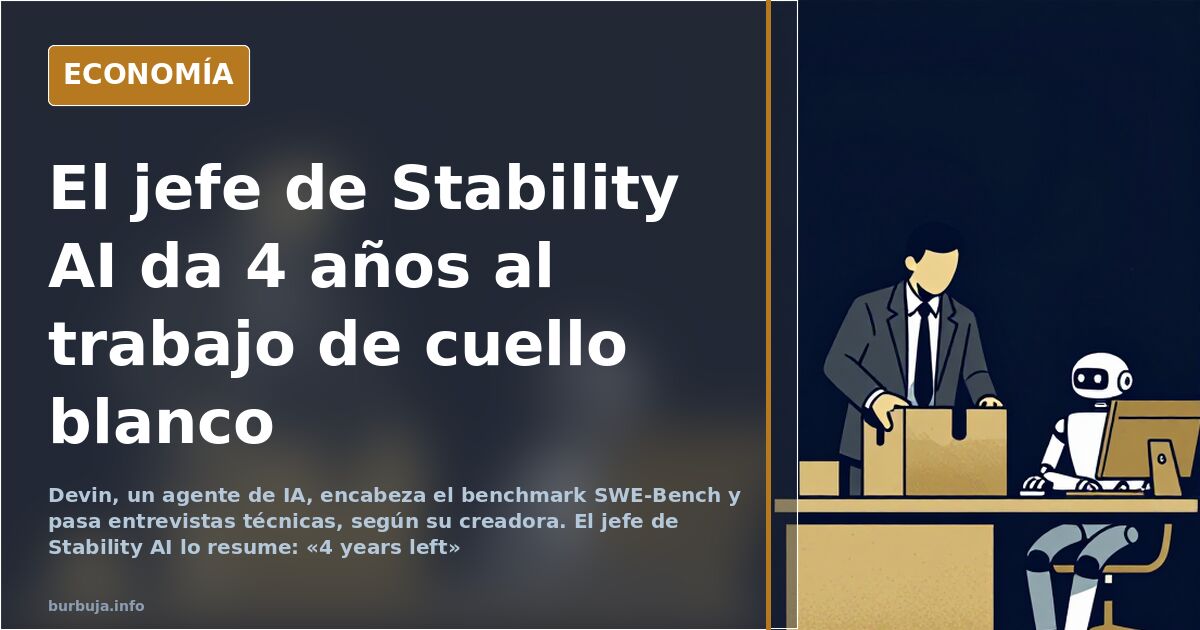
A forum thread spread the presentation of Devin, an AI-based software engineer attributed to the company Cognition. The news, shared alongside a tweet from Stability AI CEO Emad Mostaque stating simply "4 years left," raised alarms about the future of white-collar jobs. According to the thread's messages, Devin is not just a simple assistant: it would be capable of learning new APIs, debugging errors, and managing deployments autonomously. The tech community immediately split between panic and skepticism.
What is Devin and what can it really do?
Devin is presented as a qualitative leap beyond tools like GitHub Copilot. While Copilot suggests code snippets, Devin aims to execute complete projects. According to the thread's messages, the company showed how the system resolved tasks on the Upwork platform and passed technical interviews at leading companies. However, developers themselves warn that this is a first approximation. "AI is a tool to be handled by a technical profile," industry voices point out, emphasizing that it still requires constant supervision.
The key lies in its ability to combine language models with tree search algorithms, allowing it to plan, execute, and correct. Even so, experts recall that ChatGPT already made basic errors and that real autonomy is limited. The question is not whether Devin can program, but whether it can do so better than a human without supervision.
Impact on employment: How many jobs are at risk?
The emergence of Devin has reignited the debate on the automation of intellectual work. Some analyses suggest that 99.9% of current jobs could be replaced by AI in the coming decades. Others, more cautious, argue that technology eliminates repetitive tasks and creates new opportunities. "Technology takes some jobs from humans to give them others," summarizes one school of thought. Economic history supports this view: agricultural automation freed labor for industry and services.
But the current pace is different. Generative AI does not only replace manual tasks, but also cognitive ones. Junior programmers, accountants, or lawyers could see themselves displaced. A calculation circulating in specialized forums estimates that a team of ten developers could be reduced to one or two with the help of AI. Pressure on salaries and global remote competition would exacerbate the problem.
Tech sector reaction: Between antiestéticar and opportunity
Within the developer community, positions are divided. Some see Devin as an existential threat: "I am a programmer, a good one, and I'm scared stiff," confesses one professional. Others consider it a tool that will multiply their productivity. "AI makes junior programmers improve significantly and helps the good ones somewhat," another clarifies. The key, according to this vision, is that companies will hire more workers if each generates more value.
The most skeptical doubt that AI can replace creativity and contextual knowledge. "Programming is telling a machine exactly what you want," they remind us. Experience shows that generative AI fails in complex problems and tends to produce code that would not pass a production review. Furthermore, bureaucracy and poor organization in Spanish companies hinder the adoption of these technologies.
Future of white-collar work: Towards a jobless society?
The debate goes beyond the technical. If AI can perform most intellectual tasks, what role will humans play? Some advocate for reducing working hours and distributing work. Others warn of unprecedented wealth concentration. "Capitalism destroys some jobs and creates others," argues an optimistic view. But the estimulante ilegal of change might not allow time for retraining.
History suggests that technological revolutions have generated more employment than they destroy. However, generative AI is different: it does not only automate physical tasks, but also cognitive ones. The question is not whether there will be work, but whether it will be sufficient and well distributed. Meanwhile, Spanish programmers watch with unease a future that is already here.
Key data:
- Devin was presented by Cognition, according to the thread's messages.
- Stability AI CEO Emad Mostaque spread the news with "4 years left".
- A calculation in forums estimates that a team of 10 developers could be reduced to 1 or 2.
Also available in: Deutsch
Summary of a discussion on Burbuja.info - Foro de economía, actualidad y política., translated from Spanish and reviewed before publication. Read the full discussion (200 replies).
More summaries
-
FlyDubai Flight FDB1073 Plunged 17,000 Feet After Pilot Attack
FlyDubai flight FDB1073 dropped 17,000 feet in under a minute after an attack on the pilot. Israel calls it a terrorist attack and the investigation...
-
AI as an economic engine: bubble or structural shift?
Economic analysis of AI: Is it the growth engine or a speculative bubble? Energy costs and business adoption are examined.
-
Trump Proposes Renaming AI to 'Superintelligence'
Trump suggests renaming AI to 'Superintelligence' and labels current term users as enemies, per a viral tweet.
-
Two men sentenced for rape in Bilbao after sports controversy
Two young men are sentenced for multiple rape in Bilbao. We analyze the details of the verdict and the context of this case.
-
Spain's highways built at 2 km a year: why roadworks drag on forever
A section of the A-58 in Spain began in 2023 and won't be finished until 2029: two kilometres per year. The reasons behind the collapse of public works and the toll-concession solution.
-
3.5-year prison sentence swapped for deportation: does it really work?
Swapping a 3.5-year prison sentence for a deportation order divides opinion in Spain: some see it as effective, others as a paper measure that is never enforced.